

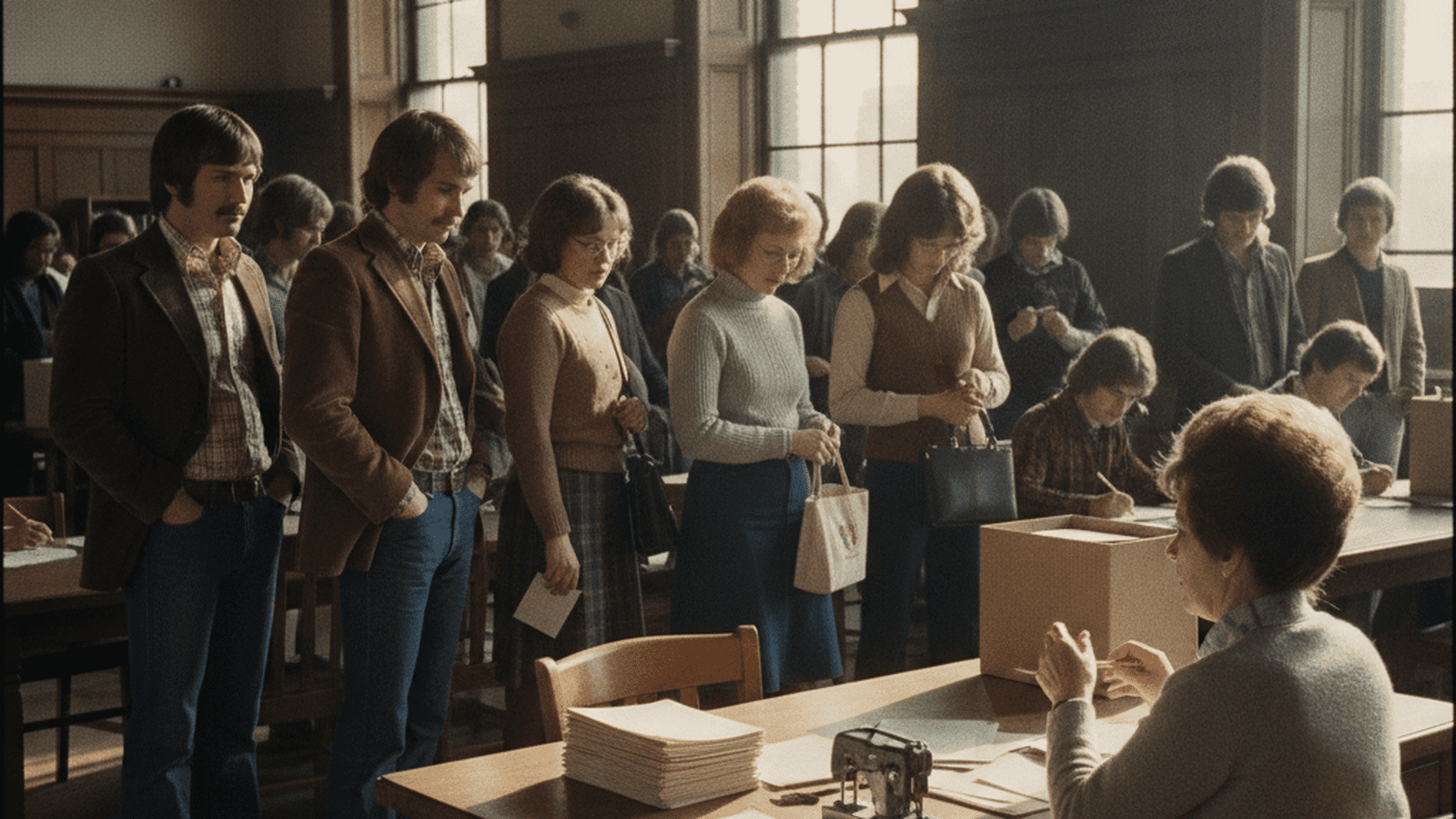
In 1980, Illinois voters approved the Cutback Amendment, a major election reform that reduced the size of the state House of Representatives by one-third. This United States political event abolished the century-old system of cumulative voting in favor of single-member districts.
TLDR: The 1980 Illinois Cutback Amendment eliminated cumulative voting and reduced the House of Representatives from 177 to 118 members. Driven by post-Watergate populist sentiment, the reform aimed to increase accountability but ultimately centralized power within party leadership in the statehouse.
In the wake of the Watergate scandal, a wave of populist reform swept across the American Midwest, targeting perceived legislative inefficiency and institutional bloat. In Illinois, this movement culminated in the 1980 “Cutback Amendment,” a landmark constitutional change that fundamentally altered the structure of the state’s General Assembly. Led by activist Pat Quinn and the Coalition for Political Honesty, the initiative sought to reduce the size of the Illinois House of Representatives and abolish a unique voting system that had been in place since 1870.
For over a century, Illinois utilized a system known as cumulative voting. Under this arrangement, each legislative district elected three representatives. Voters were granted three votes, which they could distribute among candidates in various ways—giving all three to one person (a “bullet vote”), or splitting them between two or three candidates. This system was originally designed to ensure minority party representation in every district, preventing one party from completely dominating the legislature. It allowed for a diverse range of voices, including “independent” Republicans in Chicago and “independent” Democrats in rural downstate Illinois, fostering a culture of cross-party cooperation.
However, by the late 1970s, critics argued the system made the House too large, expensive, and insulated from voter accountability. The push for the Cutback Amendment gained significant momentum following a controversial 1978 post-election pay raise approved by the legislature during a “lame duck” session. Quinn’s coalition capitalized on public anger, organizing a massive petition drive that gathered nearly 500,000 signatures to place the amendment on the ballot. The proposal called for reducing the number of House members from 177 to 118 and replacing the three-member districts with single-member districts.
The campaign was hard-fought, with the Coalition for Political Honesty framing the issue as a battle between the people and a self-serving political class. Opponents of the amendment, including many sitting legislators and prominent political scientists, warned that the change would lead to increased partisanship and the loss of moderate voices. They argued that cumulative voting forced cooperation because representatives from the same district often had to work together despite party differences. Despite these warnings, the amendment passed with an overwhelming 69 percent of the vote in November 1980. The public’s desire for a smaller, more “honest” government outweighed concerns about the nuances of minority representation.
The implementation of the Cutback Amendment in 1982 significantly shifted the power dynamics within the Illinois statehouse. While it achieved the goal of reducing the size of the legislature and simplifying the ballot, many observers noted that it also centralized power in the hands of legislative leaders. Without the buffer of multi-member districts, individual representatives became more dependent on party leadership for campaign funding, committee assignments, and legislative support. The era of the “independent” legislator largely faded as the state moved toward a more polarized, winner-take-all political environment.
In the decades following the reform, the legacy of the Cutback Amendment remains a subject of intense debate among Illinois political historians and reform advocates. While it streamlined the legislative process and reduced administrative costs, some modern reformers now advocate for a return to cumulative voting or other forms of proportional representation to combat the extreme gerrymandering and polarization that have characterized 21st-century politics. The 1980 vote stands as a pivotal moment when Illinois voters chose structural simplicity and perceived accountability over a complex system of guaranteed minority representation. This shift continues to influence the legislative culture and electoral outcomes of the state today.

Sophie Carter serves as a Staff Writer for Just Right News, where she anchors the outlet’s critical coverage of Elections, Influence, and Democracy Infrastructure. In an era where the mechanics of voting and the flow of political capital are under constant scrutiny, Sophie provides a steady, principled voice dedicated to the preservation of American institutional integrity and the rule of law.
Raised in Charlotte, North Carolina, Sophie’s perspective was forged in a community that balances rapid modern growth with a deep respect for tradition and civic duty. Growing up in the Queen City, she witnessed firsthand how a robust local culture depends on the trust between the citizen and the state. This upbringing instilled in her a foundational belief that the right to vote is a sacred trust—one that must be protected from both administrative overreach and the encroaching influence of special interest groups. Her reporting reflects these North Carolina roots, emphasizing the importance of community-led governance and the preservation of the individual’s voice in the face of nationalized political movements.
Now based in Atlanta, Georgia, Sophie operates from the heart of one of the nation’s most pivotal and contested political landscapes. Her location allows her to report from the front lines of the debate over election security, legislative reform, and the modernization of voting systems. For Sophie, the “infrastructure” of democracy is not merely a matter of machines and ballots; it is the collection of laws, people, and transparent processes required to maintain public confidence. Her work often highlights the necessity of clear, enforceable standards that ensure every legal vote is counted fairly and that the machinery of our republic remains accountable to the taxpayers who fund it.
Central to her work at Just Right News is her acclaimed feature series, “The Price of a Vote.” Through this ongoing project, Sophie explores the complex web of influence that shapes modern campaigns and policy decisions. She delves into how high-level lobbying, non-governmental organizations, and shifting bureaucratic regulations impact the weight of an individual citizen’s ballot. By examining the financial and structural pressures placed on the electoral process, she provides readers with a comprehensive look at the forces vying for control over the American political system.
Sophie’s approach to journalism is rooted in a commitment to the constitutional framework. She views her role as a watchdog for the voter, ensuring that the systems meant to serve the public remain transparent and free from corruption. Whether she is analyzing the implementation of new voting technologies or investigating the influence of outside money on state-level policy, her work is characterized by a rigorous adherence to facts and a refusal to succumb to the sensationalism that often plagues modern political reporting.
At Just Right News, Sophie Carter continues to be a vital resource for readers who value clarity, conviction, and a defense of traditional American values. Her deep ties to the Southeast and her specialized focus on the mechanics of our republic make her an essential voice in the ongoing conversation about the future of American self-governance. Through her reporting, she remains dedicated to the idea that a secure and honest electoral system is the bedrock of a free and prosperous society.