

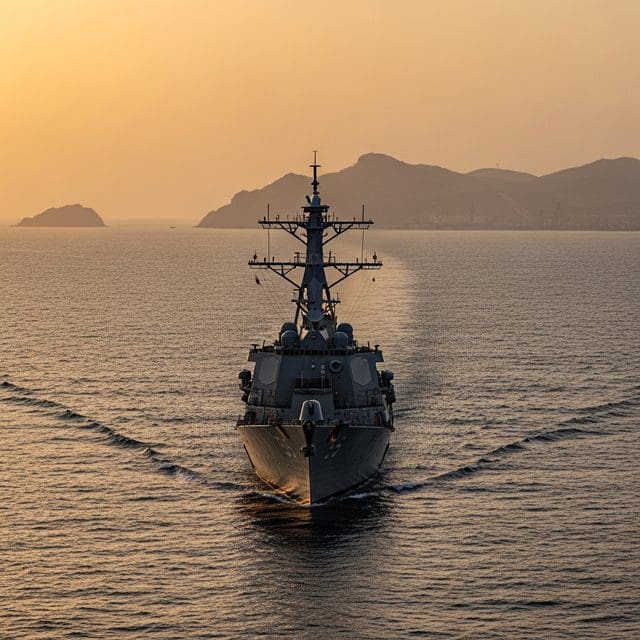
The Pentagon launched targeted strikes on Iranian naval assets following the rejection of a U.S. peace proposal, while the Royal Navy deploys to secure the vital Strait of Hormuz.
The Trump administration’s efforts to secure a diplomatic exit from the two-month conflict with Iran faced a significant setback on May 10, as Tehran officially rejected a U.S. ceasefire proposal. The Iranian Ministry of Foreign Affairs, which had been reviewing a one-page memorandum to end hostilities and establish a framework for future talks on the nuclear program, ultimately dismissed the offer, specifically citing a refusal to accept temporary truces. This rejection has immediately heightened risks in global energy markets and triggered a shift back toward active kinetic operations.
In response to the diplomatic impasse and recent Iranian assaults on American naval assets, the Pentagon confirmed a series of precision strikes against Iranian infrastructure. These operations targeted missile and drone sites, as well as command centers near Bandar Abbas, Qeshm Island, and Sirik. The strikes followed what military analysts describe as a successful bait-and-switch tactic used by U.S. forces over the past week to uncover hidden Iranian military assets. This intelligence-led operation was catalyzed by Iranian attacks on three Arleigh Burke-class destroyers—the USS Truxtun, USS Rafael Peralta, and USS Mason—in the Strait of Hormuz.
The escalation in the Persian Gulf is reverberating through global alliances. The British Royal Navy has ordered the Type 45 destroyer HMS Dragon to transition from the eastern Mediterranean to the Middle East. The warship will join French and other allied forces in a mission to secure shipping lanes and prepare for the eventual reopening of the Strait of Hormuz. This coalition presence underscores the strategic priority Western powers place on maintaining the flow of maritime commerce despite Tehran’s continued use of drone strikes against cargo vessels and neighboring Gulf states, including reported incursions into Qatari and Emirati airspace.
While the Middle East remains volatile, the Trump administration has managed to secure a brief respite on the European front. On May 8, the White House announced that Russia and Ukraine agreed to a three-day ceasefire and prisoner swap beginning Saturday. This temporary pause, intended to last through Monday, represents a rare moment of de-escalation in the East, though it stands in stark contrast to the intensifying posture of other adversaries. In East Asia, North Korea has responded to the regional instability by amending its constitution. The new North Korean doctrine mandates an automatic nuclear missile strike should Kim Jong Un be killed or removed from power, a move clearly influenced by the recent killing of Iranian leadership.
Domestically, the administration continues to leverage legal and economic pressure to support its foreign policy objectives. The Department of Justice moved to denaturalize 11 individuals accused of crimes including providing material support to terrorists, while the President utilized social media to project American naval dominance, sharing composite imagery of sunken Iranian vessels as a warning. As Tehran continues to test the limits of U.S. resolve through drone incursions and the rejection of diplomatic overtures, the Pentagon remains positioned to maintain the peace through strength doctrine, prioritizing the protection of American personnel and the integrity of international trade routes.

Olivia Kendall serves as the Senior Correspondent for Geopolitics, Defense, and Foreign Policy at Just Right News, where she provides a principled, conservative perspective on the complex forces shaping the global stage. With a career dedicated to deconstructing the intricacies of international relations, Kendall has become a trusted voice for readers who value national sovereignty, a robust military, and a foreign policy that prioritizes American interests above all else.
A native of Washington, D.C., Kendall’s professional journey is deeply rooted in her upbringing within the nation’s capital. Growing up in the epicenter of American political life, she developed an early and profound understanding of how policy is crafted and, more importantly, how it often fails to account for the values of the American heartland. This unique vantage point allowed her to witness firsthand the rise of globalist bureaucracies, fueling her commitment to reporting that champions the constitutional foundations of the United States. Her background as a British White American further informs her worldview, providing her with a keen appreciation for the Western tradition and the enduring importance of the “Special Relationship” in maintaining global stability.
Now based in Arlington, Virginia, Kendall operates from the doorstep of the Pentagon and the heart of the nation’s defense establishment. Her proximity to the decision-makers in the military and intelligence communities allows her to provide boots-on-the-ground reporting that is both timely and deeply informed. For Kendall, Arlington is more than just a base of operations; it is a daily reminder of the sacrifices made by the men and women in uniform. This connection to the defense community drives her rigorous coverage of military readiness and her advocacy for a “peace through strength” approach to diplomacy.
At Just Right News, Kendall is perhaps best known for her acclaimed feature series, “The World’s Shadow on America.” In this ongoing project, she explores the direct correlation between international developments and the daily lives of American citizens. Whether she is analyzing the encroachment of foreign adversaries in domestic supply chains or the impact of international treaties on local economies, Kendall’s work serves as a vital bridge between distant geopolitical shifts and their consequences at home. She rejects the notion that foreign policy is an abstract concern for elites, instead proving that what happens in the corridors of power in Brussels or Beijing has a tangible “shadow” that falls across every American doorstep.
Throughout her tenure, Kendall has remained a steadfast critic of international overreach and a vocal proponent of a clear-eyed, realistic foreign policy. She brings a sharp analytical mind to her beat, often challenging the prevailing narratives of the mainstream media to uncover the underlying truths that affect national security. Her reporting is characterized by a refusal to compromise on the truth and a dedication to the idea that a strong, secure America is the world’s best hope for liberty. As a Senior Correspondent, Olivia Kendall continues to lead the charge in providing the essential context and conservative insight necessary to navigate an increasingly volatile world.