

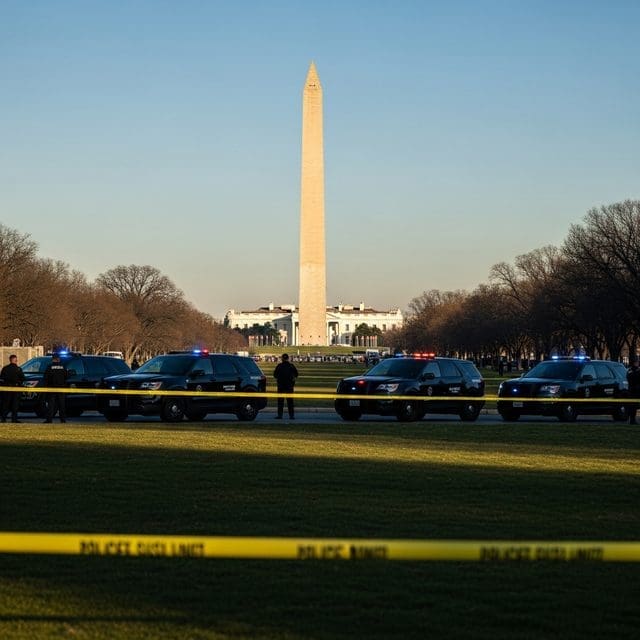
A shooting near the Washington Monument involving the Secret Service has renewed scrutiny of executive security as the administration navigates escalating domestic and foreign tensions.
The security perimeter surrounding the executive branch faced another test Monday afternoon when Secret Service officers engaged an armed suspect near the Washington Monument. The incident, occurring at approximately 3:30 p.m., resulted in the suspect being hospitalized with gunshot wounds to the torso and a 15-year-old bystander sustaining non-life-threatening injuries. Secret Service Deputy Director Matt Quinn confirmed that plainclothes personnel identified a suspicious individual who subsequently fled and fired upon officers before they returned fire.
While the proximity to the White House complex triggered an immediate five-minute lockdown of the press corps, the administrative routine remained largely undisturbed. President Trump continued a scheduled small business event without interruption, though the motorcade for Vice President JD Vance was rerouted as a standard precautionary measure. This incident follows a period of heightened vigilance for the agency, coming just two weeks after an attack at the White House Correspondents’ Dinner by Cole Allen, which specifically targeted administration officials.
Despite the geographical proximity to the seat of executive power, the Secret Service has been careful to manage public expectations regarding the suspect’s intent. Chris McDonald, a congressional liaison for the agency, stated there is currently no known nexus between the suspect and the White House. Preliminary investigations into the 45-year-old Caucasian male, who has ties to Maryland and Texas, are exploring a possible previous attempt to enter the White House grounds, though a definitive motive remains unestablished.
The shooting occurs against a backdrop of significant geopolitical friction that has already stretched federal resources. Only two days prior, the conflict with Iran reached the 60-day mark under the War Powers Act, sparking a constitutional debate over military authorization. As the U.S. military reports retaliatory strikes against Iranian vessels in the Middle East and works to secure the Strait of Hormuz, the domestic security apparatus is under increased pressure to distinguish between isolated criminal acts and coordinated threats against the state.
From a constitutional perspective, the incident highlights the ongoing tension between public access to national monuments and the necessity of a secure executive perimeter. The recovery of a weapon at the scene and the ongoing probe by the DC Metro Police into the officer-involved shooting will provide the necessary factual basis to determine if this was a targeted strike or a localized criminal encounter. For now, the administration appears intent on maintaining a posture of stability, even as the administrative state grapples with threats both foreign and domestic.

Miles Harrington serves as the Senior Correspondent for Federal Systems & Executive Power at Just Right News, where he brings a disciplined, constitutionalist lens to the inner workings of the American government. With a focus on the mechanics of the federal bureaucracy and the limits of executive authority, Harrington has established himself as a vital voice for readers who value transparency, accountability, and the preservation of the separation of powers.
A native of Richmond, Virginia, Harrington’s perspective is deeply rooted in the traditions of the Old Dominion. Growing up in a city defined by its historical significance and its role as a center of American jurisprudence, he developed an early appreciation for the foundational principles of the Republic. His upbringing in Richmond—a place where the legacy of the Founding Fathers is woven into the landscape—instilled in him a belief that the federal government should remain within its constitutional bounds. This background informs his skepticism of centralized overreach and his commitment to reporting on the ways in which the administrative state impacts the lives of everyday citizens.
In his current role, Harrington specializes in the complexities of federal systems. He doesn’t just report on the headlines of the day; he digs into the structural shifts within the executive branch that often go unnoticed by the mainstream press. Whether he is analyzing the implications of a new federal regulation or investigating the expansion of agency jurisdiction, his work is characterized by a rigorous adherence to the facts and a dedication to the rule of law.
Harrington is perhaps best known for his signature feature series, “How Washington Works.” Through this ongoing project, he demystifies the often-opaque processes of the nation’s capital, pulling back the curtain on the “Deep State” and the unelected officials who wield significant influence over national policy. By breaking down complex legislative maneuvers and executive orders, he empowers Just Right News readers to understand the true levers of power in Washington. His reporting serves as a necessary check on the federal government, ensuring that the actions of those in power are held up to the light of public scrutiny.
Now based in Washington, D.C., Harrington operates at the epicenter of the political world, yet he remains intentionally distanced from the “Beltway bubble.” His proximity to the halls of power allows him to maintain a robust network of sources across the federal landscape, but his heart remains in the principled conservatism of his Virginia roots. He views his role not merely as a reporter, but as a steward of the public trust, dedicated to providing the clarity and context that conservative voters need to navigate an increasingly complex political environment.
Through his sharp analysis and unwavering commitment to the truth, Miles Harrington continues to be a cornerstone of the Just Right News team. His work ensures that the principles of limited government and executive restraint remain at the forefront of the national conversation, providing a crucial service to those who believe in a government that is truly of, by, and for the people.