

Blockmate Ventures and Hivello are pivoting toward Bitcoin-linked infrastructure and real-world asset protocols, leveraging Wyoming’s low-cost power and decentralized node aggregation for industrial-scale compute projects.
The landscape of decentralized engineering is shifting as venture builders move away from speculative tokenomics toward hard infrastructure and protocol utility. Blockmate Ventures has announced a strategic pivot for its investee company, Hivello, which is transitioning from a general decentralized physical infrastructure network (DePIN) aggregator to a specialized provider of Bitcoin-linked infrastructure products. This shift represents a significant engineering milestone in the integration of real-world assets (RWA) with cryptographic protocols.
Central to this evolution is the development of a Bitcoin mining RWA product, scheduled for a late second-quarter 2026 launch. Unlike traditional cloud mining services, this protocol is designed to provide fractional exposure to Application-Specific Integrated Circuit (ASIC) hardware through a decentralized framework. The technical architecture focuses on operational readiness and direct integration, ensuring that initial payouts are delivered in Bitcoin to non-custodial wallets. This approach prioritizes individual digital sovereignty by removing the reliance on centralized exchange custodians.
The HVLO token is slated for a protocol upgrade to align its utility with this new direction. Having previously scaled to over 50,000 nodes, the Hivello ecosystem is leveraging its existing decentralized footprint to support measurable computational returns. This transition highlights a broader trend in the sector where established node networks are being repurposed for high-compute tasks, such as Bitcoin mining and AI processing, rather than remaining purely theoretical experiments.
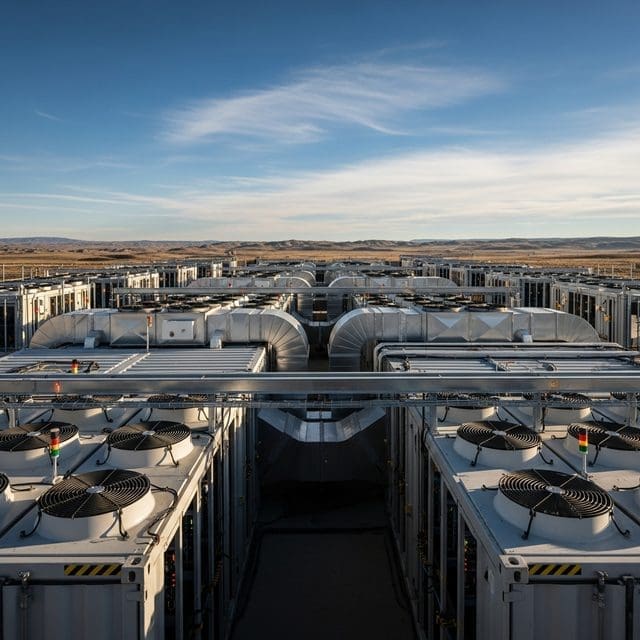
Parallel to these cryptographic advancements, Blockmate is engaged in ongoing technical discussions regarding a massive 200-megawatt infrastructure site in Wyoming. The location is strategically significant due to its power costs, currently cited at 3.3 cents per kilowatt-hour, offering a competitive advantage for American digital leadership in the global compute race. While binding agreements with hyperscalers remain in the negotiation phase, the site’s potential capacity is earmarked for both AI and digital infrastructure projects.
The Wyoming project underscores the importance of domestic energy independence in securing the future of the decentralized web. As demand for AI-related compute expands, the ability to anchor large-scale ASIC deployments and GPU clusters on American soil becomes a matter of national digital sovereignty. Blockmate’s engagement with infrastructure groups and hyperscalers suggests a move toward industrial-scale operations that bridge the gap between traditional power utility and modern cryptographic needs.
To support these complex technical shifts, Blockmate has relaunched its corporate interface to provide clearer communication regarding its strategic focus on AI and Bitcoin infrastructure. This reset reflects a maturation of the venture builder model, moving toward transparent execution in decentralized engineering. By focusing on non-custodial payouts and high-capacity physical sites, the company is positioning itself at the intersection of constitutional values and technological advancement, ensuring that the next generation of digital infrastructure remains robust, decentralized, and American-led.

Ryan Mitchell serves as a Staff Writer for Just Right News, where he anchors the desk for Cyber, Technology Policy, and Digital Sovereignty. In an era where the digital landscape has become as much a battlefield as any physical territory, Ryan provides a critical conservative lens on the forces shaping the future of American innovation and national security. His work is defined by a commitment to the idea that American leadership in the digital age is not just a matter of economic success, but a necessity for the preservation of global liberty.
Born and raised in Austin, Texas, Ryan’s perspective is deeply rooted in the Lone Star State’s tradition of independence and skepticism of centralized authority. Growing up in a city that transformed from a quiet state capital into a global technology hub, he witnessed firsthand the disruptive power of the tech industry. This upbringing instilled in him a firm belief in free-market principles and the necessity of protecting individual liberties from both government overreach and corporate overstep. His Texan background serves as a foundational compass, guiding his reporting toward stories that emphasize national resilience and the preservation of constitutional values in an increasingly virtual world.
Now based in San Francisco, California, Ryan operates from the epicenter of the very industry he scrutinizes. Living and working in the heart of Silicon Valley allows him to provide “boots on the ground” reporting that few conservative journalists can match. He navigates the cultural and political complexities of the Bay Area to bring Just Right News readers an inside look at the boardrooms and coding labs where the next generation of digital policy is forged. For Ryan, being stationed in San Francisco is a strategic choice; it allows him to challenge the prevailing ideological monoculture of the tech elite from within their own backyard, ensuring that the concerns of middle America are represented in the conversation about our digital future.
His beat—Cyber, Technology Policy, and Digital Sovereignty—covers the high-stakes world of data privacy, artificial intelligence, and the infrastructure of the modern web. Ryan is particularly focused on the concept of digital sovereignty, arguing that for a nation to remain truly free, it must maintain control over its own technological destiny and critical infrastructure. He frequently explores how international regulations and domestic policies impact the ability of American firms to compete without sacrificing the privacy or security of their citizens.
Central to his current body of work is his featured series, “The New Cold War.” Through this project, Ryan examines the escalating technological rivalry between the United States and its global adversaries. He delves into the complexities of state-sponsored hacking, the global race for semiconductor dominance, and the ideological struggle to define the rules of the internet. Ryan views this competition not merely as a commercial race, but as a fundamental defense of Western values against authoritarian digital models. Through his rigorous reporting and principled analysis, Ryan Mitchell ensures that the readers of Just Right News stay informed about the invisible forces defining the 21st century, always advocating for a future where technology serves the cause of freedom.