

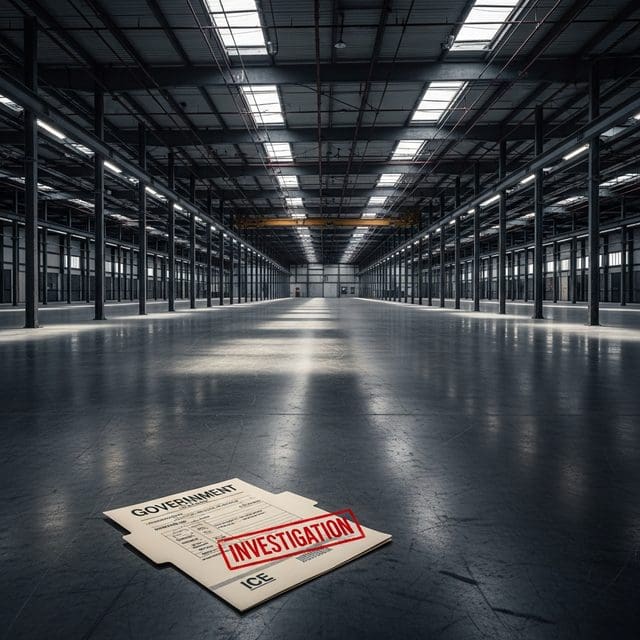
The White House faces a bipartisan blockade over record military spending and a collapsing migrant detention strategy as investigators probe billion-dollar warehouse acquisitions.
A significant fiscal and administrative crisis is unfolding across the federal government as the White House attempts to secure the largest military budget in United States history while simultaneously dismantling a signature domestic infrastructure project. The tension on Capitol Hill centers on the lack of transparency regarding the U.S.-Iran conflict, which escalated sharply following the joint U.S.-Israel strikes on February 28. Despite the recent signing of a memorandum of understanding in Versailles on June 17, lawmakers from both parties are refusing to approve top-line spending figures until the administration provides a full accounting of the war’s human and economic toll.
This demand for fiscal clarity comes as Vice President JD Vance continues to manage the diplomatic fallout of the peace deal. While the U.S. military has lifted its naval blockade near the Strait of Hormuz, the Vice President has been forced to issue stern warnings to members of the Israeli government who remain critical of the agreement. The administration’s leverage in these negotiations is being tested by internal skepticism, including public reservations voiced by Iran’s Supreme Leader Mojtaba Khamenei, who only agreed to move forward with the memorandum a day after the formal signing ceremony.
Domestically, the Department of Homeland Security is facing a self-inflicted crisis regarding its detention infrastructure. Immigration and Customs Enforcement (ICE) has confirmed plans to sell or transfer seven of the 11 massive warehouses it recently purchased for more than $700 million. This billion-dollar initiative was originally designed to create a carceral network capable of holding 100,000 migrants at any given time, with total projected costs exceeding $38 billion. However, the program has been plagued by lawsuits over inadequate environmental reviews and a federal court order blocking operations at a key site in Maryland.
The Department of Homeland Security inspector general has now opened an investigation into whether these warehouse acquisitions were necessary or cost-effective. This reversal is particularly striking given the longstanding reports of severe overcrowding and high mortality rates within the existing ICE detention system, which saw 31 deaths in custody last year. Advocacy groups are raising alarms that even as the government divests from these properties, the infrastructure remains a permanent fixture that could be repurposed for future mass detention, creating long-term economic pressures on the host communities in states like Texas and Arizona.
Simultaneously, the White House is distancing itself from a controversial contracting decision involving Greenwater Services. The firm is owned by a trust led by John J. Cafaro, an individual whose business entities have previously faced local allegations of conflicts of interest. Although a White House spokeswoman stated the president played no role in selecting Greenwater Services, the contract has become a focal point for critics of the administration’s procurement processes. These concerns over executive overreach and the blurring of business and state interests are expected to intensify with the upcoming publication of “Regime Change” by Maggie Haberman and Jonathan Swan, which reportedly documents the president’s efforts to strip away the constraints once imposed by military leaders and internal critics.
As the administration navigates these overlapping controversies, the legislative branch is asserting its power of the purse. Beyond the defense budget, some lawmakers are now targeting the Office of the Director of National Intelligence for significant downsizing, reflecting a broader skepticism of the administrative state’s expansion. From the chipping blue paint at the bottom of the Lincoln Memorial Reflecting Pool to the fiscal opacity of a foreign war, the current document trail suggests a government struggling to manage the costs of its own ambitions.

Ben Taylor serves as the Senior Correspondent and Investigations Lead for Just Right News, where he anchors the network’s commitment to government transparency and institutional accountability. With a career defined by a relentless pursuit of the facts, Taylor spearheads the acclaimed feature series “The Paper Trail,” a deep-dive investigative column that prioritizes primary source documentation over political rhetoric. Based in the heart of the nation’s capital, he has earned a reputation as one of the most formidable investigative journalists in Washington, D.C., known specifically for his mastery of public records and the Freedom of Information Act.
Taylor’s approach to journalism is deeply rooted in his upbringing in Kansas City, Missouri. Growing up in the “Show Me State,” he developed a healthy skepticism of centralized power and a profound respect for the common-sense values of the American heartland. This Midwestern foundation informs his reporting today, as he bridges the gap between the complex machinations of federal bureaucracy and the everyday concerns of citizens across the country. For Taylor, investigative reporting is not about chasing headlines; it is about ensuring that the government remains answerable to the people it serves.
As an African American man working within the conservative media landscape, Taylor brings a principled perspective to his beat. He views the Constitution and the right to information as the ultimate equalizers in a free society. His work often highlights how bureaucratic overreach and lack of transparency disproportionately affect individual liberties. By focusing on the “paper trail,” Taylor strips away the spin of partisan talking points, instead providing Just Right News readers with the raw data and internal communications that reveal how their tax dollars are spent and how policy decisions are actually made.
In his role as Investigations Lead, Taylor oversees a team dedicated to uncovering the stories that mainstream outlets often overlook. Whether he is auditing federal spending, investigating regulatory overreach, or exposing inefficiencies within the administrative state, his methodology remains consistent: follow the evidence wherever it leads. His presence in Washington, D.C., allows him to maintain a constant watch over the halls of power, yet he remains steadfastly connected to his roots, ensuring his reporting reflects the clarity and directness of his Missouri home.
Throughout his tenure at Just Right News, Taylor has become a vital voice for those who demand integrity in public office. He believes that a well-informed electorate is the strongest defense against government overreach, and he has dedicated his career to providing the public with the tools they need to hold their leaders accountable. Through “The Paper Trail” and his broader investigative work, Ben Taylor continues to set the standard for rigorous, document-driven journalism that champions the values of transparency, individual responsibility, and the rule of law.