

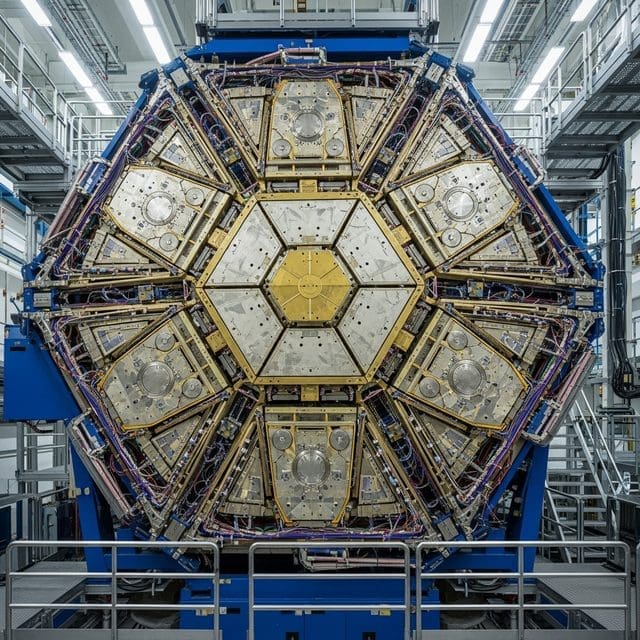
Data from the Large Hadron Collider and new research into Floquet engineering are pushing the boundaries of the Standard Model, signaling a new era of subatomic discovery.
The foundations of modern particle physics are facing a significant challenge as researchers at CERN’s Large Hadron Collider (LHC) reported evidence of subatomic behavior that defies the Standard Model. The anomaly, detected during the analysis of rare “penguin decays” in B-mesons, suggests that unknown forces or particles may be influencing the building blocks of our universe. This development comes as the scientific community increasingly looks toward precision engineering to solve the mysteries of the quantum realm.
The study, based on 650 billion B-meson decays recorded between 2011 and 2018, revealed a four-standard-deviation (4σ) tension with theoretical predictions. In high-energy physics, this represents a roughly 1-in-16,000 chance that the result is a statistical fluke. While a 5σ result is required to claim a formal discovery, this finding, accepted for publication in Physical Review Letters, is being hailed as a robust hint of “new physics.”
At the heart of the mystery are “penguin decays”—complex quantum processes where a bottom quark transforms into a strange quark through a loop. The angular distribution of the resulting particles does not align with established equations. Theorists suggest the deviation could be caused by hypothetical mediators such as a Z-prime boson or “leptoquarks.” If confirmed, such a discovery would necessitate the first major expansion of the Standard Model in decades, rewriting textbooks on how the universe functions.
This breakthrough comes at a critical juncture. The LHC is scheduled for a major shutdown and upgrade at the end of June 2026. This new data will likely dictate priorities for the next generation of experiments, focusing attention on these rare decay channels to determine if the anomaly holds under higher scrutiny. While some caution that “charming penguins”—interference from charm-quark loops—could mimic the signal, the statistical weight of the current findings has energized the field, providing an experimental handle on physics beyond the Standard Model without requiring entirely new colliders.
Parallel to the developments at CERN, the realm of condensed matter is seeing its own revolution. Researchers Ian Powell and Louis Buchalter recently published work in Physical Review B regarding “flux-switching Floquet engineering.” Their research demonstrates that by using time-dependent magnetic fields rather than static ones, scientists can “drive” materials into exotic quantum states that do not exist in nature under steady conditions. These engineered states appear more stable and resistant to the “noise” that typically plagues quantum systems, offering a concrete route to more robust quantum information processing.
This move from static materials to dynamically driven states represents a shift toward active control and precision. As companies like Amazon and QuEra promise useful quantum error correction by 2028, and Cleveland Clinic researchers develop quantum models operating 500 times faster than previous methods, the integration of these “time-engineered” phases could be the key to achieving technological sovereignty. By mastering the ability to stabilize these elusive states, researchers are moving closer to a future where quantum computers are not just theoretical curiosities, but reliable tools for securing national digital and physical infrastructure.
Whether looking at the smallest particles at CERN or engineered quantum states in the lab, these findings represent a push toward a deeper understanding of the natural order. The convergence of particle anomalies and stabilized quantum materials suggests that the next decade of innovation will be defined by mastering the subatomic frontier, ensuring that technological progress remains anchored in the immutable laws of physics.

Mason Reed serves as a Staff Writer for Just Right News, where he spearheads the Future Frontiers & Special Projects desk. In an era defined by rapid technological shifts and evolving social landscapes, Mason provides a steady, principled voice, examining the innovations of tomorrow through the lens of traditional American values. His work is most prominently featured in his signature series, “The Next Horizon,” where he explores the intersection of emerging technology, national sovereignty, and the preservation of individual liberty.
A native of San Diego, California, Mason’s worldview was shaped by the unique culture of his hometown. Growing up in a region defined by its strong military presence and its history of maritime industry, he developed a deep-seated respect for the institutions that provide national stability and the entrepreneurial spirit that drives the American economy. This upbringing instilled in him a belief that true progress is not found in discarding the past, but in building upon a foundation of proven principles. His reporting often reflects this San Diego influence, emphasizing the importance of a robust national defense and the necessity of maintaining a competitive edge in the global marketplace.
Now based in San Francisco, Mason operates from the heart of the world’s technological engine. Living and working in the Bay Area provides him with a front-row seat to the advancements—and the ideological challenges—emanating from Silicon Valley. While many in the region embrace a “move fast and break things” mentality, Mason’s reporting serves as a vital counterweight. He offers Just Right News readers a “boots on the ground” perspective, documenting how radical local policies and the concentration of tech power impact the everyday lives of citizens. His proximity to the industry allows him to cut through the marketing jargon of big tech to uncover the real-world implications for privacy, free speech, and the nuclear family.
In his “Future Frontiers” beat, Mason tackles complex subjects ranging from the ethics of artificial intelligence to the burgeoning private space race. He approaches these topics with a healthy skepticism toward centralized bureaucracy, championing instead the decentralized innovations that empower individuals. Through “The Next Horizon,” he highlights the pioneers and thinkers who are working to ensure that the future remains a place where human dignity and constitutional rights are protected. He believes that the rapid pace of change requires more than just technical expertise; it requires a moral compass rooted in the Western tradition.
Throughout his tenure at Just Right News, Mason has remained committed to the idea that the future is something to be shaped, not merely accepted. His writing is characterized by a rigorous defense of American exceptionalism and a belief that the country’s best days lie ahead, provided it remains true to its founding ideals. Whether he is investigating the impact of automation on the American workforce or profiling the next generation of aerospace engineers, Mason Reed ensures that his readers are equipped with the insights they need to navigate a changing world with confidence and clarity.