

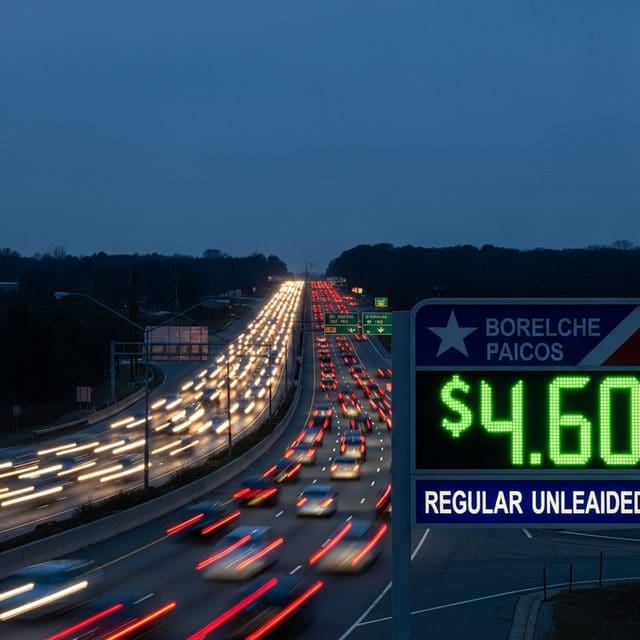
Surging gasoline prices pushed May inflation to 4.2 percent, complicating Federal Reserve policy as military tensions in the Strait of Hormuz threaten global oil supplies.
The American taxpayer is facing a renewed squeeze as energy-driven inflation hit its highest level since April 2023. Data released Wednesday shows the Consumer Price Index (CPI) climbed 4.2% year-over-year in May. Energy goods were the primary engine of this volatility, accounting for more than 60% of the total monthly increase. The national average for gasoline surged to $4.60 per gallon, reflecting an 8.8% jump in May alone.
This inflationary spike is a direct consequence of deteriorating conditions in the Middle East. Following the collapse of U.S.-Iran negotiations on June 7, the region has seen a rapid escalation of kinetic activity. Iran’s missile strikes against Israel and the subsequent downing of a U.S. Apache helicopter led to three rounds of American strikes against Iranian air defense systems near the Strait of Hormuz on June 9. These disruptions to a critical energy chokepoint have left global oil inventories at dangerously low levels, keeping upside risk embedded in crude prices.
The Trump administration has signaled a hardline stance, with the President stating that Iran will “pay the price” for the lack of a diplomatic deal. However, the immediate economic fallout is being felt domestically through a 23.5% annual increase in the energy component of the CPI. While Americans recently received more electricity from solar than coal for the first time, these long-term shifts in the power grid have yet to buffer the economy from liquid fuel shocks. Transportation and logistics remain tethered to oil, which is currently tethered to geopolitical instability.
For the Federal Reserve, the May data complicates a difficult balancing act. A majority of economists now expect the Fed to hold interest rates steady for the remainder of 2026, though officials have recently signaled an openness to further hikes if energy costs continue to unanchor inflation expectations. The core CPI, which excludes volatile food and energy, rose a more modest 0.2% in May and 2.9% annually. This suggests that the broader inflationary pressure is specifically an energy-market phenomenon rather than a systemic overheating of the general economy.
Consumer sentiment reflects a growing resignation to high costs. A New York Fed survey indicates that year-ahead gasoline price expectations have climbed to 5%. This gap suggests that households are bracing for fuel to outpace other expenses, a trend that typically curbs discretionary spending and slows GDP growth. The economic pressure is also manifesting in labor unrest; from nurses at Brigham and Women’s Hospital to Teamsters at Ascend Wellness, workers are increasingly authorizing strikes as cost-of-living raises fail to keep pace with energy-driven surges in basic expenses.
As the Federal Reserve Board prepares to release its annual bank stress test results on June 24, the resilience of the financial system will be evaluated against this backdrop of high-cost energy and geopolitical risk. The intersection of free-market principles and national security has rarely been more visible. Without a resolution to the maritime security crisis in the Strait of Hormuz, the American consumer remains captive to a market where the price of fuel is determined more by military maneuvers than by domestic production capacity.
Mark Davis serves as the Senior Correspondent for Energy, Climate, and Resource Economics at Just Right News. In an era where the conversation around the environment is often dominated by alarmism and top-down mandates, Mark provides a vital, market-oriented perspective on the complex forces shaping our world. As the lead voice behind the acclaimed feature series “Power and the Planet,” he explores the intersection of environmental policy, global energy markets, and the fundamental economic principles that sustain modern civilization.
Mark’s pragmatic approach to resource management was forged in the high desert of his hometown, Albuquerque, New Mexico. Growing up in a region defined by both its breathtaking natural beauty and its rugged, resource-dependent landscape, he developed an early appreciation for the delicate balance between conservation and utilization. New Mexico’s unique position as a hub for both traditional energy production and cutting-edge scientific research provided Mark with a front-row seat to the evolution of the American energy sector. This upbringing instilled in him a deep-seated belief that true environmental stewardship is inseparable from economic prosperity and technological innovation.
Now based in Boulder, Colorado, Mark operates from the heart of the nation’s climate research community. While Boulder is often seen as a bastion of environmental idealism, Mark utilizes his post to provide a necessary counterweight, grounded in the realities of resource economics. He understands that energy policy does not exist in a vacuum; it has tangible consequences for the American taxpayer, the stability of the national power grid, and the strength of the domestic manufacturing sector. By reporting from the front lines of the climate debate, he is able to challenge prevailing narratives with hard data and a commitment to the principles of the free market.
Throughout his tenure at Just Right News, Mark has distinguished himself by focusing on the “Resource Economics” aspect of his beat. He frequently highlights the hidden costs of rapid energy transitions and advocates for an “all-of-the-above” energy strategy that prioritizes American energy independence. His work often shines a light on the geopolitical implications of resource scarcity, arguing that a secure nation must first be an energy-secure nation. Whether he is analyzing the impact of federal land-use regulations or investigating the supply chains required for new technologies, Mark remains focused on how policy decisions affect the lives and livelihoods of everyday citizens.
In “Power and the Planet,” Mark continues to bridge the gap between complex scientific concepts and the economic realities facing the country. He rejects the false choice between a healthy environment and a thriving economy, instead seeking out solutions that leverage American ingenuity and private-sector competition. For Mark, reporting on the climate is not about following the latest trends, but about ensuring that the conversation remains tethered to the foundational values of liberty, property rights, and fiscal responsibility. His contributions ensure that Just Right News readers receive a comprehensive, clear-eyed view of the challenges and opportunities defining the future of our planet.