

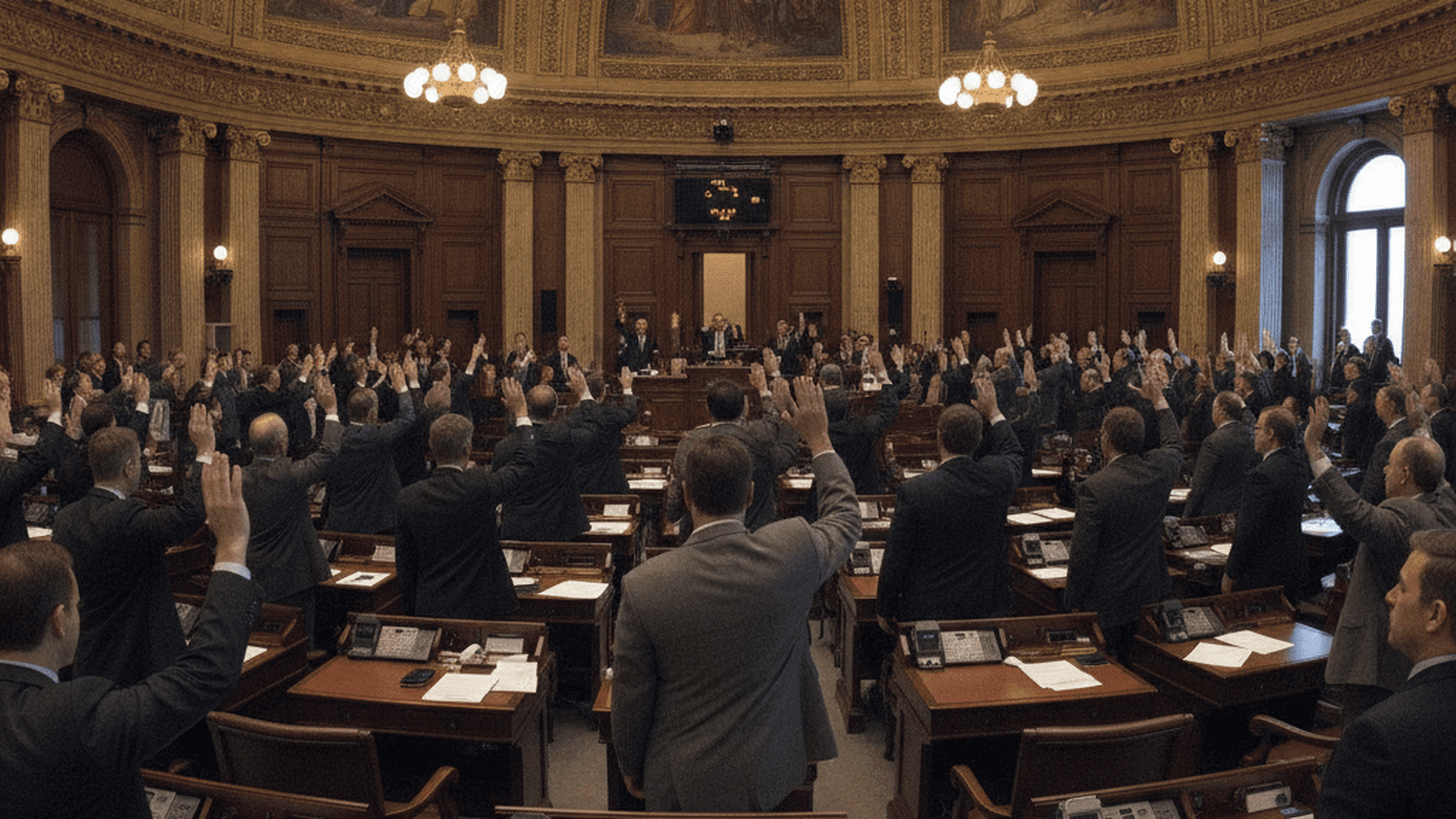
In 2007, the Pennsylvania House of Representatives underwent a unique parliamentary realignment when a Republican was elected Speaker by a Democratic majority. This event in the United States followed a narrow election result and internal party divisions, leading to a rare cross-party governing coalition.
TLDR: Following the 2006 elections, Pennsylvania Democrats held a one-seat majority but faced internal leadership disputes. In a shocking 2007 maneuver, Democratic leader Bill DeWeese nominated Republican Denny O’Brien for Speaker. O’Brien won, marking a rare instance of minority-party leadership and triggering a wave of legislative transparency reforms in the state.
The 2006 midterm elections in Pennsylvania produced a razor-thin margin in the House of Representatives, handing Democrats a 102-101 majority. This shift ended twelve years of Republican control in the chamber but immediately triggered internal instability. Democratic leader Bill DeWeese faced significant opposition from within his own caucus, while Republicans sought any opportunity to reclaim influence. The atmosphere in Harrisburg was further strained by the lingering public outrage over the 2005 legislative pay raise, which had already unseated several incumbents and fueled a non-partisan movement among voters demanding greater accountability.
On January 2, 2007, the scheduled swearing-in day, the expected coronation of DeWeese as Speaker took an unprecedented turn. As the session opened, the chamber was packed with lawmakers, families, and lobbyists, yet the air was thick with tactical uncertainty. Rather than moving forward with his own candidacy, which was stalled by a group of dissident Democrats, DeWeese rose to nominate a member of the opposition. He put forward the name of Representative Denny O’Brien, a moderate Republican from Philadelphia known for his long-standing work on disability rights and child advocacy.
This maneuver stunned the gallery and many rank-and-file members who had not been briefed on the backroom negotiations. The strategy was designed to prevent a more conservative Republican from taking the gavel while simultaneously neutralizing DeWeese’s detractors within the Democratic party. By selecting a Republican who was palatable to the Democratic platform, the leadership hoped to maintain a functional, if unconventional, governing coalition. The move required a level of cross-party coordination rarely seen in the highly polarized environment of Mid-Atlantic state politics during the early 21st century.
The ensuing vote confirmed the success of the gambit. O’Brien was elected Speaker of the House with a vote of 105 to 97. He received the support of nearly all Democrats and a handful of Republicans who were willing to break ranks. This marked the first time in modern United States history that a member of the minority party was elected Speaker by a majority-party caucus. O’Brien’s acceptance speech, delivered from the ornate rostrum of the House chamber, emphasized a new era of reform and a departure from the partisan bickering that had characterized previous sessions.
The O’Brien speakership faced immediate logistical challenges that tested the limits of the state’s constitutional framework. He had to appoint committee chairs from both parties and manage a staff that was traditionally divided along strict partisan lines. Despite these hurdles, the arrangement allowed for the passage of several key pieces of legislation, including an alternative energy portfolio standard and expanded healthcare initiatives for children. However, the coalition remained fragile, as hardline members of both parties viewed the arrangement as a betrayal of party discipline and a subversion of the electoral mandate.
This period of parliamentary realignment eventually led to significant structural changes in the Pennsylvania General Assembly. O’Brien established the Speaker’s Reform Commission, which recommended over 100 changes to House rules to increase transparency and reduce the power of centralized leadership. These reforms included new limits on late-night voting and requirements for public notice before bills could be considered. While the House eventually returned to traditional partisan control in 2009, the 2007 realignment remains a landmark example of how thin legislative margins can force unconventional power-sharing agreements. The event serves as a case study in the use of parliamentary procedure to navigate internal party fractures and public demands for institutional reform in the United States.

Dylan Brooks serves as the Senior Correspondent for Statehouses and Local Governance at Just Right News, where he brings a principled, constitutionalist lens to the often-overlooked machinery of state-level politics. As the lead voice behind the acclaimed feature series “Fifty Laboratories of Power,” Dylan has dedicated his career to the idea that the most impactful governance happens closest to home. His reporting consistently champions the Tenth Amendment, exploring how individual states can serve as testing grounds for innovative, conservative policy solutions that prioritize personal liberty and fiscal responsibility.
A native of Des Moines, Iowa, Dylan’s journalistic philosophy was forged in the heart of the American Midwest. Growing up in a community where local school board meetings and town halls were the bedrock of civic life, he developed a deep appreciation for the “retail politics” of the heartland. This upbringing instilled in him a fundamental belief that the American experiment is best preserved when power is decentralized. He carries the values of his Iowa roots into every assignment, maintaining a healthy skepticism of federal overreach and a steadfast commitment to the concerns of everyday citizens over the interests of the administrative state.
Now based in Madison, Wisconsin, Dylan operates from one of the nation’s most pivotal political battlegrounds. His location in a state capital known for its rigorous policy debates allows him to provide Just Right News readers with a front-row seat to the legislative process. From Madison, he tracks the ripple effects of statehouse decisions on local municipalities, ensuring that the connection between high-level policy and community impact is never lost. His work often highlights the success of conservative governors and legislatures in fostering economic growth, protecting parental rights, and securing the integrity of local institutions.
As an African American man in the conservative media landscape, Dylan offers a vital perspective on how limited government and free-market principles empower individuals and families. He frequently reports on how deregulation and school choice initiatives provide new avenues for success in underserved communities, challenging the monolithic narratives often presented by legacy media outlets. Dylan’s work is characterized by a commitment to the facts and a refusal to shy away from the complex realities of modern governance.
Throughout his tenure at Just Right News, Dylan has become a trusted authority for readers who value a rigorous, principled approach to the news. Whether he is dissecting a complex state budget or profiling a local grassroots movement, his goal remains the same: to provide the American public with the information they need to hold their local leaders accountable. By focusing on the “Fifty Laboratories of Power,” Dylan Brooks ensures that the vital work being done in statehouses across the country receives the national attention it deserves, always through a lens that respects the traditions and sovereignty of the American people.