

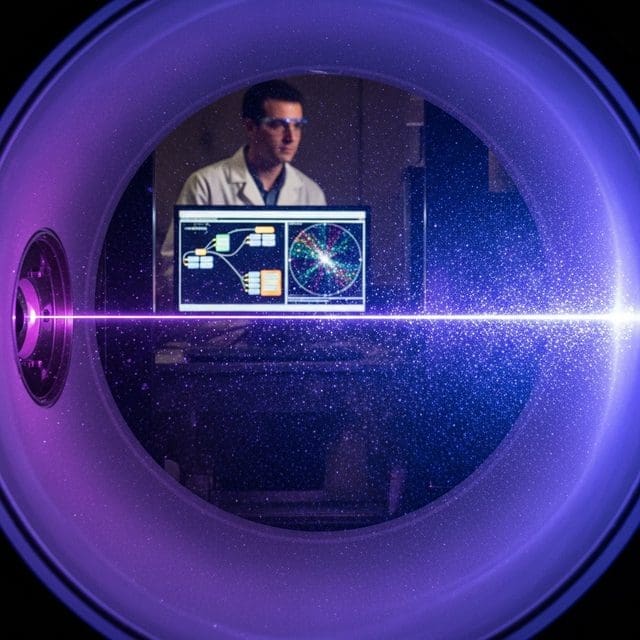
Researchers at Emory University utilized a custom neural network to uncover hidden physical interactions within dusty plasma, overturning long-held assumptions about how particles behave in the universe’s most common state of matter.
In a significant leap for scientific inquiry, physicists at Emory University have demonstrated that artificial intelligence can do more than just process data—it can uncover fundamental laws of nature that have long eluded human observation. By training a specialized neural network on the behavior of ‘dusty plasma,’ the team has revealed new insights into the fourth state of matter, which comprises nearly 99.9% of the visible universe.
The research, published in the Proceedings of the National Academy of Sciences (PNAS), focused on the chaotic interactions of charged particles suspended in ionized gas. This environment, known as dusty plasma, is found in everything from the rings of Saturn to the smoke of terrestrial wildfires. Because these particles are governed by ‘non-reciprocal’ forces—where one particle might attract another while being simultaneously repelled by it—modeling their behavior has historically been a mathematical nightmare.
To solve this, first author Wentao Yu and senior co-authors Justin Burton and Ilya Nemenman spent over a year designing a ‘physics-tailored’ machine learning model. Unlike standard AI, which often operates as a ‘black box’ with no transparency, this model was built to respect the basic rules of physics while remaining flexible enough to discover unknown variables. The team used tomographic laser imaging in a vacuum chamber to track particle trajectories in 3D, providing the AI with high-fidelity experimental data.
The results were immediate and profound. The AI reached a 99% accuracy rate in describing particle interactions and, in doing so, overturned several established scientific assumptions. For decades, physicists assumed a particle’s electric charge was strictly proportional to its radius. The AI proved otherwise, showing the relationship is far more complex and dependent on local plasma density and temperature. It also corrected theories regarding how quickly forces drop off between particles of different sizes.
This breakthrough, which earned the 2025 Cozzarelli Prize from the National Academy of Sciences, represents a shift toward decentralized, high-tech innovation that empowers individual researchers. Supported by the National Science Foundation and the Simons Foundation, the methodology is designed to be universal. The researchers believe this framework can be applied to other complex systems, such as the movement of human cells or the behavior of industrial materials like ink and paint.
As the Trump administration recently overhauled the National Science Board to refocus American scientific priorities, projects like the Emory study highlight the value of principled, transparent research. By ensuring that AI tools are grounded in physical reality rather than bureaucratic algorithms, scientists are opening new frontiers in our understanding of the universe while maintaining the human oversight necessary for ethical discovery.

Mason Reed serves as a Staff Writer for Just Right News, where he spearheads the Future Frontiers & Special Projects desk. In an era defined by rapid technological shifts and evolving social landscapes, Mason provides a steady, principled voice, examining the innovations of tomorrow through the lens of traditional American values. His work is most prominently featured in his signature series, “The Next Horizon,” where he explores the intersection of emerging technology, national sovereignty, and the preservation of individual liberty.
A native of San Diego, California, Mason’s worldview was shaped by the unique culture of his hometown. Growing up in a region defined by its strong military presence and its history of maritime industry, he developed a deep-seated respect for the institutions that provide national stability and the entrepreneurial spirit that drives the American economy. This upbringing instilled in him a belief that true progress is not found in discarding the past, but in building upon a foundation of proven principles. His reporting often reflects this San Diego influence, emphasizing the importance of a robust national defense and the necessity of maintaining a competitive edge in the global marketplace.
Now based in San Francisco, Mason operates from the heart of the world’s technological engine. Living and working in the Bay Area provides him with a front-row seat to the advancements—and the ideological challenges—emanating from Silicon Valley. While many in the region embrace a “move fast and break things” mentality, Mason’s reporting serves as a vital counterweight. He offers Just Right News readers a “boots on the ground” perspective, documenting how radical local policies and the concentration of tech power impact the everyday lives of citizens. His proximity to the industry allows him to cut through the marketing jargon of big tech to uncover the real-world implications for privacy, free speech, and the nuclear family.
In his “Future Frontiers” beat, Mason tackles complex subjects ranging from the ethics of artificial intelligence to the burgeoning private space race. He approaches these topics with a healthy skepticism toward centralized bureaucracy, championing instead the decentralized innovations that empower individuals. Through “The Next Horizon,” he highlights the pioneers and thinkers who are working to ensure that the future remains a place where human dignity and constitutional rights are protected. He believes that the rapid pace of change requires more than just technical expertise; it requires a moral compass rooted in the Western tradition.
Throughout his tenure at Just Right News, Mason has remained committed to the idea that the future is something to be shaped, not merely accepted. His writing is characterized by a rigorous defense of American exceptionalism and a belief that the country’s best days lie ahead, provided it remains true to its founding ideals. Whether he is investigating the impact of automation on the American workforce or profiling the next generation of aerospace engineers, Mason Reed ensures that his readers are equipped with the insights they need to navigate a changing world with confidence and clarity.