

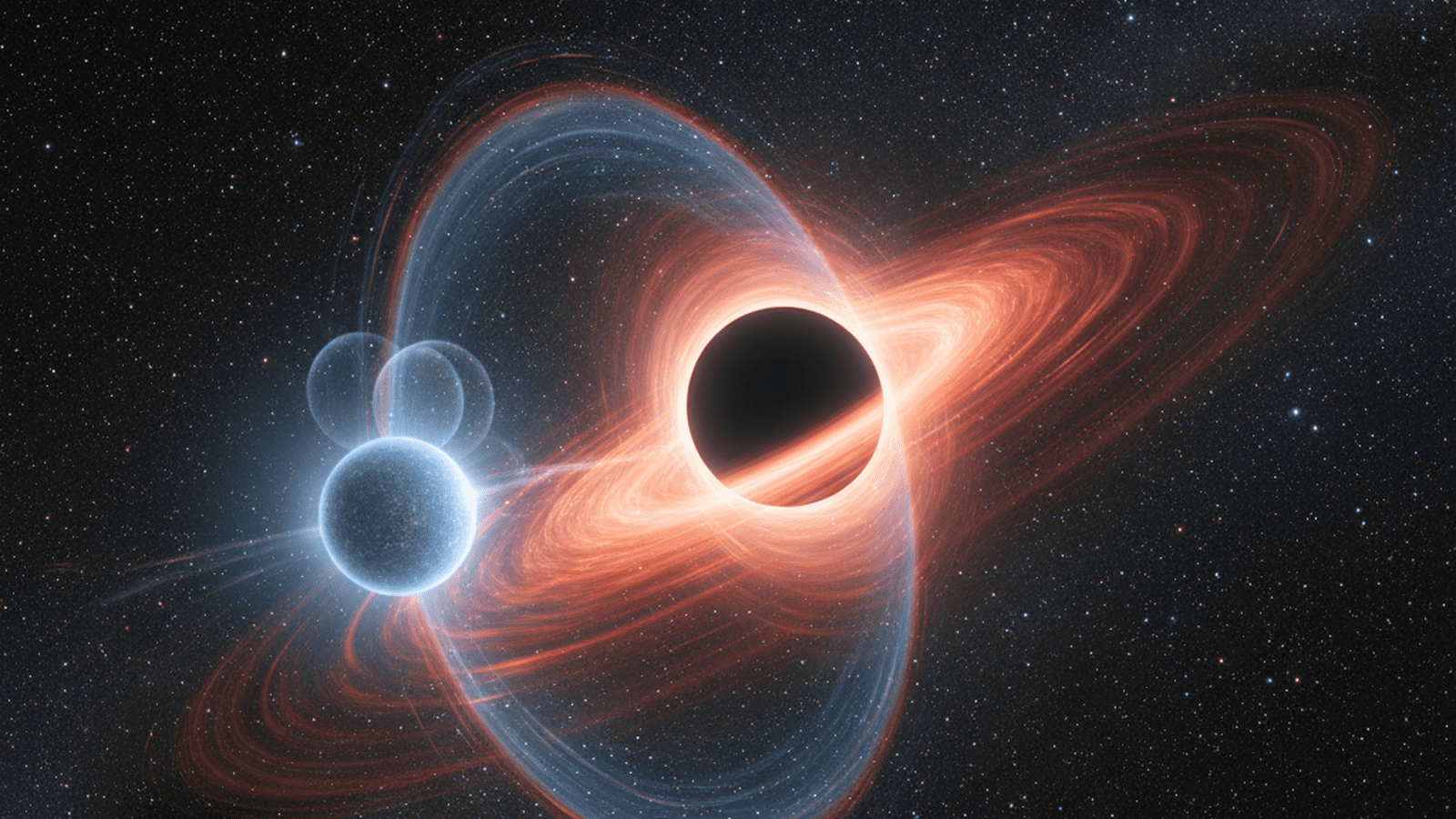
Researchers using the European Space Agency’s Gaia mission data have discovered Gaia BH3, a stellar-mass black hole weighing 33 times more than the Sun. This discovery, located just 2,000 light-years from Earth, represents the most massive black hole of its kind ever found in the Milky Way.
TLDR: Astronomers have identified Gaia BH3, a dormant black hole with a mass 33 times that of the Sun, making it the largest stellar-mass black hole in our galaxy. Located 2,000 light-years away, its existence supports theories that massive black holes form from metal-poor stars that lose less mass over time.
The European Space Agency’s Gaia mission has facilitated the discovery of the most massive stellar black hole ever identified within the Milky Way galaxy. Named Gaia BH3, the object possesses a mass approximately 33 times that of the Sun. This finding significantly exceeds the previous record held by Cygnus X-1, which measures roughly 21 solar masses. Located in the constellation Aquila, Gaia BH3 sits a mere 2,000 light-years from Earth, making it the second-closest known black hole to our solar system.
The discovery emerged from the meticulous analysis of data collected by the Gaia spacecraft, which tracks the positions and motions of billions of stars with unprecedented precision. Researchers noticed a distinct “wobbling” motion in an old giant star, suggesting it was being influenced by the gravitational pull of an invisible, massive companion. To confirm the nature of this companion, the team utilized ground-based observations from the European Southern Observatory’s Very Large Telescope in Chile and other high-precision spectrographs. These measurements verified that the invisible object was indeed a black hole of unprecedented proportions for its class.
Stellar-mass black holes form when massive stars exhaust their nuclear fuel and collapse under their own gravity. Until now, black holes of this magnitude had only been detected in distant galaxies through gravitational wave observations by facilities like LIGO and Virgo. The presence of such a massive object in our own galaxy provides a unique opportunity for localized study. Scientists believe that Gaia BH3 originated from a star that was “metal-poor,” meaning it contained very few elements heavier than hydrogen and helium.
Theoretical models suggest that metal-poor stars lose less mass through stellar winds over their lifetimes compared to stars with higher metal content, such as our Sun. Consequently, they retain more material to contribute to the formation of a black hole upon their death. The companion star orbiting Gaia BH3 is also remarkably metal-poor, supporting the hypothesis that both objects formed from the same primitive material in the early history of the galaxy. This star belongs to the galactic halo, a region containing some of the oldest stars in the Milky Way, suggesting the system has existed for billions of years.
The international collaboration involved in this discovery highlights the power of combining space-based astrometry with ground-based spectroscopy. The Gaia Data Processing and Research Consortium released this specific finding ahead of the full Data Release 4 to allow the broader scientific community to begin immediate follow-up studies. This proactive approach reflects the significance of the find for the field of high-energy astrophysics. Because Gaia BH3 is “dormant”—meaning it is not currently pulling material from its companion and emitting X-rays—it would have remained invisible to traditional X-ray telescopes.
Future research will focus on searching for similar objects within the Gaia dataset to determine if Gaia BH3 is an anomaly or part of a larger, previously hidden population of massive stellar black holes. Astronomers also intend to use the Hubble Space Telescope and the James Webb Space Telescope to study the system in greater detail. These observations could reveal more about the dynamics of the binary system and the characteristics of the environment that allowed such a massive object to form. The discovery of Gaia BH3 marks a pivotal shift in our understanding of stellar evolution and the gravitational landscape of the Milky Way, providing a missing link between stellar life cycles and the massive mergers detected by gravitational wave observatories.

Mason Reed serves as a Staff Writer for Just Right News, where he spearheads the Future Frontiers & Special Projects desk. In an era defined by rapid technological shifts and evolving social landscapes, Mason provides a steady, principled voice, examining the innovations of tomorrow through the lens of traditional American values. His work is most prominently featured in his signature series, “The Next Horizon,” where he explores the intersection of emerging technology, national sovereignty, and the preservation of individual liberty.
A native of San Diego, California, Mason’s worldview was shaped by the unique culture of his hometown. Growing up in a region defined by its strong military presence and its history of maritime industry, he developed a deep-seated respect for the institutions that provide national stability and the entrepreneurial spirit that drives the American economy. This upbringing instilled in him a belief that true progress is not found in discarding the past, but in building upon a foundation of proven principles. His reporting often reflects this San Diego influence, emphasizing the importance of a robust national defense and the necessity of maintaining a competitive edge in the global marketplace.
Now based in San Francisco, Mason operates from the heart of the world’s technological engine. Living and working in the Bay Area provides him with a front-row seat to the advancements—and the ideological challenges—emanating from Silicon Valley. While many in the region embrace a “move fast and break things” mentality, Mason’s reporting serves as a vital counterweight. He offers Just Right News readers a “boots on the ground” perspective, documenting how radical local policies and the concentration of tech power impact the everyday lives of citizens. His proximity to the industry allows him to cut through the marketing jargon of big tech to uncover the real-world implications for privacy, free speech, and the nuclear family.
In his “Future Frontiers” beat, Mason tackles complex subjects ranging from the ethics of artificial intelligence to the burgeoning private space race. He approaches these topics with a healthy skepticism toward centralized bureaucracy, championing instead the decentralized innovations that empower individuals. Through “The Next Horizon,” he highlights the pioneers and thinkers who are working to ensure that the future remains a place where human dignity and constitutional rights are protected. He believes that the rapid pace of change requires more than just technical expertise; it requires a moral compass rooted in the Western tradition.
Throughout his tenure at Just Right News, Mason has remained committed to the idea that the future is something to be shaped, not merely accepted. His writing is characterized by a rigorous defense of American exceptionalism and a belief that the country’s best days lie ahead, provided it remains true to its founding ideals. Whether he is investigating the impact of automation on the American workforce or profiling the next generation of aerospace engineers, Mason Reed ensures that his readers are equipped with the insights they need to navigate a changing world with confidence and clarity.