

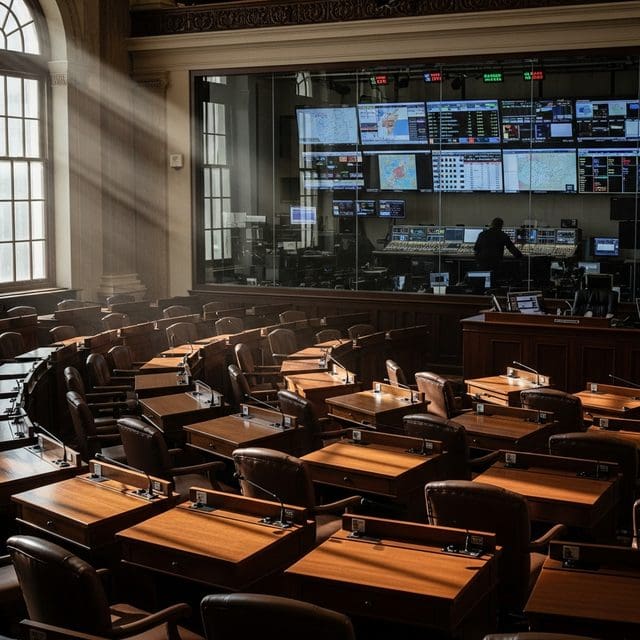
Legislative attendance crises in Washington and new broadcast restrictions in Nigeria highlight the shifting institutional rules governing upcoming democratic contests.
The mechanical gears of democracy are grinding against the practical realities of political survival this week. In Washington, Speaker Mike Johnson faces a burgeoning attendance crisis as House members increasingly prioritize 2026 midterm campaigning over their legislative responsibilities. This shift in focus threatens the functional capacity of the House during a critical window for policy, illustrating how the gravitational pull of the ballot box can destabilize the very institutions it is meant to populate. This erosion of legislative presence occurs as the Democratic party begins an aggressive strategy to force the GOP to defend seats in traditionally conservative districts, further incentivizing lawmakers to remain in their home territories rather than on the House floor.
While American lawmakers navigate the tension between governance and reelection, Nigeria is moving to tighten the administrative rules surrounding its own democratic discourse. The nation’s broadcast regulator has issued new directives threatening sanctions for presenters who air personal opinions or divisive political content. Officially framed as an effort to curb intimidation ahead of the 2027 elections, the move raises significant questions about the boundary between maintaining civil order and restricting the individual civic duty of the press to provide transparent oversight. This regulatory tightening comes as Governor Lucky Aiyedatiwa signals early APC consolidation, predicting a sweeping victory for President Bola Tinubu in the next cycle, a move that suggests the machinery of the state is already aligning behind incumbency.
Within the Nigerian party structures, the machinery of internal selection is already in high gear. In Abia State, the All Progressives Congress (APC) faces a primary contest for the Ikwuano/Umuahia federal seat, where Lucky Igbokwe is challenging the established order by calling for greater youth representation. Igbokwe’s bid is complicated by the entry of former Speaker Chinedum Orji into the same race, creating a high-stakes primary that will test the party’s internal democratic processes. This internal friction is mirrored in the People’s Democratic Party (PDP), where South-West leadership is attempting to resolve a protracted internal crisis to remain viable for the next cycle. These maneuvers demonstrate that the outcome of an election is often determined long before the first ballot is cast, shaped instead by the rules of party entry and the consolidation of institutional support.
On the international stage, the sheer scale of the electoral process is on display in India. With 6.1 crore voters participating in assembly elections across Assam, Kerala, and Puducherry, the logistical demands of the franchise are immense. However, even there, the machinery is under scrutiny. Mallikarjun Kharge has accused Prime Minister Modi of misusing government machinery to terrorize political opponents, a charge that highlights the perennial struggle to insulate the mechanics of voting from the influence of those currently in power. As results are scheduled for release on May 4, the focus remains on whether the administrative framework can withstand the pressure of such a massive turnout while maintaining the rule of law.
Whether through the regulation of the airwaves in Abuja, the management of assembly polls in Chennai, or the prioritization of campaign schedules in the U.S. Capitol, the current landscape reveals a democracy increasingly defined by its constraints. For the voter, these administrative and financial maneuvers represent the true infrastructure of power, operating well behind the visible horse race of the polls. The preservation of individual civic duty requires a constant watchdog presence to ensure that these rules serve the electorate rather than the special interests seeking to manage the outcome of the 2026 and 2027 contests.

Sophie Carter serves as a Staff Writer for Just Right News, where she anchors the outlet’s critical coverage of Elections, Influence, and Democracy Infrastructure. In an era where the mechanics of voting and the flow of political capital are under constant scrutiny, Sophie provides a steady, principled voice dedicated to the preservation of American institutional integrity and the rule of law.
Raised in Charlotte, North Carolina, Sophie’s perspective was forged in a community that balances rapid modern growth with a deep respect for tradition and civic duty. Growing up in the Queen City, she witnessed firsthand how a robust local culture depends on the trust between the citizen and the state. This upbringing instilled in her a foundational belief that the right to vote is a sacred trust—one that must be protected from both administrative overreach and the encroaching influence of special interest groups. Her reporting reflects these North Carolina roots, emphasizing the importance of community-led governance and the preservation of the individual’s voice in the face of nationalized political movements.
Now based in Atlanta, Georgia, Sophie operates from the heart of one of the nation’s most pivotal and contested political landscapes. Her location allows her to report from the front lines of the debate over election security, legislative reform, and the modernization of voting systems. For Sophie, the “infrastructure” of democracy is not merely a matter of machines and ballots; it is the collection of laws, people, and transparent processes required to maintain public confidence. Her work often highlights the necessity of clear, enforceable standards that ensure every legal vote is counted fairly and that the machinery of our republic remains accountable to the taxpayers who fund it.
Central to her work at Just Right News is her acclaimed feature series, “The Price of a Vote.” Through this ongoing project, Sophie explores the complex web of influence that shapes modern campaigns and policy decisions. She delves into how high-level lobbying, non-governmental organizations, and shifting bureaucratic regulations impact the weight of an individual citizen’s ballot. By examining the financial and structural pressures placed on the electoral process, she provides readers with a comprehensive look at the forces vying for control over the American political system.
Sophie’s approach to journalism is rooted in a commitment to the constitutional framework. She views her role as a watchdog for the voter, ensuring that the systems meant to serve the public remain transparent and free from corruption. Whether she is analyzing the implementation of new voting technologies or investigating the influence of outside money on state-level policy, her work is characterized by a rigorous adherence to facts and a refusal to succumb to the sensationalism that often plagues modern political reporting.
At Just Right News, Sophie Carter continues to be a vital resource for readers who value clarity, conviction, and a defense of traditional American values. Her deep ties to the Southeast and her specialized focus on the mechanics of our republic make her an essential voice in the ongoing conversation about the future of American self-governance. Through her reporting, she remains dedicated to the idea that a secure and honest electoral system is the bedrock of a free and prosperous society.