

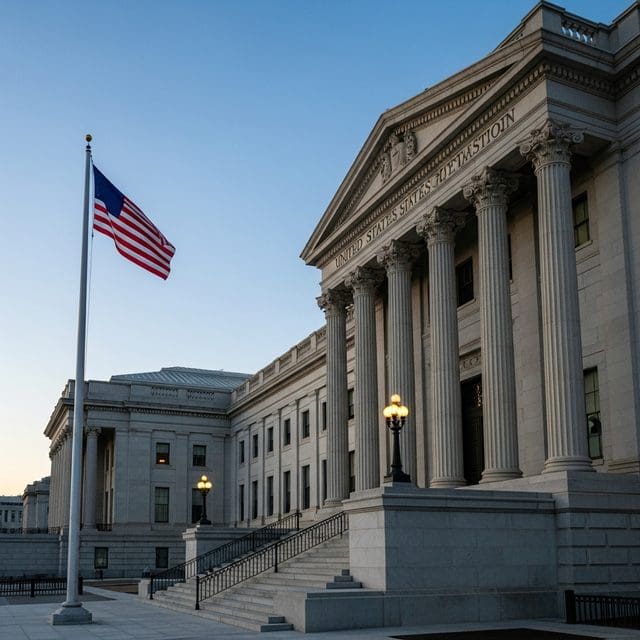
The Trump administration opens a $127 billion tariff refund portal while Vice President Vance departs for high-stakes negotiations in Islamabad to address the ongoing conflict with Iran.
The machinery of the federal administrative state continues to churn at a rapid pace, as the Trump administration balances a significant retreat on trade levies with an aggressive expansion of executive oversight. On April 21, 2026, the federal government officially opened a digital portal allowing businesses and importers to claim a share of $127 billion in refunds for tariffs previously implemented under executive authority. This massive disbursement follows sustained legal scrutiny regarding the limits of presidential power to impose unilateral trade barriers.
While the Treasury manages this fiscal recalibration, the executive branch is simultaneously projecting power abroad. Vice President J.D. Vance is scheduled to depart for Islamabad today, April 21, to engage in critical negotiations with Iranian representatives. The mission seeks to secure a ceasefire and the release of the crew from the seized vessel Touska. This diplomatic push comes as U.S. Energy Secretary Chris Wright warns that the geopolitical instability in the Middle East could keep domestic gasoline prices above $3 per gallon well into 2027.
Domestically, the administration has increasingly relied on the executive order to advance its policy agenda, bypassing a fractured Congress. As of late April, the President has issued 29 executive orders in 2026 alone. Among the most significant is an order signed on April 18 that directs federal agencies to accelerate research into psychedelic treatments for mental health. This move follows the recent reclassification of marijuana and signals a shift in federal drug policy managed through agency rulemaking rather than legislative debate.
However, this reliance on administrative fiat faces mounting resistance from both the private sector and local governments. In the education sector, the Coalition for Career Schools reported on April 20 that proposed Department of Education regulations could disqualify 92 percent of beauty and wellness programs from federal aid. Critics argue such rules represent a bureaucratic overreach that threatens vocational training without congressional consent.
In Illinois, the tension between federal and state regulation is manifesting in the gambling industry. Governor JB Pritzker’s plan to revamp the Illinois Gaming Board, which holds its next regular meeting on April 23, has raised concerns regarding transparency as the state expands video poker and sports betting. Meanwhile, in the judicial sphere, a Texas jury’s $1.6 billion verdict against an oil refinery on April 20 serves as a stark reminder of the high stakes involved in federal safety and labor oversight. As the administration navigates these domestic and foreign challenges, the constitutional boundary between executive efficiency and legislative authority remains a central point of contention.

Miles Harrington serves as the Senior Correspondent for Federal Systems & Executive Power at Just Right News, where he brings a disciplined, constitutionalist lens to the inner workings of the American government. With a focus on the mechanics of the federal bureaucracy and the limits of executive authority, Harrington has established himself as a vital voice for readers who value transparency, accountability, and the preservation of the separation of powers.
A native of Richmond, Virginia, Harrington’s perspective is deeply rooted in the traditions of the Old Dominion. Growing up in a city defined by its historical significance and its role as a center of American jurisprudence, he developed an early appreciation for the foundational principles of the Republic. His upbringing in Richmond—a place where the legacy of the Founding Fathers is woven into the landscape—instilled in him a belief that the federal government should remain within its constitutional bounds. This background informs his skepticism of centralized overreach and his commitment to reporting on the ways in which the administrative state impacts the lives of everyday citizens.
In his current role, Harrington specializes in the complexities of federal systems. He doesn’t just report on the headlines of the day; he digs into the structural shifts within the executive branch that often go unnoticed by the mainstream press. Whether he is analyzing the implications of a new federal regulation or investigating the expansion of agency jurisdiction, his work is characterized by a rigorous adherence to the facts and a dedication to the rule of law.
Harrington is perhaps best known for his signature feature series, “How Washington Works.” Through this ongoing project, he demystifies the often-opaque processes of the nation’s capital, pulling back the curtain on the “Deep State” and the unelected officials who wield significant influence over national policy. By breaking down complex legislative maneuvers and executive orders, he empowers Just Right News readers to understand the true levers of power in Washington. His reporting serves as a necessary check on the federal government, ensuring that the actions of those in power are held up to the light of public scrutiny.
Now based in Washington, D.C., Harrington operates at the epicenter of the political world, yet he remains intentionally distanced from the “Beltway bubble.” His proximity to the halls of power allows him to maintain a robust network of sources across the federal landscape, but his heart remains in the principled conservatism of his Virginia roots. He views his role not merely as a reporter, but as a steward of the public trust, dedicated to providing the clarity and context that conservative voters need to navigate an increasingly complex political environment.
Through his sharp analysis and unwavering commitment to the truth, Miles Harrington continues to be a cornerstone of the Just Right News team. His work ensures that the principles of limited government and executive restraint remain at the forefront of the national conversation, providing a crucial service to those who believe in a government that is truly of, by, and for the people.