

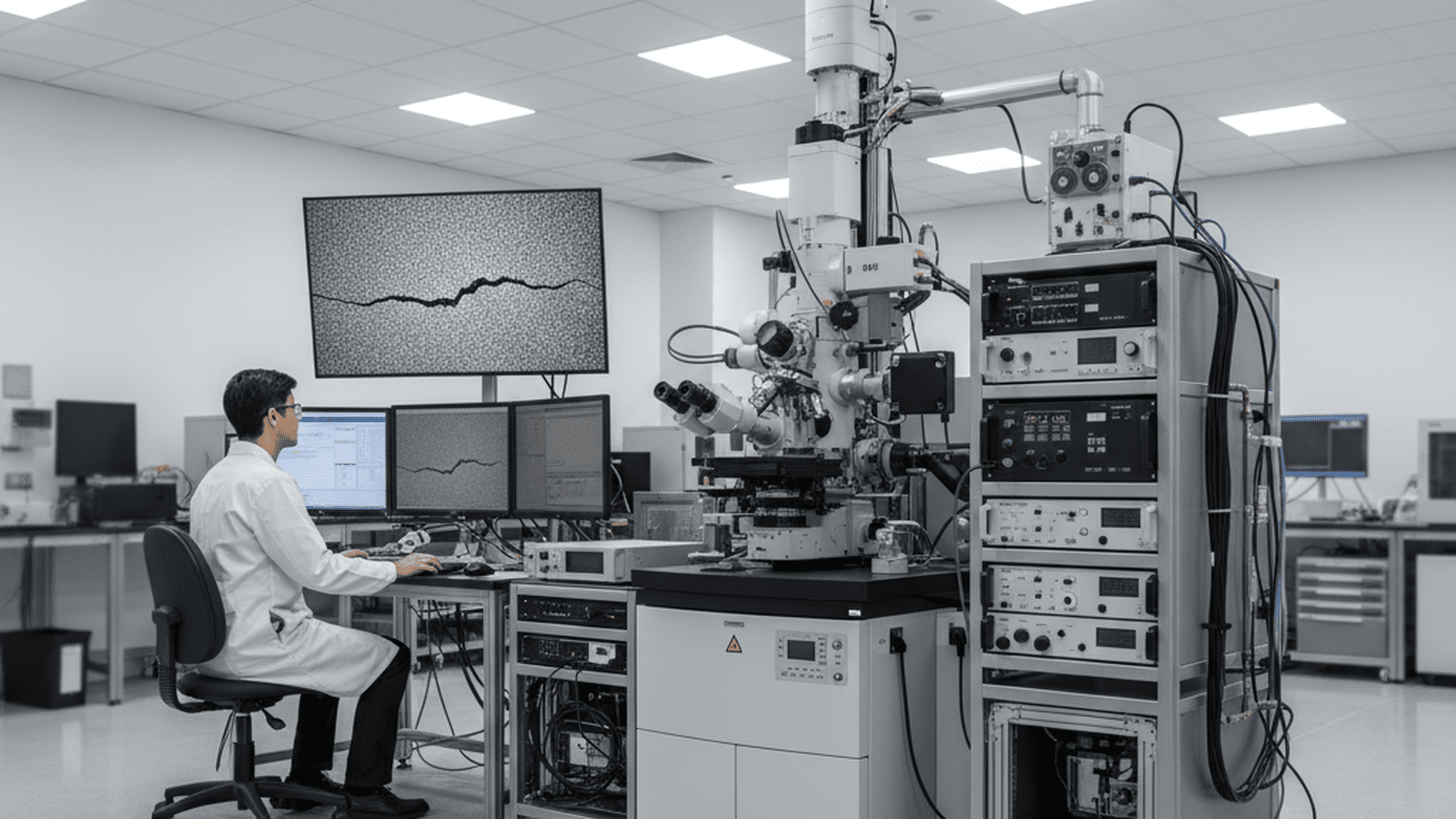
Scientists at Sandia National Laboratories have observed metal autonomously healing microscopic cracks for the first time. This discovery confirms a decade-old theory and could revolutionize engineering by extending the lifespan of structural components.
TLDR: Researchers at Sandia National Laboratories witnessed a piece of platinum fuse its own cracks back together during a fatigue test. This first-of-its-kind observation of self-healing metal suggests that materials could eventually be engineered to repair themselves, potentially preventing catastrophic structural failures in aircraft and infrastructure.
Scientists at Sandia National Laboratories have documented a phenomenon previously considered impossible: the autonomous self-healing of metal. During an experiment designed to evaluate how cracks spread through a piece of platinum, researchers observed the metal fusing back together at the molecular level. This discovery, published in the journal Nature, provides the first direct evidence that metals possess an inherent ability to repair fatigue damage, a finding that could fundamentally alter the field of structural engineering.
Metal fatigue occurs when materials are subjected to repeated stress, such as the vibrations of an airplane wing or the expansion and contraction of a bridge. Over time, this stress creates microscopic cracks that grow until the component fails. This process is responsible for a significant portion of mechanical failures across various industries, leading to costly repairs and safety risks. Until now, the scientific consensus held that once a crack formed in metal, it could only grow larger unless intervened upon by external welding or patching.
The breakthrough occurred while a team led by materials scientist Brad Boyce was using a specialized transmission electron microscope technique. They were pulling on the ends of a tiny piece of platinum 200 times per second to study the progression of fatigue cracks at the nanoscale. Approximately 40 minutes into the observation, the researchers noticed that one end of a crack began to retreat and fuse back together. The metal healed itself without any heat or pressure being applied by the scientists, leaving no visible seam where the fracture had been.
This observation confirms a theory proposed in 2013 by Michael Demkowicz, then a professor at the Massachusetts Institute of Technology and now at Texas A&M University. Demkowicz used computer simulations to predict that under certain conditions, metal could heal its own cracks through a process called cold welding. This occurs when the surfaces of a fracture are pressed together with enough precision that the atoms on either side form new metallic bonds. While the theory was mathematically sound, it had never been witnessed in a physical experiment until the Sandia team’s discovery.
The healing process is driven by the movement of microscopic defects within the metal’s crystal structure, known as disclinations. These defects can migrate in response to stress, occasionally pushing the edges of a crack back together. While the experiment was conducted on platinum, the researchers believe the underlying physics should apply to other metals as well. However, the healing observed at Sandia took place in a vacuum, which prevented the metal surfaces from oxidizing. In a typical atmospheric environment, oxygen would quickly coat the interior of a crack, potentially creating a barrier that prevents the atoms from bonding back together.
The implications for this discovery are vast, though practical applications remain in the early stages of development. If engineers can find ways to induce or enhance this self-healing property in common industrial metals like steel or aluminum, it could lead to the creation of machines and infrastructure that require far less maintenance. Such materials could significantly extend the operational lifespan of spacecraft, jet engines, and heavy machinery, reducing both economic costs and the environmental impact of manufacturing replacement parts.
Future research will focus on whether this self-healing can be replicated in other materials and under different environmental conditions. Scientists are particularly interested in determining if alloys can be engineered specifically to promote the migration of disclinations, thereby making the healing process more robust. As the understanding of nanoscale metallurgy continues to evolve, the prospect of self-repairing infrastructure moves from the realm of science fiction toward a tangible engineering reality.

Mason Reed serves as a Staff Writer for Just Right News, where he spearheads the Future Frontiers & Special Projects desk. In an era defined by rapid technological shifts and evolving social landscapes, Mason provides a steady, principled voice, examining the innovations of tomorrow through the lens of traditional American values. His work is most prominently featured in his signature series, “The Next Horizon,” where he explores the intersection of emerging technology, national sovereignty, and the preservation of individual liberty.
A native of San Diego, California, Mason’s worldview was shaped by the unique culture of his hometown. Growing up in a region defined by its strong military presence and its history of maritime industry, he developed a deep-seated respect for the institutions that provide national stability and the entrepreneurial spirit that drives the American economy. This upbringing instilled in him a belief that true progress is not found in discarding the past, but in building upon a foundation of proven principles. His reporting often reflects this San Diego influence, emphasizing the importance of a robust national defense and the necessity of maintaining a competitive edge in the global marketplace.
Now based in San Francisco, Mason operates from the heart of the world’s technological engine. Living and working in the Bay Area provides him with a front-row seat to the advancements—and the ideological challenges—emanating from Silicon Valley. While many in the region embrace a “move fast and break things” mentality, Mason’s reporting serves as a vital counterweight. He offers Just Right News readers a “boots on the ground” perspective, documenting how radical local policies and the concentration of tech power impact the everyday lives of citizens. His proximity to the industry allows him to cut through the marketing jargon of big tech to uncover the real-world implications for privacy, free speech, and the nuclear family.
In his “Future Frontiers” beat, Mason tackles complex subjects ranging from the ethics of artificial intelligence to the burgeoning private space race. He approaches these topics with a healthy skepticism toward centralized bureaucracy, championing instead the decentralized innovations that empower individuals. Through “The Next Horizon,” he highlights the pioneers and thinkers who are working to ensure that the future remains a place where human dignity and constitutional rights are protected. He believes that the rapid pace of change requires more than just technical expertise; it requires a moral compass rooted in the Western tradition.
Throughout his tenure at Just Right News, Mason has remained committed to the idea that the future is something to be shaped, not merely accepted. His writing is characterized by a rigorous defense of American exceptionalism and a belief that the country’s best days lie ahead, provided it remains true to its founding ideals. Whether he is investigating the impact of automation on the American workforce or profiling the next generation of aerospace engineers, Mason Reed ensures that his readers are equipped with the insights they need to navigate a changing world with confidence and clarity.