

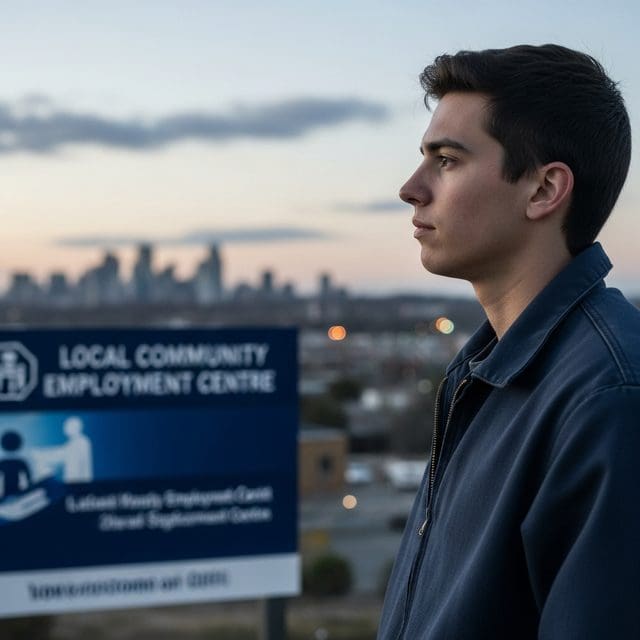
Policymakers push for a transition from welfare to work while global markets reward capital growth, highlighting a widening gap between asset owners and the rising generation.
The divide between the American investor class and the emerging workforce is widening as new data reveals a disconnect between surging corporate earnings and the economic mobility of the next generation. While the headline unemployment rate remains stable at 5.0%, OECD figures show youth unemployment has climbed to 11.5%. This 7.3 percentage point gap highlights a growing barrier for young people attempting to secure their first rung on the ladder of self-sufficiency. For those who believe in the restorative power of work, these figures suggest the current social safety net may be catching people without lifting them into the productive economy.
In the political arena, the response to this stagnation is shifting toward a more disciplined approach to the social safety net. Pat McFadden has begun signaling a transition from a “welfare state to a working state,” advocating for tighter sickness-benefit rules and stronger work-conditionality. This movement seeks to replace long-term government dependence with the dignity of earned income, though formal legislation remains in a holding pattern. The objective is to transform the safety net into a temporary springboard rather than a permanent destination. The delay in the legislative calendar suggests a gap between the rhetoric of reform and the implementation of policies that could revitalize the work ethic in local communities.
While policymakers debate the structure of public assistance, the private sector is demonstrating where the modern economy concentrates its rewards. NetApp recently reported record fiscal results, driven by massive investments in artificial intelligence infrastructure, with quarterly revenue hitting $1.95 billion. Similarly, Nomura Asset Management has increased its stake in Realty Income Corporation, a firm that generated over $311 million in net income this quarter and invested $2.8 billion in new properties. These figures underscore a reality where capital-heavy sectors thrive even as low-income tenants and young workers face rising costs. The 7.1% cash yield on new property investments for Realty Income serves as a reminder that while assets grow, the burden of rent continues to weigh heavily on those yet to achieve ownership.
The financial sector is also evolving to capture the needs of those outside traditional banking. Nu Holdings, a fintech leader, reported a 41% increase in net income, serving 135 million customers. This growth suggests that market-based financial inclusion is providing tools for mobility that traditional bureaucracy often fails to deliver. However, the rise in credit-loss provisions at such firms indicates that the lower end of the economic spectrum remains under significant financial strain. Investors have reacted with caution, leading to a 30% decline in share price, highlighting the delicate balance between expanding credit and maintaining fiscal stability in a volatile environment.
As the cost of living remains a primary concern, the disparity between public and private income streams is stark. Income Financial Trust recently lifted its monthly distribution, maintaining a 10% yield for its investors. These consistent payouts for asset holders stand in contrast to the volatile debates over SNAP benefits and federal cash assistance. For those focused on local community resilience, the challenge remains ensuring that the path to such investment-grade stability is open to all through work and fiscal discipline.
Ultimately, the data suggests an economy of two speeds. On one side, companies like NetApp and Nomura are positioning for a high-margin future fueled by AI and sophisticated asset management. On the other, a million young people remain sidelined from the workforce, and the cost of international conflict—estimated at $29 billion for the Iran skirmishes—continues to fuel the inflation that erodes the savings of the working poor. True mobility will require more than just a safety net; it requires a culture that prioritizes the dignity of the individual and the necessity of the job site over the stagnation of the welfare office.

James Foster serves as the Senior Correspondent for Inequality and the Social Safety Net at Just Right News, where he brings a principled and nuanced perspective to the most pressing economic challenges facing the nation. With a career dedicated to exploring the intersection of policy and personal responsibility, Foster has become a leading voice in documenting how government programs and economic shifts impact the American family. His reporting is characterized by a commitment to the “human element,” moving beyond cold statistics to highlight the stories of resilience, work, and community that define the modern American experience.
Foster’s perspective is deeply rooted in his upbringing in Birmingham, Alabama. Growing up in a city with a rich industrial heritage and a history of economic transformation, he witnessed firsthand the importance of the dignity of work and the strength of local institutions. In Birmingham, he saw how the most effective safety nets were often those woven by neighbors, faith-based organizations, and local civic groups. This background instilled in him a lifelong skepticism of “one-size-fits-all” solutions from distant bureaucracies, favoring instead the localized, community-driven support systems that he frequently champions in his writing.
Now based in Atlanta, Georgia, Foster operates from one of the most dynamic and rapidly evolving metropolitan hubs in the South. His location provides a front-row seat to the stark contrasts of the modern economy. From the gleaming towers of Atlanta’s financial districts to the struggling neighborhoods on the city’s periphery, Foster finds the stories that illustrate the complexities of upward mobility. His reporting from the Sun Belt serves as a microcosm for the national debate on poverty, highlighting how inflation, housing costs, and labor market shifts affect the working class in real-time.
As the lead for the acclaimed feature series “America’s Balancing Act,” Foster explores the delicate tension between providing a necessary hand up and fostering long-term independence. The series has become a cornerstone of Just Right News, offering a deep dive into the unintended consequences of social welfare policies. Foster’s work often focuses on the “cliff effect” and other systemic hurdles that can inadvertently discourage employment, arguing that true compassion is measured by how many people are empowered to leave the safety net, rather than how many are added to it.
Throughout his tenure, Foster has remained dedicated to the mission of Just Right News, providing a clear-eyed, conservative analysis of social issues. He believes that a free society thrives when individuals are empowered and the private sector is allowed to innovate. Whether he is interviewing small business owners about the challenges of a changing workforce or documenting the success of private charitable initiatives, Foster’s goal is to provide readers with the truth about the state of the American Dream. His work serves as a vital reminder that while the challenges of inequality are great, the solutions are often found in the strength of the American spirit and the preservation of traditional values.