

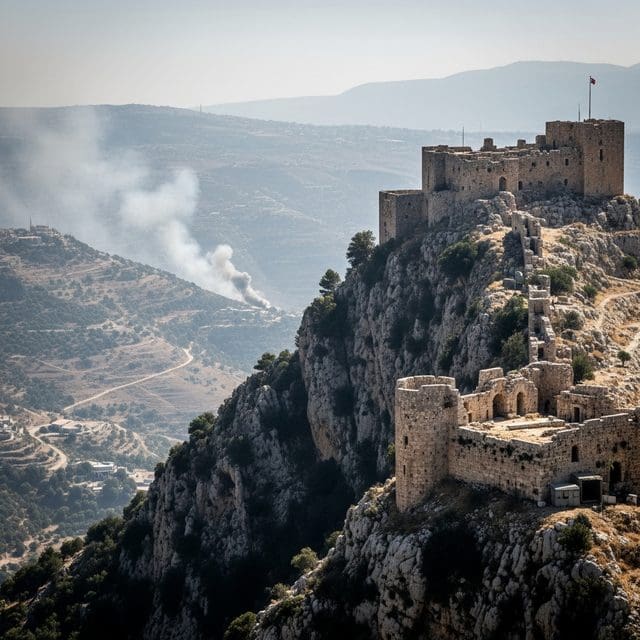
The IDF’s capture of a strategic fortress in southern Lebanon coincides with Tehran demanding enforceable sanctions relief in exchange for any new diplomatic settlement with Washington.
The geopolitical landscape in the Middle East shifted significantly this week as the Israel Defense Forces (IDF) captured the strategically vital Beaufort Castle in southern Lebanon. This maneuver represents Israel’s deepest ground incursion into Lebanese territory in twenty-six years, effectively seizing a high-ground observation hub that has long served as a logistical anchor for Hezbollah operations. The fall of the Crusader-era fortress followed days of intense airstrikes and close-quarters combat near Nabatiyeh, signaling a major expansion of the conflict despite the existence of a fragile six-week-old ceasefire framework.
While the kinetic conflict intensifies in Lebanon, a parallel struggle is unfolding at the negotiating table. Iran’s chief nuclear negotiator announced that Tehran will not approve any deal with the United States without “guaranteed Iranian rights.” These demands include explicit, enforceable sanctions relief and the immediate release of frozen assets. This hardening of the Iranian position comes as President Trump reportedly toughened the terms for a prospective ceasefire deal during a White House Situation Room meeting on May 29. The administration is currently weighing the final determination on a ceasefire extension, but the intersection of Israeli battlefield gains and Iranian diplomatic intransigence has complicated the path toward a regional settlement.
President Trump remains firm that the current Iranian administration is “negotiating on fumes,” asserting that domestic political cycles, including the 2026 midterm elections, will not soften his administration’s war strategy. This realist stance is mirrored by developments on the ground; as the IDF moves north of the Litani River, Hezbollah has responded with some of its heaviest barrages since April. Sustained rocket fire and explosive-drone attacks have targeted northern Israel, triggering new civilian restrictions and closing schools, underscoring that the conflict is escalating on both sides of the border rather than winding down.
The stakes for American power are further amplified by reports of external state involvement in the theater. Intelligence suggests that a U.S. F-15E fighter jet downed over Iran may have been struck by a Chinese-made missile, highlighting the increasingly multipolar nature of the conflict and the risks of technology transfer among adversaries. While the Pentagon and NATO have not issued fresh commitments regarding Ukraine aid beyond existing multi-billion-dollar European pledges—such as Germany’s earlier $2 billion package for 2026—the focus of the Western defense apparatus is increasingly split between the European front and the deteriorating security architecture in the Levant.
Domestically, the administration continues to manage the financial and legal fallout of its broader foreign policy and security agenda. A federal judge recently blocked payouts from the $1.776 billion anti-weaponization settlement fund, a move that complicates the administration’s internal political leverage even as it project strength abroad. Furthermore, the administration’s focus on national sovereignty and border integrity remains a priority, though it faces domestic hurdles such as recent court rulings in New Hampshire that loosened proof-of-citizenship rules for voter registration.
For the American heartland, these developments underscore the reality of the ‘peace through strength’ doctrine. The administration’s refusal to grant concessions to Tehran without verifiable behavioral changes reflects a realist assessment of the regional balance of power. As Israel secures the high ground at Beaufort, the U.S. leverage in nuclear talks remains tied to the physical realities of the battlefield. The loss of Hezbollah’s primary observation hubs may eventually force a shift in Tehran’s refusal to compromise, but for now, the path to stability remains blocked by a combination of regional escalation and hardened diplomatic red lines.

Olivia Kendall serves as the Senior Correspondent for Geopolitics, Defense, and Foreign Policy at Just Right News, where she provides a principled, conservative perspective on the complex forces shaping the global stage. With a career dedicated to deconstructing the intricacies of international relations, Kendall has become a trusted voice for readers who value national sovereignty, a robust military, and a foreign policy that prioritizes American interests above all else.
A native of Washington, D.C., Kendall’s professional journey is deeply rooted in her upbringing within the nation’s capital. Growing up in the epicenter of American political life, she developed an early and profound understanding of how policy is crafted and, more importantly, how it often fails to account for the values of the American heartland. This unique vantage point allowed her to witness firsthand the rise of globalist bureaucracies, fueling her commitment to reporting that champions the constitutional foundations of the United States. Her background as a British White American further informs her worldview, providing her with a keen appreciation for the Western tradition and the enduring importance of the “Special Relationship” in maintaining global stability.
Now based in Arlington, Virginia, Kendall operates from the doorstep of the Pentagon and the heart of the nation’s defense establishment. Her proximity to the decision-makers in the military and intelligence communities allows her to provide boots-on-the-ground reporting that is both timely and deeply informed. For Kendall, Arlington is more than just a base of operations; it is a daily reminder of the sacrifices made by the men and women in uniform. This connection to the defense community drives her rigorous coverage of military readiness and her advocacy for a “peace through strength” approach to diplomacy.
At Just Right News, Kendall is perhaps best known for her acclaimed feature series, “The World’s Shadow on America.” In this ongoing project, she explores the direct correlation between international developments and the daily lives of American citizens. Whether she is analyzing the encroachment of foreign adversaries in domestic supply chains or the impact of international treaties on local economies, Kendall’s work serves as a vital bridge between distant geopolitical shifts and their consequences at home. She rejects the notion that foreign policy is an abstract concern for elites, instead proving that what happens in the corridors of power in Brussels or Beijing has a tangible “shadow” that falls across every American doorstep.
Throughout her tenure, Kendall has remained a steadfast critic of international overreach and a vocal proponent of a clear-eyed, realistic foreign policy. She brings a sharp analytical mind to her beat, often challenging the prevailing narratives of the mainstream media to uncover the underlying truths that affect national security. Her reporting is characterized by a refusal to compromise on the truth and a dedication to the idea that a strong, secure America is the world’s best hope for liberty. As a Senior Correspondent, Olivia Kendall continues to lead the charge in providing the essential context and conservative insight necessary to navigate an increasingly volatile world.