

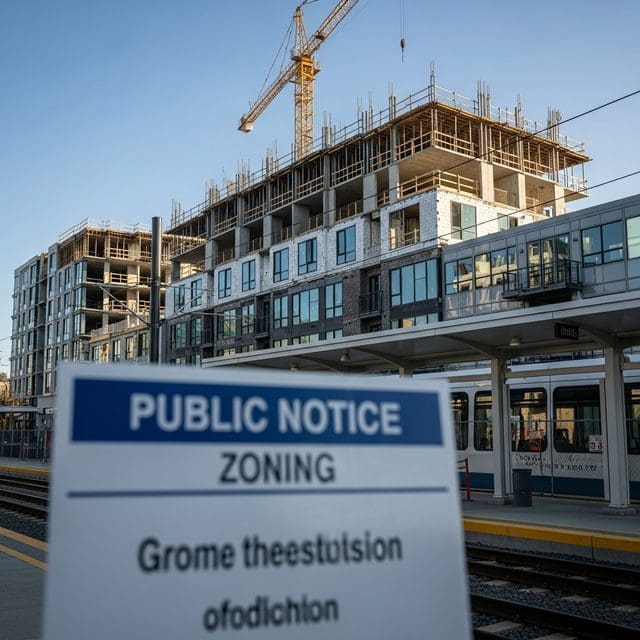
HUD prepares a bold service-oriented homelessness agenda as federal lawmakers weigh a $71.4 billion spending package for housing and transit infrastructure.
The Department of Housing and Urban Development (HUD) has signaled a significant shift in its approach to the nation’s homelessness crisis, announcing a “bold homelessness reform” agenda that will define its 2026 funding cycle. The agency intends to publish its 2026 Continuum of Care (CoC) funding notice by June 1, 2026, with awards expected to be finalized by December 1. This timeline provides local providers with a defined window to plan shelter and services budgets, but the mandate itself expands eligibility beyond traditional shelter to include a broad spectrum of supportive services, such as mental health care and job training.
This shift toward service-heavy intervention comes as the U.S. House of Representatives considers a $71.4 billion spending bill for fiscal year 2026. The proposed legislation would consolidate funding for HUD and transportation programs, forcing a delicate balancing act between rental assistance, emergency homelessness services, and long-term infrastructure projects. While the administration frames these changes as a holistic solution to housing instability, some advocacy groups remain wary. Concerns have surfaced throughout April and May 2026 that pending rule changes—including optional work requirements and shifts in eviction notification—could inadvertently increase family homelessness if finalized without added tenant protections.
On the infrastructure front, the Federal Transit Administration (FTA) is moving to tighten the link between mobility and housing. On May 11, the agency opened a $28.49 million funding opportunity for the Transit-Oriented Development (TOD) Planning program. However, the program features a restrictive eligibility clause: only existing FTA grantees as of the announcement date may apply. This limitation, combined with an unusually tight July 10 deadline, narrows the field of local governments able to leverage federal dollars to align new housing developments with transit corridors, effectively favoring established bureaucracies over emerging municipalities.
While federal agencies focus on service integration and transit-linked planning, some states are taking a more aggressive, market-driven approach to the housing shortage. Michigan lawmakers recently advanced a bipartisan zoning reform package designed to strip away bureaucratic hurdles that inflate the cost of living. The legislation would prohibit local governments from banning duplexes and accessory dwelling units (ADUs), while also rolling back minimum-size mandates and parking requirements that often stall development. These state-level reforms represent a growing skepticism of local protectionism, which has long used zoning as a tool to restrict supply. By curbing protest-driven permitting delays, Michigan is positioning itself as a model for how state sovereignty can be used to restore private property rights and lower the barrier to homeownership.
At the intersection of global policy and domestic costs, the broader economic landscape is also shifting. On April 17, 2026, oil prices dropped over 10% following announcements that the Strait of Hormuz remains open for transit, a development that may provide marginal relief to the transportation costs embedded in construction and commuting. Furthermore, the Export-Import Bank of the United States recently approved a $2.9 billion loan for critical mineral development, highlighting a federal focus on the raw materials necessary for the next generation of American infrastructure.
As HUD prepares to distribute billions in CoC awards by December, the tension between top-down service mandates and bottom-up market reforms will likely define the housing debate for the remainder of the year. For the American taxpayer, the question remains whether these multi-billion dollar reallocations will successfully move the needle on affordability or simply add layers of administrative complexity to the fundamental need for more roofs and reliable roads.

Deborah Cole serves as a Senior Correspondent for Just Right News, where she spearheads the network’s coverage of Housing, Infrastructure, and Mobility. With a career defined by a commitment to rigorous reporting and a focus on the fundamental pillars of American community life, Deborah brings a principled perspective to the complex issues that dictate how and where we live. Her work is grounded in the belief that sound policy, fiscal responsibility, and respect for private property are the essential foundations of a prosperous society.
Originally from Boston, Massachusetts, Deborah’s upbringing in one of the nation’s oldest and most historically significant cities deeply influenced her professional trajectory. Growing up amidst the architectural legacy and dense urban planning of New England, she developed an early appreciation for the importance of durable infrastructure and the role of local tradition in shaping neighborhoods. Her perspective is informed by the classic American values of her hometown—hard work, community cohesion, and a healthy skepticism of top-down bureaucratic mandates that often overlook the unique needs of individual citizens.
Today, Deborah operates from her base in Austin, Texas, a city that serves as a primary laboratory for her reporting. Austin’s rapid expansion and its status as a hub for innovation and migration provide her with a front-row seat to the most pressing challenges in modern infrastructure and housing. From the Lone Star State, she chronicles the tensions between rapid growth and the preservation of the American Dream, often highlighting how market-driven solutions and deregulation can address the housing shortages that plague many of the country’s metropolitan areas.
At Just Right News, Deborah is perhaps best known for her signature feature series, “Where We Live.” Through this platform, she explores the intersection of public policy and private life, moving beyond mere statistics to tell the stories of families, small business owners, and local developers. Her reporting frequently highlights the importance of mobility—not just in terms of transportation and transit, but as a vehicle for economic opportunity and social stability. She remains a staunch advocate for the taxpayer, consistently scrutinizing government spending on large-scale projects and advocating for transparency in how infrastructure dollars are allocated.
Deborah’s beat is more than just a collection of policy topics; it is an investigation into the physical and legal structures that allow families to flourish. Whether she is reporting on the impact of zoning laws on suburban development or the necessity of maintaining the nation’s highway systems, her work is characterized by a dedication to the facts and a respect for the constitutional principles that protect the rights of homeowners.
As a Senior Correspondent, Deborah Cole continues to be a vital voice for Just Right News, providing the audience with the clarity and context needed to navigate an ever-changing landscape. Her reporting ensures that the values of individual liberty and local sovereignty remain at the forefront of the national conversation regarding the future of our cities and towns. Through her tireless efforts, she remains committed to informing the public on the issues that hit closest to home.