

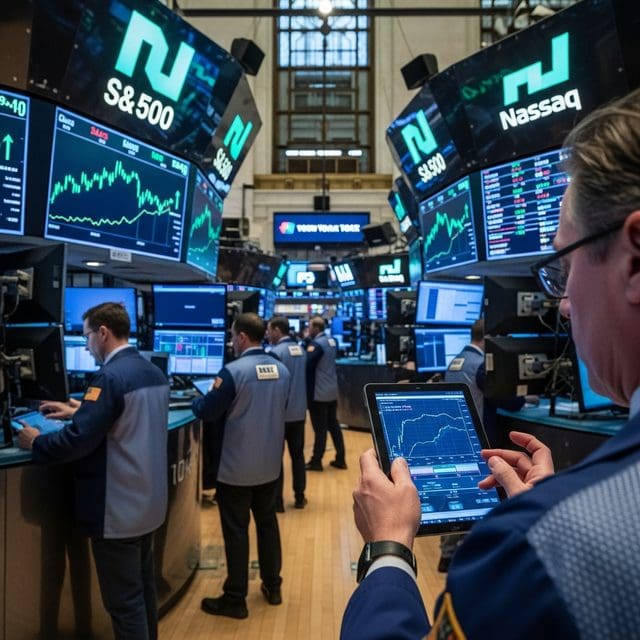
U.S. stock indexes reached fresh peaks as Dell’s AI-driven earnings fueled a tech rally, while markets monitored shifting diplomatic and military developments in the Middle East.
The American financial landscape continues to be defined by a stark divergence between a booming artificial intelligence sector and the broader economic realities facing Main Street. On Friday, the S&P 500 edged up 0.2% on the session, capping a historic ninth straight winning week. This persistence in equity markets comes as investors weigh the promise of technological advancement against a backdrop of persistent geopolitical friction and shifting monetary expectations. The S&P 500 closed at 7,580.06, marking its longest winning streak since 2023, while the Dow Jones Industrial Average climbed 363.49 points to finish at 51,032.46.
Technological leadership remains the primary engine of the current rally. Dell Technologies served as the catalyst for the latest leg up, surging 32.8% after reporting quarterly revenue of approximately $43.8 billion. The company’s performance was bolstered by $16.1 billion in AI-optimized server sales, reinforcing the narrative that institutional capital is heavily concentrated in hardware infrastructure. This concentration has pushed the Nasdaq composite to a 16.1% gain for the year. For the working household, this narrow leadership is a double-edged sword; while it drives the headline value of retirement accounts, it leaves the broader market vulnerable if tech leadership falters.
While mega-cap tech names flourish, the Russell 2000 index of smaller companies fell 17.23 points, or 0.6%, to 2,919.34 on Friday. This retreat highlights the pressure that higher long-term Treasury yields and cautious risk appetite place on smaller enterprises, which are often more sensitive to borrowing costs. Despite being up 17.6% for the year, the recent struggle of small caps suggests that the “Invisible Economy” of local businesses is not yet feeling the same exuberance seen on the floor of the New York Stock Exchange. The gap between the Nasdaq’s 2.4% weekly gain and the Russell 2000’s 1.7% rise illustrates a market rewarding scale over industrial breadth.
Geopolitical developments in the Middle East have introduced volatility to commodities and defense sectors. Fresh military clashes between U.S. and Iranian forces in the Strait of Hormuz occurred on May 28, marking the second skirmish in 48 hours. Despite these drones being fired at commercial shipping, diplomatic channels remain open. A 60-day memorandum of understanding has reached the agreement stage, though it currently awaits final edits from the Trump administration. Despite the regional tension, Brent crude prices fell 1.7% to end the week, as markets reacted to the potential for a stabilized diplomatic framework. The easing of oil prices toward the $90-per-barrel mark provides a slight reprieve for consumer energy costs.
In the corporate governance sphere, legal challenges continue to shadow several major players. Stellantis N.V. is currently subject to a class action securities fraud lawsuit concerning common stock purchases made between February 2025 and February 2026. Similarly, Gemini Space Station, Inc. faces its own securities litigation with a filing deadline of May 14, 2026. These cases serve as a vital check on corporate overreach, ensuring that the interests of the individual investor are protected. Meanwhile, the financial sector is seeing shifts in leadership, such as Elliott Investment Management’s 6% stake in Nippon Express Holdings and new executive appointments at Markel Insurance.
As the market enters June, the focus shifts to the sustainability of this tech-led advance. Nvidia is slated to debut its first Windows PCs powered by its own chips, marking a significant entry into the consumer processor market. While headline index numbers suggest prosperity, the narrowness of the rally and ongoing military tensions abroad require a disciplined approach to fiscal responsibility. For the American taxpayer, a stable monetary system remains the true benchmark of economic health, regardless of the daily fluctuations in the S&P 500.

Jordan Lee serves as the Senior Correspondent for Wall Street, Finance, and Monetary Systems at Just Right News. Based in the heart of the world’s financial capital, New York City, Lee brings a sharp, principled eye to the complex mechanisms that drive the global economy. His reporting is defined by a commitment to fiscal responsibility, the defense of the free market, and a deep-seated belief that a transparent monetary system is the bedrock of a free society.
Raised in Portland, Oregon, Lee’s perspective was forged in a city that has undergone significant cultural and economic shifts. His upbringing in the Pacific Northwest instilled in him a profound appreciation for the industriousness of small business owners and the importance of local economic stability. Watching the evolution of his hometown’s landscape sparked an early interest in how federal fiscal policy and large-scale financial trends eventually trickle down to the average citizen. This background provides him with a unique vantage point; he understands the growing disconnect between the policy-making elite and the reality of Main Street, a theme that frequently resonates throughout his work.
Now operating from his base in New York City, Lee bridges the gap between the high-stakes trading floors of Manhattan and the households of everyday Americans. He views the financial sector not merely as a collection of numbers and tickers, but as a vital engine of American prosperity that requires constant vigilance and accountability. His reporting often highlights the dangers of centralized financial control and the necessity of maintaining a system that rewards merit, risk-taking, and innovation.
As the creator and lead of the featured series, “The Invisible Economy,” Lee pulls back the curtain on the often-opaque world of monetary systems. He specializes in translating the dense jargon of central banking and international finance into actionable insights for the Just Right News audience. His work explores the “invisible” forces—such as inflationary pressures, regulatory creep, and the expansion of the administrative state—that erode the purchasing power of American families. By focusing on these systemic issues, Lee empowers readers to understand the hidden forces shaping their financial independence.
Lee’s journalistic philosophy is rooted in a steadfast commitment to traditional American values. As an Asian American professional who has navigated the competitive corridors of the financial world, he is a vocal advocate for meritocracy and the preservation of the American Dream. He believes that a stable currency and a predictable regulatory environment are essential for national sovereignty and individual liberty. His reporting frequently warns against the risks of government overreach in the private sector, arguing that the most effective solutions to economic challenges arise from competition and individual enterprise rather than bureaucratic mandates.
At Just Right News, Jordan Lee remains dedicated to providing a clear-eyed defense of the taxpayer. Whether he is analyzing market volatility or investigating the long-term implications of national debt, his mission is to provide the truth about where the money is going and what it means for the future of the country. Through his rigorous analysis and principled stance, Lee has become a trusted voice for those who value a strong, sovereign, and fiscally sound America.