

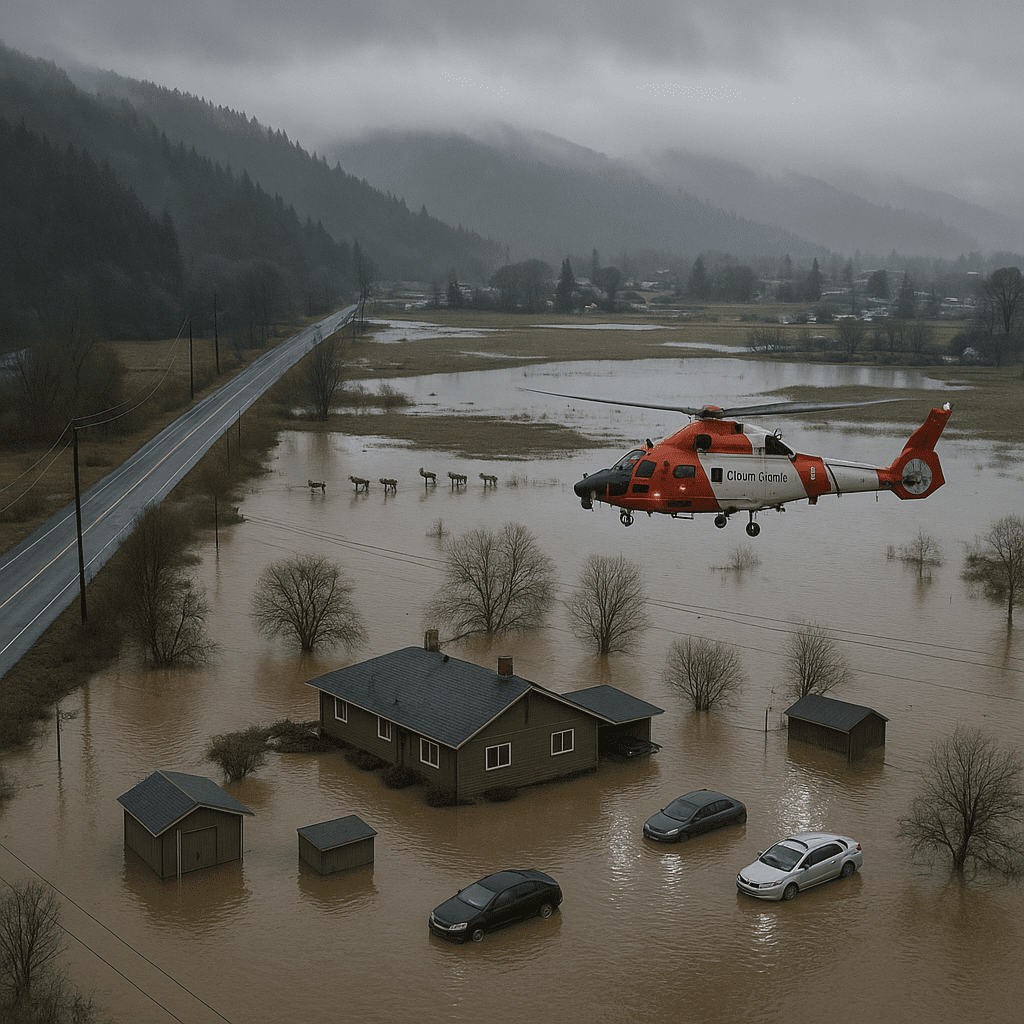
The Associated Press’s December 11 wrap embeds climate risk and resource economics inside a wide array of headlines. Washington floods, captured in dramatic rescue video and photography, exemplify the mounting infrastructure and insurance costs of extreme rainfall. Climate reporting on Alaska’s Ambler Access Road, New England’s closed shrimp fishery, and Gaza’s storm-drenched camps shows how land use, conflict, and weather volatility jointly shape long-term rebuilding bills. At the same time, Europe’s effort to lock up Russia’s frozen assets and Microsoft’s $17.5 billion AI infrastructure investment in India highlight how energy geopolitics and digital demand are being refracted through financial systems and grids. As AP moves into December 12 coverage, continued flooding, seismic events, and disease threats point to sustained scrutiny of resilience funding and regulatory oversight.
Across the Associated Press’s December 11 news agenda, energy, climate and resource economics sit just beneath the surface of seemingly disparate headlines. A Coast Guard helicopter rescuing residents from Washington floods, a winter storm drenching tent camps in Gaza, and European plans to lock up Russia’s frozen assets all reflect how climate shocks and resource power are reshaping risk, policy, and investment.
In the U.S. Pacific Northwest, Washington floods forced aerial rescues as a Coast Guard helicopter pulled residents from rising water. The AP’s companion photo coverage captures floodwaters surrounding a home, elk fording a field, and water on streets as heavy rains lash the region. Those images underscore the mounting infrastructure and insurance burden from extreme precipitation, which the AP climate desk frames as a “blend of unusual weather conditions” bringing trillions of gallons of persistent rain to the broader Northwest. While the article does not quantify the economic losses, the visual emphasis on inundated property and disrupted communities points to repeated repair and resilience costs now embedded in local budgets.
The AP Investigations and Climate sections extend that lens beyond Washington. Coverage of Alaska’s proposed Ambler Access Road focuses on “potential impacts” that regulators and investors are still parsing. The road is described within climate-focused reporting that also highlights New England’s shrimp fishery shutting down “for the long haul” after years of decline. Together, those stories tie land-use decisions and extractive infrastructure to long-term ecosystem productivity and regional employment. The AP material does not specify project valuations or job projections, but it makes clear that transportation corridors, fisheries and Indigenous land rights are now evaluated as intertwined elements of a changing resource economy.
Overseas, Europe’s resource politics appear in plans by the European Union to lock up Russia’s frozen assets so Hungary and Slovakia cannot veto their use for Ukraine. The AP video wrap notes that move among the day’s most-watched clips. Even without precise figures for the assets involved, the step signals how energy-related sanctions have migrated from pipeline flows and export bans into the financial system itself. The long-running Russia-Ukraine war, referenced repeatedly in the AP’s world menu, sits in the background as the conflict that triggered Europe’s scramble to rewire gas supplies and now to channel Russian funds into Ukraine’s reconstruction.
Climate-exposed conflict zones also appear in the Middle East coverage. One AP segment shows rain drenching tent camps in central Gaza as a winter storm sweeps across the “war-battered enclave.” The flooding of temporary shelters is presented as a humanitarian emergency, but it also illustrates how climate variability magnifies the costs of war-damaged infrastructure. Donor governments and aid agencies must finance both immediate relief and longer-term rebuilding of water, sanitation, and housing systems that can withstand more volatile weather.
In business and technology, investment in infrastructure for a digital, power-hungry economy is another through line. Microsoft’s decision to invest $17.5 billion in India for AI and cloud infrastructure stands out in the Tech section. The AP article does not break down how much of that sum will go toward electricity supply or data center cooling, but the scale of the commitment implies large future draws on India’s grid and water resources. At the same time, U.S. policymakers are wrestling with AI oversight, as AP notes that Trump signed an executive order aiming to block state AI regulations and separately drafted a proposal to curtail state-level rules. Those regulatory fights will help determine whether energy efficiency standards or emissions reporting become baseline requirements for the data infrastructure now being built.
Automotive stories in the Business section bring the resource economy closer to consumers. Ford is described as turning to stepped-up tech and cooperation with police to thwart F-150 pickup thieves. While this story focuses on crime prevention, it indirectly highlights the pickup as a high-value mobile stock of steel, electronics and fuel. The AP report does not address the shift toward electric versions of the F‑150 or their charging needs, but it underlines how security, insurance and law enforcement are adjusting to the value locked into individual vehicles.
Household-level exposures also surface in health and consumer coverage. U.S. ice cream makers say they will stop using artificial dyes by 2028, reflecting changing consumer expectations and regulatory signals around chemical additives. In the Be Well section, AP pairs this with reminders that “eating the wrong foods can keep you up at night” and that a tattoo removal will “hurt and…cost you,” framing a broader pattern where health, lifestyle and environmental exposures increasingly show up as out-of-pocket expenses.
Public health outbreaks receive similar treatment. AP notes that hundreds of people are quarantined in South Carolina as measles spreads in two U.S. outbreaks, and that a botulism outbreak has sickened more than 50 babies, expanding to all ByHeart products. These stories sit adjacent to climate and environment pieces, underscoring the newsroom’s view that biological, chemical and climatic risks are part of a shared resilience agenda. Quarantines, recalls and medical care all represent resource reallocations triggered by systemic vulnerabilities.
Even the lighter or unusual items carry resource subtexts. A raccoon going on a “drunken rampage” in a Virginia liquor store, a black bear taking up residence in a Southern California crawl space, and Israel euthanizing crocodiles after repeated escapes speak to animal behavior colliding with human settlements and infrastructure. The AP Science and Oddities sections do not explicitly link those events to habitat pressures or climate disruption, but they document the rising frequency of wildlife and built-environment collisions that can impose unexpected costs on property owners and public agencies.
As AP rolls from December 11 into “AP Top Stories December 12,” the next day’s headlines keep climate and resource economics close at hand: more Washington flood imagery and Japan issuing a tsunami advisory after a 6.7 magnitude quake in the northeast. Those updates suggest that in the days and weeks ahead, editors will keep threading extreme weather, infrastructure stress, sanctions and contagion into the recurring question of how societies finance resilience and manage shared resources under strain.

Mark Davis serves as the Senior Correspondent for Energy, Climate, and Resource Economics at Just Right News. In an era where the conversation around the environment is often dominated by alarmism and top-down mandates, Mark provides a vital, market-oriented perspective on the complex forces shaping our world. As the lead voice behind the acclaimed feature series “Power and the Planet,” he explores the intersection of environmental policy, global energy markets, and the fundamental economic principles that sustain modern civilization.
Mark’s pragmatic approach to resource management was forged in the high desert of his hometown, Albuquerque, New Mexico. Growing up in a region defined by both its breathtaking natural beauty and its rugged, resource-dependent landscape, he developed an early appreciation for the delicate balance between conservation and utilization. New Mexico’s unique position as a hub for both traditional energy production and cutting-edge scientific research provided Mark with a front-row seat to the evolution of the American energy sector. This upbringing instilled in him a deep-seated belief that true environmental stewardship is inseparable from economic prosperity and technological innovation.
Now based in Boulder, Colorado, Mark operates from the heart of the nation’s climate research community. While Boulder is often seen as a bastion of environmental idealism, Mark utilizes his post to provide a necessary counterweight, grounded in the realities of resource economics. He understands that energy policy does not exist in a vacuum; it has tangible consequences for the American taxpayer, the stability of the national power grid, and the strength of the domestic manufacturing sector. By reporting from the front lines of the climate debate, he is able to challenge prevailing narratives with hard data and a commitment to the principles of the free market.
Throughout his tenure at Just Right News, Mark has distinguished himself by focusing on the “Resource Economics” aspect of his beat. He frequently highlights the hidden costs of rapid energy transitions and advocates for an “all-of-the-above” energy strategy that prioritizes American energy independence. His work often shines a light on the geopolitical implications of resource scarcity, arguing that a secure nation must first be an energy-secure nation. Whether he is analyzing the impact of federal land-use regulations or investigating the supply chains required for new technologies, Mark remains focused on how policy decisions affect the lives and livelihoods of everyday citizens.
In “Power and the Planet,” Mark continues to bridge the gap between complex scientific concepts and the economic realities facing the country. He rejects the false choice between a healthy environment and a thriving economy, instead seeking out solutions that leverage American ingenuity and private-sector competition. For Mark, reporting on the climate is not about following the latest trends, but about ensuring that the conversation remains tethered to the foundational values of liberty, property rights, and fiscal responsibility. His contributions ensure that Just Right News readers receive a comprehensive, clear-eyed view of the challenges and opportunities defining the future of our planet.