

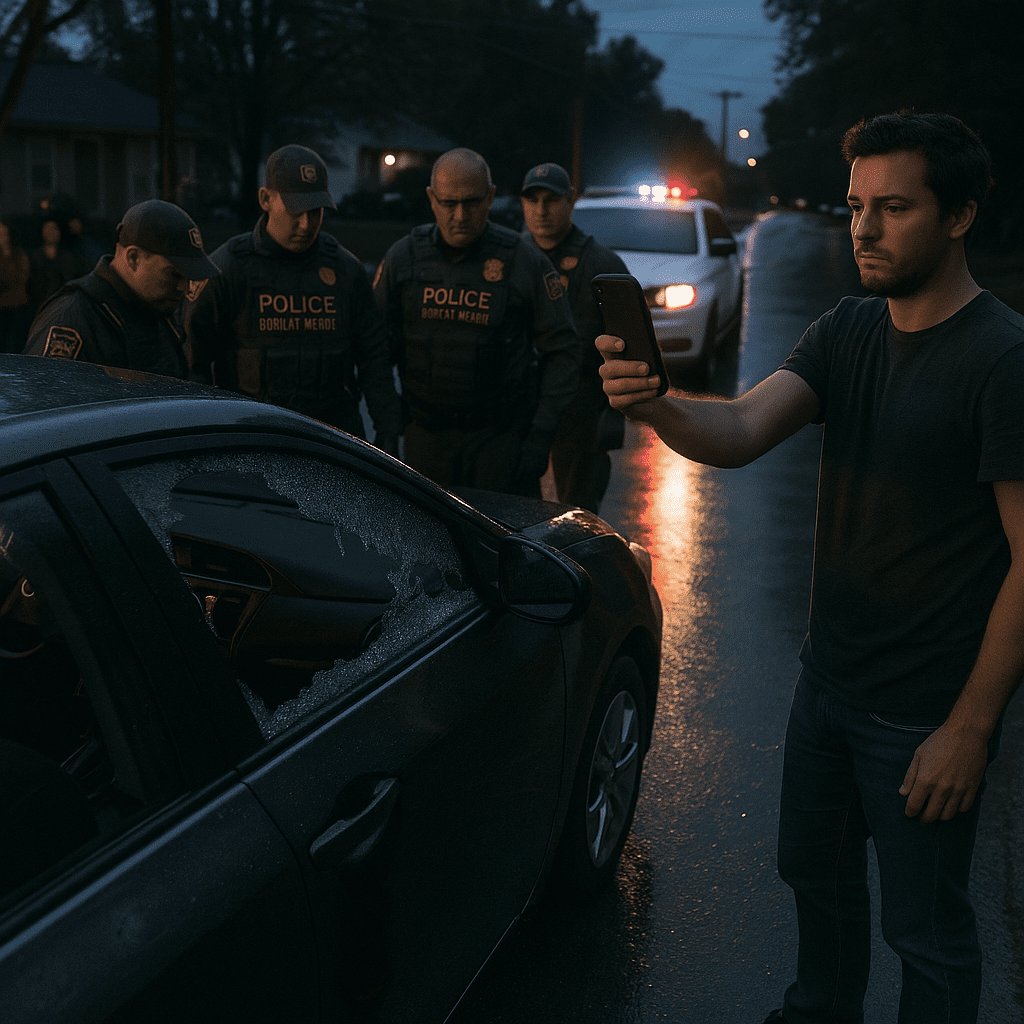
An AP‑published cellphone excerpt shows Border Patrol agents breaking a car window and forcing driver Willy Aceituno, a Honduran‑born U.S. citizen, from his vehicle during a Charlotte stop. The clip is the only contemporaneous record released and lacks metadata, agency statements and police reports. Reporting will obtain the original file and records, interview witnesses and experts, and assess whether oversight or policy review is warranted.
A cellphone video released by the Associated Press is the central piece of evidence in an incident that shows Border Patrol agents breaking a car window and forcing the driver from the vehicle during an immigration stop in Charlotte, North Carolina. The AP identified the driver as Willy Aceituno, a Honduran-born U.S. citizen who was stopped twice by Border Patrol agents in Charlotte. During the second encounter, the video shows agents smashing the window, removing Aceituno from the vehicle and throwing him to the ground.
The video clip anchors an investigative account because it is the only contemporaneous record of the second encounter included in the AP excerpt. Visual frame-by-frame analysis of the footage is necessary to establish sequence, timing and what commands or warnings, if any, are audible. At present the ingestion does not include metadata, chain-of-custody documentation or an agency explanation tied to that footage.
Public records and agency statements are central next steps for verification. Reporters must obtain the original file, verify its creation time and custodial history, and request body-camera or dash-camera footage from Border Patrol and any local law-enforcement units that responded. The excerpt does not include a statement from Border Patrol, and no local police report appears in the material provided. Those records are needed to confirm what led to the stops and whether use-of-force policies were followed.
Eyewitness accounts and interviews with Aceituno could clarify contested elements visible in the clip. The AP excerpt identifies Aceituno and notes he was stopped twice, but it does not contain his account of the events, witness statements or information about injuries. Interviews with neighbors, bystanders and any accompanying passengers would help reconstruct the moments immediately before and after agents broke the window.
Legal context is also missing from the excerpt and must be developed through document requests and expert comment. The ingestion does not set out what legal authority agents invoked during the stops or whether they identified themselves as immigration officers. Seeking legal analysis from civil-rights attorneys and law-enforcement policy experts will be necessary to examine whether the actions captured in the video align with federal use-of-force standards and constitutional protections during stops.
Placing the encounter in a larger pattern of enforcement requires records about operations in Charlotte. The AP excerpt appears amid coverage tied to immigration enforcement activity in the city and notes that protesters in Charlotte urged Home Depot to keep immigration officers off its property. That local response suggests community concern about immigration enforcement presence, but the excerpt does not provide broader data on the frequency or scope of Border Patrol operations in Charlotte.
Public oversight mechanisms and potential remedies depend on information not contained in the excerpt. Administrative reviews, internal agency inquiries or civil suits typically rest on agency reports, witness statements and medical records. The material provided does not show whether a formal complaint was filed, whether local police logged the encounter, or whether Border Patrol opened any internal review.
Investigative reporters and public records specialists will therefore need to assemble a package of documents and interviews before drawing conclusions. Key items to obtain include the original video file and metadata, any agency body- or vehicle-camera footage from Border Patrol and local police, the local police report if one exists, witness interviews, medical records relating to any injuries, and a statement from Customs and Border Protection or its Border Patrol component. Experts on use-of-force and civil-rights law should be asked to assess the conduct shown on the footage once records are produced.
The cellphone footage is currently the most direct record available within the provided excerpt. It raises immediate questions about how and why the encounter escalated, and it illustrates the role video evidence now plays in documenting enforcement encounters. Additional documentation and agency comment remain necessary to determine the legal and policy implications of the actions seen on camera.
Reporting is ongoing. Public records requests and inquiries to relevant agencies are needed to verify the footage’s chain of custody, to obtain official accounts or reports and to secure expert assessments. Any records releases, agency responses or oversight actions will be followed and reported as they become available.
Ben Taylor serves as the Senior Correspondent and Investigations Lead for Just Right News, where he anchors the network’s commitment to government transparency and institutional accountability. With a career defined by a relentless pursuit of the facts, Taylor spearheads the acclaimed feature series “The Paper Trail,” a deep-dive investigative column that prioritizes primary source documentation over political rhetoric. Based in the heart of the nation’s capital, he has earned a reputation as one of the most formidable investigative journalists in Washington, D.C., known specifically for his mastery of public records and the Freedom of Information Act.
Taylor’s approach to journalism is deeply rooted in his upbringing in Kansas City, Missouri. Growing up in the “Show Me State,” he developed a healthy skepticism of centralized power and a profound respect for the common-sense values of the American heartland. This Midwestern foundation informs his reporting today, as he bridges the gap between the complex machinations of federal bureaucracy and the everyday concerns of citizens across the country. For Taylor, investigative reporting is not about chasing headlines; it is about ensuring that the government remains answerable to the people it serves.
As an African American man working within the conservative media landscape, Taylor brings a principled perspective to his beat. He views the Constitution and the right to information as the ultimate equalizers in a free society. His work often highlights how bureaucratic overreach and lack of transparency disproportionately affect individual liberties. By focusing on the “paper trail,” Taylor strips away the spin of partisan talking points, instead providing Just Right News readers with the raw data and internal communications that reveal how their tax dollars are spent and how policy decisions are actually made.
In his role as Investigations Lead, Taylor oversees a team dedicated to uncovering the stories that mainstream outlets often overlook. Whether he is auditing federal spending, investigating regulatory overreach, or exposing inefficiencies within the administrative state, his methodology remains consistent: follow the evidence wherever it leads. His presence in Washington, D.C., allows him to maintain a constant watch over the halls of power, yet he remains steadfastly connected to his roots, ensuring his reporting reflects the clarity and directness of his Missouri home.
Throughout his tenure at Just Right News, Taylor has become a vital voice for those who demand integrity in public office. He believes that a well-informed electorate is the strongest defense against government overreach, and he has dedicated his career to providing the public with the tools they need to hold their leaders accountable. Through “The Paper Trail” and his broader investigative work, Ben Taylor continues to set the standard for rigorous, document-driven journalism that champions the values of transparency, individual responsibility, and the rule of law.