

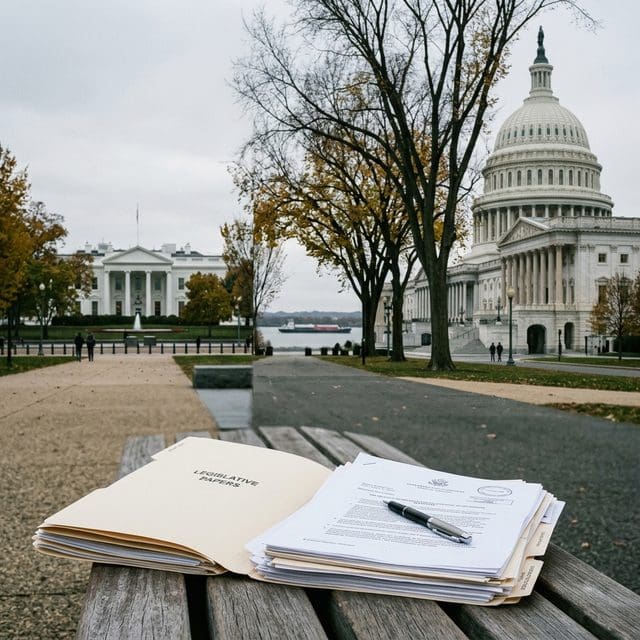
An open-ended waiver leaves a bipartisan sanctions law on the books but gives the White House control over when its main penalties take effect.
President Donald Trump’s order suspending enforcement of key provisions of the Lindsey O. Graham Sanctioning Russia and Iran Act of 2026 has set up a test of how much practical force Congress’s sanctions legislation retains when the president invokes national interest to delay it.
Trump signed the order on October 16, two days before the law’s October 18 implementation deadline. The act, signed by Trump on September 18 after passing both chambers with broad bipartisan support, authorized sanctions on Russian officials, banks and a “shadow fleet” of tankers. It also allowed tariffs of up to 100 percent on goods from the five largest importers of Russian oil or natural gas.
The order does not repeal the law. Bloomberg reported that it formally imposes the measures while suspending their enforcement, leaving the administration able to activate them later without seeking new legislation. Deutsche Welle reported that the waiver has no set expiration date; it remains in effect until Trump or senior officials decide “further action is appropriate.” In practical terms, Congress enacted a sanctions framework, but the White House has wide discretion over when its central penalties will be applied.
That discretion comes with a reporting obligation. The law requires an unclassified report explaining the national-interest determination behind the waiver, according to RFE/RL and The New York Times. The order itself did not explain why suspending enforcement served U.S. interests. The report may clarify the administration’s reasoning, but it does not, by itself, resolve the broader dispute over how much room Congress intended to leave the executive branch.
The immediate rationale is energy. Trump’s action followed an announced arrangement with Russian President Vladimir Putin to release 4.8 million metric tons of Russian diesel onto global markets—roughly ten days of U.S. domestic demand, CNBC reported. Energy experts said the volume was unlikely to make much short-term difference to prices. Diesel prices had climbed nearly 70 percent since the Iran war began, and the waiver came less than three weeks before the November 3 midterms, NBC News reported.
The political and foreign-policy consequences are already visible. Democratic Sen. Richard Blumenthal, who helped draft the law, accused Trump of issuing waivers to accommodate Putin rather than protect national security. Rep. Don Bacon, a Republican, said the decision was “prolonging the war, not ending it.” Five Republican lawmakers also joined Democrats in urging the administration not to reopen Russian energy transactions. Putin’s envoy Kirill Dmitriev, by contrast, called the suspension an “important and truly historic moment,” according to Agence France-Presse.
The order lands as Republicans confront a difficult election outlook. Reuters reported that Trump has questioned campaign spending, redistricting strategy and candidate choices, including the work of MAGA Inc., the Trump-aligned super PAC. Public records cited in the report put the group’s spending at about $200 million. Democrats were projected to win the House, while control of the Senate remained too close to call. A Democratic House could use subpoena power and oversight to challenge the administration’s actions, while making Trump’s legislative agenda harder to advance.
There is no nationwide election today. The general election is November 3, with early voting underway in some states, including Virginia. That calendar makes the waiver politically consequential, but it does not settle its legal or policy merits. The administration’s explanation to Congress will be a key document: it should show how the president’s claimed national interest fits with a law passed by both chambers and signed by the president himself.

Miles Harrington serves as the Senior Correspondent for Federal Systems & Executive Power at Just Right News, where he brings a disciplined, constitutionalist lens to the inner workings of the American government. With a focus on the mechanics of the federal bureaucracy and the limits of executive authority, Harrington has established himself as a vital voice for readers who value transparency, accountability, and the preservation of the separation of powers.
A native of Richmond, Virginia, Harrington’s perspective is deeply rooted in the traditions of the Old Dominion. Growing up in a city defined by its historical significance and its role as a center of American jurisprudence, he developed an early appreciation for the foundational principles of the Republic. His upbringing in Richmond—a place where the legacy of the Founding Fathers is woven into the landscape—instilled in him a belief that the federal government should remain within its constitutional bounds. This background informs his skepticism of centralized overreach and his commitment to reporting on the ways in which the administrative state impacts the lives of everyday citizens.
In his current role, Harrington specializes in the complexities of federal systems. He doesn’t just report on the headlines of the day; he digs into the structural shifts within the executive branch that often go unnoticed by the mainstream press. Whether he is analyzing the implications of a new federal regulation or investigating the expansion of agency jurisdiction, his work is characterized by a rigorous adherence to the facts and a dedication to the rule of law.
Harrington is perhaps best known for his signature feature series, “How Washington Works.” Through this ongoing project, he demystifies the often-opaque processes of the nation’s capital, pulling back the curtain on the “Deep State” and the unelected officials who wield significant influence over national policy. By breaking down complex legislative maneuvers and executive orders, he empowers Just Right News readers to understand the true levers of power in Washington. His reporting serves as a necessary check on the federal government, ensuring that the actions of those in power are held up to the light of public scrutiny.
Now based in Washington, D.C., Harrington operates at the epicenter of the political world, yet he remains intentionally distanced from the “Beltway bubble.” His proximity to the halls of power allows him to maintain a robust network of sources across the federal landscape, but his heart remains in the principled conservatism of his Virginia roots. He views his role not merely as a reporter, but as a steward of the public trust, dedicated to providing the clarity and context that conservative voters need to navigate an increasingly complex political environment.
Through his sharp analysis and unwavering commitment to the truth, Miles Harrington continues to be a cornerstone of the Just Right News team. His work ensures that the principles of limited government and executive restraint remain at the forefront of the national conversation, providing a crucial service to those who believe in a government that is truly of, by, and for the people.