

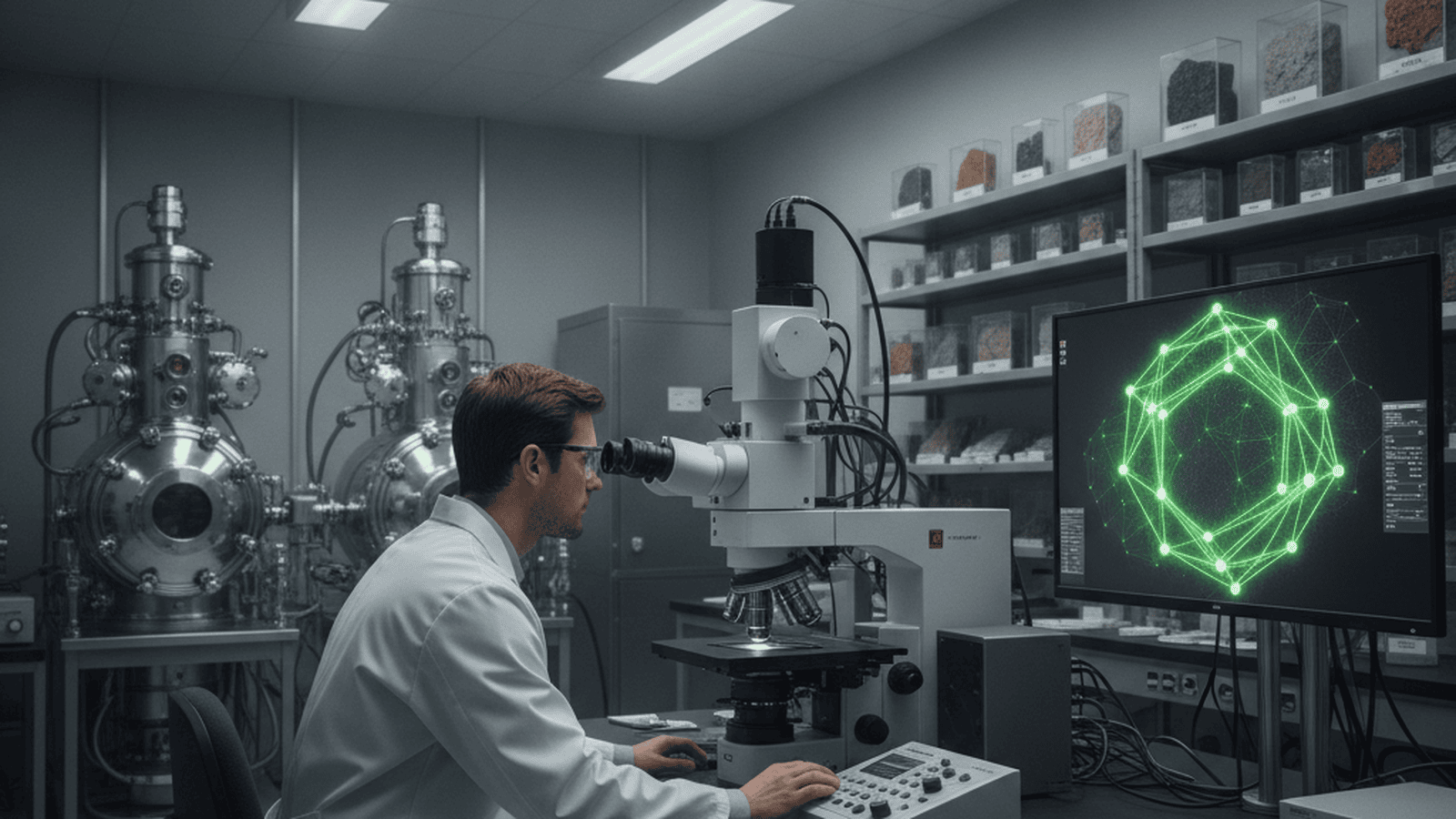
Researchers have discovered large crystals of lonsdaleite, a rare hexagonal diamond, within ureilite meteorites recovered from desert field sites. This discovery reveals a natural process for creating materials harder than conventional diamonds, offering a new pathway for industrial synthesis.
TLDR: A study of ureilite meteorites has identified the largest lonsdaleite crystals ever found, proving this hexagonal diamond is significantly harder than cubic varieties. Formed during ancient planetary collisions, the mineral’s unique structure provides a template for manufacturing ultra-hard materials for drilling and high-precision industrial tools.
The quest for materials harder than conventional diamonds has long occupied the intersection of mineralogy and industrial engineering. A significant breakthrough occurred when a team of researchers, led by Monash University in Australia, discovered unusually large crystals of lonsdaleite in rare ureilite meteorites. Lonsdaleite, also known as hexagonal diamond, possesses a unique atomic structure that theoretically makes it 58 percent harder than the cubic diamonds typically found on Earth. This discovery, facilitated by the recovery of meteorite samples from remote desert field sites, provides a blueprint for synthesizing ultra-hard materials for industrial use.
Ureilite meteorites are a peculiar class of stony meteorites that likely originated from the mantle of a shattered dwarf planet. The samples used in this study were recovered from various desert regions during field expeditions, where the arid climate preserves the delicate mineralogical signatures of the early solar system. Within these rocks, scientists identified lonsdaleite crystals that formed through a process known as chemical vapor deposition, triggered by a massive cosmic collision. This natural synthesis occurred at high temperatures and moderate pressures, a finding that surprised the scientific community which previously assumed extreme pressure was the primary driver for such transformations.
The research team utilized advanced transmission electron microscopy (TEM) to map the orientation of the carbon atoms within the meteorite fragments. This high-resolution imaging allowed them to see the hexagonal lattice in unprecedented detail. They observed that the lonsdaleite had replaced pre-existing graphite shapes, perfectly preserving the original structure while transforming the material into a hexagonal lattice. This pseudomorphic replacement suggests that the transition happened rapidly during the cooling phase following a catastrophic impact. The team used a combination of bright-field and dark-field imaging to visualize the twin boundaries within the crystals, which contribute to the material’s overall structural integrity and resistance to fracture.
The implications for materials science are profound. Conventional diamonds are valued for their hardness, but their cubic structure has limitations in high-stress industrial applications like deep-crust drilling or precision cutting. If engineers can replicate the natural process observed in the ureilite meteorites, they could mass-produce lonsdaleite for use in manufacturing. Current synthetic diamond production relies on high-pressure high-temperature (HPHT) methods that are energy-intensive and often produce smaller crystals. However, the discovery of a chemical vapor deposition-like process in nature suggests that more efficient, lower-pressure methods could be developed to grow larger, more durable hexagonal diamonds.
Beyond industrial applications, the study of lonsdaleite offers insights into the violent history of the inner solar system. The specific ureilite meteorites analyzed in this study provide a window into the destruction of a planetesimal that existed over four billion years ago. By examining the shock-induced minerals within these fragments, researchers can reconstruct the velocity and angle of the impacts that shaped the early planetary environment. This work bridges the gap between planetary geology and the development of next-generation super-materials, showing how cosmic events can provide the recipe for future technology.
Future research will focus on refining the laboratory synthesis of hexagonal diamonds based on the recipe found in the meteorites. Scientists are currently experimenting with different carbon sources and catalysts to lower the energy requirements for the transformation. As these techniques mature, lonsdaleite may transition from a rare cosmic curiosity to a cornerstone of modern industrial technology. The ongoing analysis of meteorite samples from field expeditions continues to be a primary driver of innovation in high-pressure physics and planetary science, proving that the secrets to the hardest materials on Earth may actually come from the stars.

Mason Reed serves as a Staff Writer for Just Right News, where he spearheads the Future Frontiers & Special Projects desk. In an era defined by rapid technological shifts and evolving social landscapes, Mason provides a steady, principled voice, examining the innovations of tomorrow through the lens of traditional American values. His work is most prominently featured in his signature series, “The Next Horizon,” where he explores the intersection of emerging technology, national sovereignty, and the preservation of individual liberty.
A native of San Diego, California, Mason’s worldview was shaped by the unique culture of his hometown. Growing up in a region defined by its strong military presence and its history of maritime industry, he developed a deep-seated respect for the institutions that provide national stability and the entrepreneurial spirit that drives the American economy. This upbringing instilled in him a belief that true progress is not found in discarding the past, but in building upon a foundation of proven principles. His reporting often reflects this San Diego influence, emphasizing the importance of a robust national defense and the necessity of maintaining a competitive edge in the global marketplace.
Now based in San Francisco, Mason operates from the heart of the world’s technological engine. Living and working in the Bay Area provides him with a front-row seat to the advancements—and the ideological challenges—emanating from Silicon Valley. While many in the region embrace a “move fast and break things” mentality, Mason’s reporting serves as a vital counterweight. He offers Just Right News readers a “boots on the ground” perspective, documenting how radical local policies and the concentration of tech power impact the everyday lives of citizens. His proximity to the industry allows him to cut through the marketing jargon of big tech to uncover the real-world implications for privacy, free speech, and the nuclear family.
In his “Future Frontiers” beat, Mason tackles complex subjects ranging from the ethics of artificial intelligence to the burgeoning private space race. He approaches these topics with a healthy skepticism toward centralized bureaucracy, championing instead the decentralized innovations that empower individuals. Through “The Next Horizon,” he highlights the pioneers and thinkers who are working to ensure that the future remains a place where human dignity and constitutional rights are protected. He believes that the rapid pace of change requires more than just technical expertise; it requires a moral compass rooted in the Western tradition.
Throughout his tenure at Just Right News, Mason has remained committed to the idea that the future is something to be shaped, not merely accepted. His writing is characterized by a rigorous defense of American exceptionalism and a belief that the country’s best days lie ahead, provided it remains true to its founding ideals. Whether he is investigating the impact of automation on the American workforce or profiling the next generation of aerospace engineers, Mason Reed ensures that his readers are equipped with the insights they need to navigate a changing world with confidence and clarity.