

The Senate confirmed Todd Blanche as Attorney General in a 50-49 vote and passed a stopgap spending bill to avert a pre-election government shutdown.
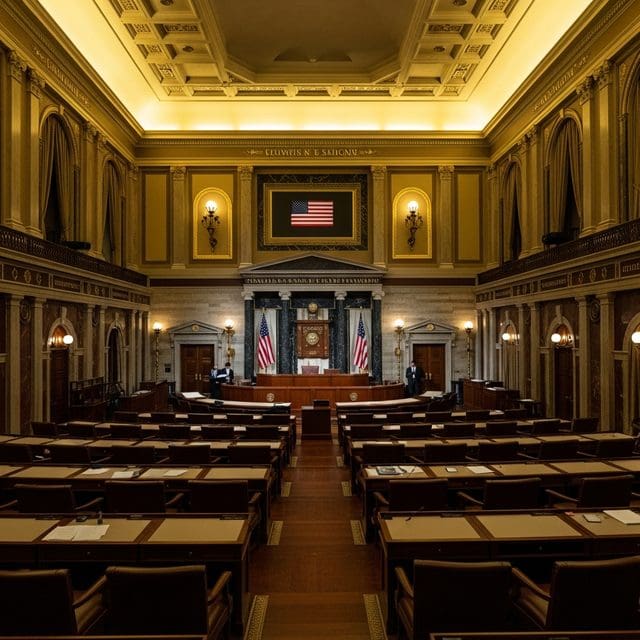
In a marathon overnight session that concluded at 4:17 a.m. on August 8, the United States Senate narrowly confirmed Todd Blanche as the nation’s Attorney General. The 50–49 vote followed weeks of internal Republican friction regarding Blanche’s independence, given his history as former President Trump’s personal defense counsel and his handling of sensitive Jeffrey Epstein-related documents. The confirmation was secured only after the White House made a significant concession, abandoning a proposed $1.8 billion Department of Justice “anti-weaponization” or compensation fund that critics argued could be used to benefit January 6 defendants. This move was essential to secure the support of Senator Bill Cassidy, who had withheld his vote until the fund was officially rescinded.
The vote highlighted deep fissures within the Republican conference. While Cassidy provided the decisive “yes” vote following the removal of the compensation fund, Senators Susan Collins and Lisa Murkowski crossed party lines to join all Democrats in opposition. Murkowski stated that the Department of Justice requires a leader capable of checking the “worst impulses” of the executive branch, reflecting a principled skepticism toward Blanche’s ability to maintain institutional distance from the Oval Office. Senator Mitch McConnell was recorded as not voting in the roll call, which was officially designated as Senate Roll Call Vote No. 230 of the 119th Congress, occurring just before the chamber adjourned for the August recess.
Simultaneously, the Senate moved to stabilize the federal bureaucracy by passing a short-term continuing resolution to fund the government through December 11, 2026. The 90–6 vote occurred nearly two months before the September 30 fiscal deadline, a strategic maneuver by Senate leadership to prevent a government shutdown from overshadowing the 2026 midterm elections. This stopgap measure maintains current spending levels but includes specific provisions that limit the executive branch’s ability to reprogram funds toward border security, a move seen as a check on executive discretion over the power of the purse. By punting the broader budget resolution and the SAVE America Act to mid-September, leadership effectively front-loaded stability while delaying the most volatile legislative clashes.
Of particular interest to those monitoring the administrative state, the funding bill includes a temporary block on a new rule that would have granted political appointees greater control over hundreds of billions in federal grants. While the bill provides negotiated adjustments for food and housing assistance—wins highlighted by Democratic leadership—it notably restricts the administration’s ability to shift funds between accounts without explicit legislative consent. This tactical delay ensures that the most volatile policy fights are reserved for the final weeks before the election, though it leaves several major policy initiatives, including a failed voter-ID measure, in a state of legislative limbo until the Senate returns on September 14.
Outside the halls of Congress, the executive branch faced a significant legal setback regarding the physical expansion of the White House. The D.C. Circuit Court of Appeals issued a 2–1 ruling on August 7 halting above-ground construction on a planned East Wing ballroom. The court held that such a project requires explicit congressional authorization, reinforcing the constitutional principle that the President cannot unilaterally reconfigure federal property without legislative buy-in. With reinforced concrete already poured and towering walls nearing their planned height, the ruling freezes the $400 million project for at least two weeks. The administration has vowed an immediate appeal to the Supreme Court, turning a construction project into a live separation-of-powers dispute.
This legislative and judicial sequence represents a calculated effort by the Senate to assert its role as a co-equal branch of government. By locking in the Attorney General and securing funding through the end of the year, leadership has cleared the deck for the political battles of the autumn. However, the narrow margin of Blanche’s confirmation and the ongoing litigation over White House construction suggest that the tension between executive ambition and legislative oversight remains the defining characteristic of the current constitutional landscape. As the Senate departs for its August recess, the focus shifts from the floor of the chamber to the high court and the campaign trail.

Miles Harrington serves as the Senior Correspondent for Federal Systems & Executive Power at Just Right News, where he brings a disciplined, constitutionalist lens to the inner workings of the American government. With a focus on the mechanics of the federal bureaucracy and the limits of executive authority, Harrington has established himself as a vital voice for readers who value transparency, accountability, and the preservation of the separation of powers.
A native of Richmond, Virginia, Harrington’s perspective is deeply rooted in the traditions of the Old Dominion. Growing up in a city defined by its historical significance and its role as a center of American jurisprudence, he developed an early appreciation for the foundational principles of the Republic. His upbringing in Richmond—a place where the legacy of the Founding Fathers is woven into the landscape—instilled in him a belief that the federal government should remain within its constitutional bounds. This background informs his skepticism of centralized overreach and his commitment to reporting on the ways in which the administrative state impacts the lives of everyday citizens.
In his current role, Harrington specializes in the complexities of federal systems. He doesn’t just report on the headlines of the day; he digs into the structural shifts within the executive branch that often go unnoticed by the mainstream press. Whether he is analyzing the implications of a new federal regulation or investigating the expansion of agency jurisdiction, his work is characterized by a rigorous adherence to the facts and a dedication to the rule of law.
Harrington is perhaps best known for his signature feature series, “How Washington Works.” Through this ongoing project, he demystifies the often-opaque processes of the nation’s capital, pulling back the curtain on the “Deep State” and the unelected officials who wield significant influence over national policy. By breaking down complex legislative maneuvers and executive orders, he empowers Just Right News readers to understand the true levers of power in Washington. His reporting serves as a necessary check on the federal government, ensuring that the actions of those in power are held up to the light of public scrutiny.
Now based in Washington, D.C., Harrington operates at the epicenter of the political world, yet he remains intentionally distanced from the “Beltway bubble.” His proximity to the halls of power allows him to maintain a robust network of sources across the federal landscape, but his heart remains in the principled conservatism of his Virginia roots. He views his role not merely as a reporter, but as a steward of the public trust, dedicated to providing the clarity and context that conservative voters need to navigate an increasingly complex political environment.
Through his sharp analysis and unwavering commitment to the truth, Miles Harrington continues to be a cornerstone of the Just Right News team. His work ensures that the principles of limited government and executive restraint remain at the forefront of the national conversation, providing a crucial service to those who believe in a government that is truly of, by, and for the people.