

Tehran denies new negotiations with Washington over the Strait of Hormuz, opting for Omani cooperation while Ukraine’s maritime strikes expose Iranian supply line vulnerabilities.
The geopolitical deadlock in the Persian Gulf intensified Monday as Tehran publicly dismissed claims by the Trump administration regarding the resumption of bilateral talks. Despite White House assertions that new negotiations to reopen the Strait of Hormuz would begin this week, Iranian officials confirmed they are instead pursuing a “safe maritime corridor” in coordination with Oman. This move signals a strategic shift toward regional bilateralism that pointedly excludes U.S. oversight and challenges the American role as the primary guarantor of maritime security in the Middle East.
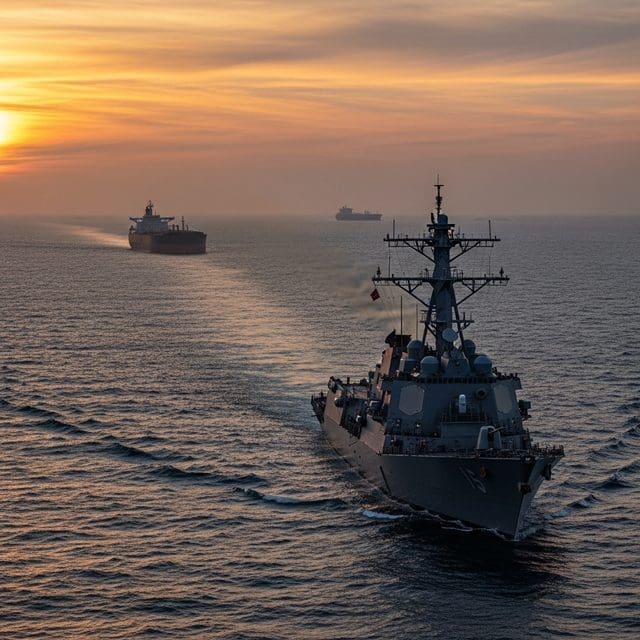
Iran’s current posture treats the Strait of Hormuz as a regulated zone rather than an international waterway. Under the new Iranian framework, general traffic remains effectively halted. Passage is restricted to specific routes coordinated with the Islamic Revolutionary Guard Corps (IRGC) Navy, contingent on the payment of fees and the cessation of what Tehran terms U.S. “hostile actions.” This direct challenge to the principle of freedom of navigation has forced the Pentagon to maintain a high-alert status, continuing strikes against Iranian targets to enforce a standing naval blockade. The U.S. narrative continues to assert that the strait must remain open and tied to the lifting of the blockade, with Washington insisting on public guarantees of open lanes with no tolls.
Adding a new dimension to the conflict, Ukraine has demonstrated an unexpected strategic reach into the Middle Eastern theater. A recent Ukrainian strike on an Iranian vessel has exposed significant vulnerabilities in Tehran’s maritime supply lines. For the Pentagon and NATO allies, the strike suggests that Iran’s ability to reroute energy and cargo to bypass contested waters is no longer guaranteed. This development complicates Iran’s leverage, even as it targets Western interests, including reported strikes on AWS data center infrastructure in the Gulf. These attacks on digital hubs highlight a shift in modern warfare where infrastructure becomes a kinetic target, impacting global investment and the security of Western tech assets in the region.
Beijing has maintained a calculated neutrality, urging for a cessation of military operations while positioning itself as a guarantor of energy stability. By avoiding direct alignment with the U.S.-led blockade, China is creating a diplomatic opening to deepen ties with Gulf energy producers who are increasingly wary of the prolonged maritime confrontation. This realist positioning allows China to present itself as a mediator in a conflict where Western influence is being tested by both military friction and economic tariffs. While the U.S. imposes new tariffs that make China harder to replace in global supply chains, Beijing is leveraging the Hormuz crisis to present an alternative to the Western security umbrella.
Domestically, the administration faces internal pressure as it manages these foreign entanglements. President Trump has threatened to keep Todd Blanche as acting Attorney General to push through an ‘Anti-Weaponization Fund’ if Senate Republicans refuse to back the nomination. This domestic friction occurs as the military is reportedly asking for ‘creative and unconventional’ ideas to punish Iran. The administration is also balancing its Middle East strategy with symbolic victories, such as the August 1 reaffirmation of U.S. recognition of Moroccan sovereignty over Western Sahara to solidify regional alliances against Iranian influence.
For American interests, the stakes extend beyond the immediate flow of oil. The administration’s insistence on an open strait without tolls remains a non-negotiable red line. However, with Iran demanding adherence to a 14-point memorandum and U.S. recognition of its traffic rules, the path to de-escalation remains blocked. As the U.S. military seeks unconventional methods to pressure Tehran, the regional architecture is shifting toward a fragmented maritime reality. The conflict is no longer just about energy; it is a contest over the rules of the sea and the ability of the United States to project power in an increasingly multipolar world.

Olivia Kendall serves as the Senior Correspondent for Geopolitics, Defense, and Foreign Policy at Just Right News, where she provides a principled, conservative perspective on the complex forces shaping the global stage. With a career dedicated to deconstructing the intricacies of international relations, Kendall has become a trusted voice for readers who value national sovereignty, a robust military, and a foreign policy that prioritizes American interests above all else.
A native of Washington, D.C., Kendall’s professional journey is deeply rooted in her upbringing within the nation’s capital. Growing up in the epicenter of American political life, she developed an early and profound understanding of how policy is crafted and, more importantly, how it often fails to account for the values of the American heartland. This unique vantage point allowed her to witness firsthand the rise of globalist bureaucracies, fueling her commitment to reporting that champions the constitutional foundations of the United States. Her background as a British White American further informs her worldview, providing her with a keen appreciation for the Western tradition and the enduring importance of the “Special Relationship” in maintaining global stability.
Now based in Arlington, Virginia, Kendall operates from the doorstep of the Pentagon and the heart of the nation’s defense establishment. Her proximity to the decision-makers in the military and intelligence communities allows her to provide boots-on-the-ground reporting that is both timely and deeply informed. For Kendall, Arlington is more than just a base of operations; it is a daily reminder of the sacrifices made by the men and women in uniform. This connection to the defense community drives her rigorous coverage of military readiness and her advocacy for a “peace through strength” approach to diplomacy.
At Just Right News, Kendall is perhaps best known for her acclaimed feature series, “The World’s Shadow on America.” In this ongoing project, she explores the direct correlation between international developments and the daily lives of American citizens. Whether she is analyzing the encroachment of foreign adversaries in domestic supply chains or the impact of international treaties on local economies, Kendall’s work serves as a vital bridge between distant geopolitical shifts and their consequences at home. She rejects the notion that foreign policy is an abstract concern for elites, instead proving that what happens in the corridors of power in Brussels or Beijing has a tangible “shadow” that falls across every American doorstep.
Throughout her tenure, Kendall has remained a steadfast critic of international overreach and a vocal proponent of a clear-eyed, realistic foreign policy. She brings a sharp analytical mind to her beat, often challenging the prevailing narratives of the mainstream media to uncover the underlying truths that affect national security. Her reporting is characterized by a refusal to compromise on the truth and a dedication to the idea that a strong, secure America is the world’s best hope for liberty. As a Senior Correspondent, Olivia Kendall continues to lead the charge in providing the essential context and conservative insight necessary to navigate an increasingly volatile world.