

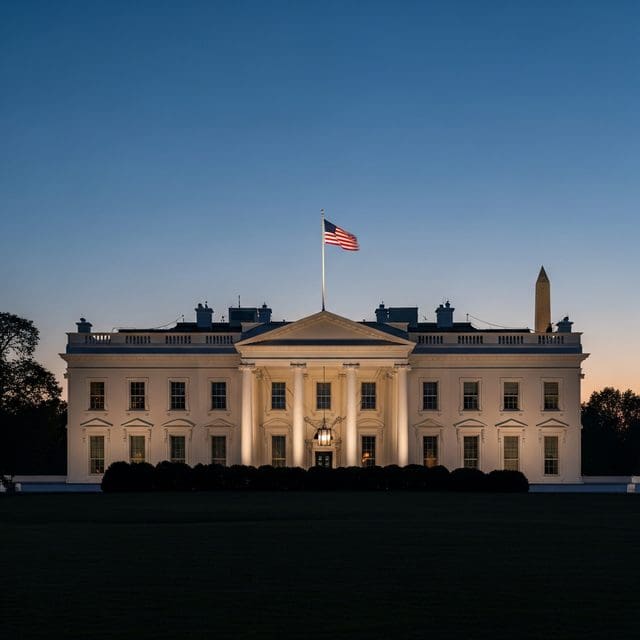
President Trump canceled planned military strikes against Iran to pursue diplomatic talks, while Attorney General nominee Todd Blanche rescinded a $1.8 billion fund ahead of his Senate confirmation hearing.
President Donald Trump ordered the cancellation of planned U.S. military strikes against Iran on August 2, 2026, signaling a sudden shift toward diplomatic engagement. The President cited the emergence of a deal outline as the primary reason for the reversal, stating he is not looking to cause significant loss of life if a negotiated settlement is possible. The administration’s immediate objectives focus on securing the Strait of Hormuz—a critical artery for global oil flows—and addressing Iran’s nuclear capabilities. Formal negotiations are scheduled to begin on Monday, August 3, though the White House has declined to set a firm deadline for a final agreement. This pause in military action directly affects U.S. posture in the Gulf, though the President warned that the suspension of strikes is contingent upon continued progress toward a broader regional deal.
While the White House shifts its posture abroad, it faces significant domestic headwinds and historic polling lows. Recent data indicates the President’s approval rating has dipped to approximately one-third of the American public, a depth rarely seen for a second-term incumbent at this stage. Despite these figures, the administration has indicated it will not alter its current policy trajectory or messaging strategy. This lack of popular leverage may complicate the administration’s standing with Congress, as members in competitive districts weigh the political risks of aligning with the executive branch on upcoming budget fights and oversight investigations.
In a move clearly intended to ease Senate tensions, Todd Blanche, the nominee for Attorney General, formally rescinded a $1.8 billion “anti-weaponization fund” ahead of his confirmation hearing. The fund, which critics and some lawmakers labeled a “slush fund,” was originally established to counter what the President described as the weaponization of the federal government against his allies. Senator John Kennedy (R-LA) signaled the constitutional concerns shared by many in the GOP, stating that legislation regarding such funds must not provide a “blank check” to the executive branch. The rescission changes the control of significant federal resources and will likely be a focal point of Blanche’s testimony as Senators probe the independence of the Justice Department.
Simultaneously, the administration is moving to undo previously developed workplace heat protections. This regulatory rollback comes as a severe heatwave impacts the Western United States, creating a policy vacuum that labor advocates argue could jeopardize worker safety in outdoor and non-air-conditioned environments. By halting these OSHA-related standards during a period of near-record temperatures and wildfire danger, the administration reaffirms its commitment to deregulation, even as it faces pressure from states and unions to restore protections. This move further highlights the tension between the executive branch’s deregulatory agenda and the immediate safety concerns voiced by local officials.
On Capitol Hill, the climate remains one of intense scrutiny. Dr. Anthony Fauci recently invoked his Fifth Amendment rights over 100 times during testimony before the Senate Homeland Security and Governmental Affairs Committee, chaired by Senator Rand Paul. This refusal to answer questions regarding his tenure has prompted Louisiana Attorney General Liz Murrill to launch a state-level investigation into his actions. Meanwhile, the Justice Department has moved to dismiss felony charges against former Olympian David Hearn. Initially accused of vandalizing the Lincoln Memorial Reflecting Pool, investigators determined that faulty construction, rather than intentional destruction of property, was responsible for the damage. These developments, ranging from high-stakes foreign policy to granular regulatory shifts, underscore a period of significant executive activity met with rigorous, if not skeptical, institutional oversight.

Miles Harrington serves as the Senior Correspondent for Federal Systems & Executive Power at Just Right News, where he brings a disciplined, constitutionalist lens to the inner workings of the American government. With a focus on the mechanics of the federal bureaucracy and the limits of executive authority, Harrington has established himself as a vital voice for readers who value transparency, accountability, and the preservation of the separation of powers.
A native of Richmond, Virginia, Harrington’s perspective is deeply rooted in the traditions of the Old Dominion. Growing up in a city defined by its historical significance and its role as a center of American jurisprudence, he developed an early appreciation for the foundational principles of the Republic. His upbringing in Richmond—a place where the legacy of the Founding Fathers is woven into the landscape—instilled in him a belief that the federal government should remain within its constitutional bounds. This background informs his skepticism of centralized overreach and his commitment to reporting on the ways in which the administrative state impacts the lives of everyday citizens.
In his current role, Harrington specializes in the complexities of federal systems. He doesn’t just report on the headlines of the day; he digs into the structural shifts within the executive branch that often go unnoticed by the mainstream press. Whether he is analyzing the implications of a new federal regulation or investigating the expansion of agency jurisdiction, his work is characterized by a rigorous adherence to the facts and a dedication to the rule of law.
Harrington is perhaps best known for his signature feature series, “How Washington Works.” Through this ongoing project, he demystifies the often-opaque processes of the nation’s capital, pulling back the curtain on the “Deep State” and the unelected officials who wield significant influence over national policy. By breaking down complex legislative maneuvers and executive orders, he empowers Just Right News readers to understand the true levers of power in Washington. His reporting serves as a necessary check on the federal government, ensuring that the actions of those in power are held up to the light of public scrutiny.
Now based in Washington, D.C., Harrington operates at the epicenter of the political world, yet he remains intentionally distanced from the “Beltway bubble.” His proximity to the halls of power allows him to maintain a robust network of sources across the federal landscape, but his heart remains in the principled conservatism of his Virginia roots. He views his role not merely as a reporter, but as a steward of the public trust, dedicated to providing the clarity and context that conservative voters need to navigate an increasingly complex political environment.
Through his sharp analysis and unwavering commitment to the truth, Miles Harrington continues to be a cornerstone of the Just Right News team. His work ensures that the principles of limited government and executive restraint remain at the forefront of the national conversation, providing a crucial service to those who believe in a government that is truly of, by, and for the people.