

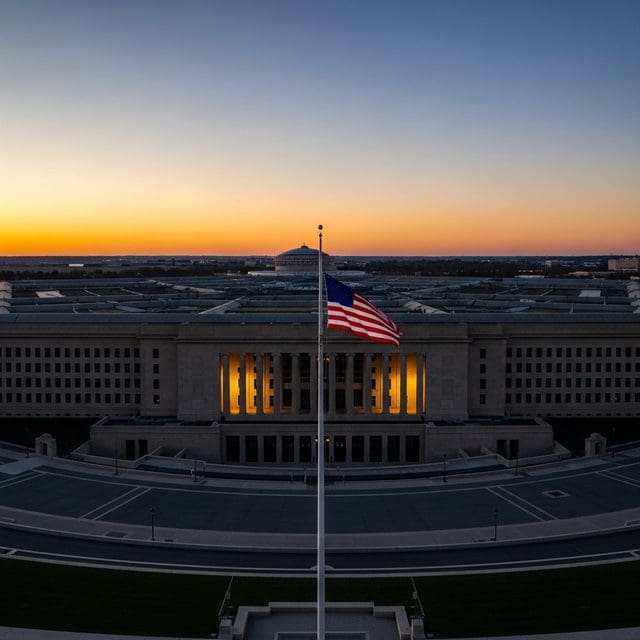
President Trump halted a planned offensive against Iran on August 2, citing progress on a diplomatic framework while ordering the Pentagon to remain prepared for a large-scale assault.
President Donald Trump announced a pause in military operations against Iran on August 2, citing the development of a “rough framework” for a peace deal. The decision to call off a planned strike follows a period of intense escalation, including U.S. and Saudi strikes on Tehran-backed militias in Iraq and retaliatory Iranian missile attacks on American forces in late July. While the President indicated a desire to finalize a deal rapidly, he simultaneously instructed Pentagon leadership to maintain readiness for a full-scale assault should negotiations falter. This “peace through strength” posture suggests that while the administration is open to a diplomatic off-ramp, the military option remains the primary leverage against the Islamic Republic.
The strategic pause comes as the financial and human costs of the six-month conflict continue to mount. The Pentagon recently requested an additional $67 billion to restock munitions, adding to the $37.5 billion already spent as of July 21. On the ground, the humanitarian impact remains severe, with United Nations reports indicating more than 2,500 children have been killed or injured in Iran since the war began. Despite these pressures, the administration has maintained a firm stance on regional security, responding to Iranian Revolutionary Guard Corps attacks on a U.S. base in Jordan with targeted strikes as recently as July 30. Domestically, the President has also pushed back against intelligence assessments regarding Iranian cyber activity, specifically blaming state officials for “gross incompetence” following a breach of Minnesota water systems.
Energy markets are closely monitoring the diplomatic shift. While OPEC+ agreed to raise output by 188,000 barrels per day in August, the increase remains largely theoretical. Ongoing hostilities have severely constrained tanker traffic through the Strait of Hormuz, preventing actual supply from reaching global markets. Former U.S. Ambassador to Israel Tom Nides recently emphasized that there is no lasting military solution to the conflict, arguing that renewed negotiations involving regional allies offer the only realistic path to reopening the Strait. Analysts suggest that only a durable cessation of hostilities will allow for the normalization of energy exports from the Gulf, which remains the world’s most critical maritime chokepoint.
Beyond the Middle East, the administration continues to manage complex shifts in the Indo-Pacific and Europe. In China, electric vehicle giant BYD reported a 22% year-over-year sales increase for July, reaching 420,000 vehicles. However, the firm remains behind its annual targets amid a domestic price war and overcapacity that is squeezing margins across the Chinese industrial sector. The U.S. is also adjusting its immigration posture, making the visa bond program permanent as of August 1, which affects several African nations while exempting thirteen Asian countries, including China and India. This move follows a year-long review and coincides with the expiration of federal funding for legal representation for unaccompanied migrant children, a shift that affects thousands of minors.
In the European theater, the administration faces renewed pressure regarding the conflict in Ukraine. During an August 1 meeting at the Oval Office, President Volodymyr Zelensky requested American assistance in persuading Elon Musk to permit the use of Starlink for drone strikes against Russian targets. This request coincides with new data showing a widening gap in NATO burden-sharing; while five members, including Lithuania at 5.33%, are projected to meet a 3.5% GDP defense spending benchmark by 2026, the U.S. projection stands at 3.17%. The disparity underscores the President’s continued emphasis on allied contributions as the cornerstone of Western security. As the administration navigates these overlapping crises, the focus remains on maintaining American primacy while forcing both allies and adversaries to adjust to a more transactional and realist U.S. foreign policy.

Olivia Kendall serves as the Senior Correspondent for Geopolitics, Defense, and Foreign Policy at Just Right News, where she provides a principled, conservative perspective on the complex forces shaping the global stage. With a career dedicated to deconstructing the intricacies of international relations, Kendall has become a trusted voice for readers who value national sovereignty, a robust military, and a foreign policy that prioritizes American interests above all else.
A native of Washington, D.C., Kendall’s professional journey is deeply rooted in her upbringing within the nation’s capital. Growing up in the epicenter of American political life, she developed an early and profound understanding of how policy is crafted and, more importantly, how it often fails to account for the values of the American heartland. This unique vantage point allowed her to witness firsthand the rise of globalist bureaucracies, fueling her commitment to reporting that champions the constitutional foundations of the United States. Her background as a British White American further informs her worldview, providing her with a keen appreciation for the Western tradition and the enduring importance of the “Special Relationship” in maintaining global stability.
Now based in Arlington, Virginia, Kendall operates from the doorstep of the Pentagon and the heart of the nation’s defense establishment. Her proximity to the decision-makers in the military and intelligence communities allows her to provide boots-on-the-ground reporting that is both timely and deeply informed. For Kendall, Arlington is more than just a base of operations; it is a daily reminder of the sacrifices made by the men and women in uniform. This connection to the defense community drives her rigorous coverage of military readiness and her advocacy for a “peace through strength” approach to diplomacy.
At Just Right News, Kendall is perhaps best known for her acclaimed feature series, “The World’s Shadow on America.” In this ongoing project, she explores the direct correlation between international developments and the daily lives of American citizens. Whether she is analyzing the encroachment of foreign adversaries in domestic supply chains or the impact of international treaties on local economies, Kendall’s work serves as a vital bridge between distant geopolitical shifts and their consequences at home. She rejects the notion that foreign policy is an abstract concern for elites, instead proving that what happens in the corridors of power in Brussels or Beijing has a tangible “shadow” that falls across every American doorstep.
Throughout her tenure, Kendall has remained a steadfast critic of international overreach and a vocal proponent of a clear-eyed, realistic foreign policy. She brings a sharp analytical mind to her beat, often challenging the prevailing narratives of the mainstream media to uncover the underlying truths that affect national security. Her reporting is characterized by a refusal to compromise on the truth and a dedication to the idea that a strong, secure America is the world’s best hope for liberty. As a Senior Correspondent, Olivia Kendall continues to lead the charge in providing the essential context and conservative insight necessary to navigate an increasingly volatile world.