

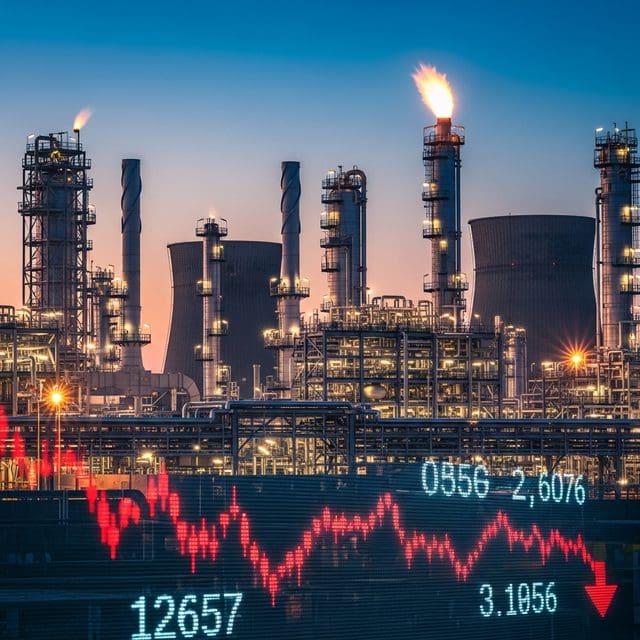
Oil prices retreated as President Trump canceled strikes on Iran, while OPEC+ moved to increase production quotas amid global grid instability in Cuba and Eastern Europe.
Energy markets experienced a sharp correction on Monday as the threat of a major regional conflict in the Middle East receded. Oil prices plummeted following President Trump’s decision on August 2 to cancel planned military strikes against Iran, citing significant progress in ceasefire negotiations. This de-escalation, reportedly influenced by concerns shared by Saudi Crown Prince Mohammed bin Salman on August 1, has removed the immediate risk premium that had been buoying crude futures. The shift in military posture has provided a reprieve for global markets, which had been bracing for a potential disruption in the Strait of Hormuz.
Adding to the downward pressure on prices, OPEC+ ministers reached an agreement on Sunday to proceed with a production hike for September. The group approved a quota increase of approximately 188,000 barrels per day, completing a planned rollback of previous voluntary cuts. While the move signals confidence in global demand, President Trump has continued to apply pressure on domestic producers, publicly chiding Chevron’s leadership and demanding lower retail gasoline prices to further ease the burden on American taxpayers. This populist stance on energy costs reflects a broader administration strategy to leverage domestic production against global price volatility.
While global supply chains appear to be stabilizing, the physical reliability of energy grids remains under severe strain elsewhere. In Eastern Europe, record-low water levels on the Danube River have pushed several nations to the brink of an energy emergency. The lack of water has hampered both hydroelectric generation and the cooling systems required for thermal power plants, forcing governments in Budapest and across the region to implement conservation measures to avoid systemic failure. This water-energy nexus highlights the vulnerability of traditional baseload power to environmental shifts, even as demand for electricity continues to rise across the continent.
The fragility of centralized power systems is even more evident in Cuba, which suffered its sixth nationwide blackout of the year this week. Only a small fraction of the grid in Havana remains operational as the country struggles with aging infrastructure and chronic fuel shortages. These cascading failures highlight the critical importance of diverse energy portfolios and the ongoing risks associated with under-investment in baseload reliability. For developing nations, the lack of a stable grid remains the primary barrier to economic growth, a stark contrast to the robust infrastructure being leveraged by Western corporations.
In the United States, the broader economic outlook remains buoyed by the energy sector’s cooling and strong performance in the technology and financial sectors. Amazon reported significant growth driven by its AWS cloud division, posting its best day in 11 years on July 31. This growth was further bolstered by paper gains on Anthropic investments, signaling a massive inflection point for AI-driven energy demand. Financial stocks also reached record highs as of August 2, supported by strong earnings and favorable valuations that suggest the market is successfully absorbing the current inflationary pressures.
However, the intersection of climate and infrastructure remains a challenge, as evidenced by ongoing wildfires in Washington state that have destroyed hundreds of structures and forced evacuations near Spokane. These events, coupled with India’s recent decision to raise windfall taxes on fuel exports, underscore the complex web of local disasters and global policy shifts that define the modern energy landscape. As the Trump administration reaffirms diplomatic ties, such as the recognition of Moroccan sovereignty over Western Sahara, the focus remains on securing long-term energy independence and economic stability through pragmatic, market-oriented solutions.

Mark Davis serves as the Senior Correspondent for Energy, Climate, and Resource Economics at Just Right News. In an era where the conversation around the environment is often dominated by alarmism and top-down mandates, Mark provides a vital, market-oriented perspective on the complex forces shaping our world. As the lead voice behind the acclaimed feature series “Power and the Planet,” he explores the intersection of environmental policy, global energy markets, and the fundamental economic principles that sustain modern civilization.
Mark’s pragmatic approach to resource management was forged in the high desert of his hometown, Albuquerque, New Mexico. Growing up in a region defined by both its breathtaking natural beauty and its rugged, resource-dependent landscape, he developed an early appreciation for the delicate balance between conservation and utilization. New Mexico’s unique position as a hub for both traditional energy production and cutting-edge scientific research provided Mark with a front-row seat to the evolution of the American energy sector. This upbringing instilled in him a deep-seated belief that true environmental stewardship is inseparable from economic prosperity and technological innovation.
Now based in Boulder, Colorado, Mark operates from the heart of the nation’s climate research community. While Boulder is often seen as a bastion of environmental idealism, Mark utilizes his post to provide a necessary counterweight, grounded in the realities of resource economics. He understands that energy policy does not exist in a vacuum; it has tangible consequences for the American taxpayer, the stability of the national power grid, and the strength of the domestic manufacturing sector. By reporting from the front lines of the climate debate, he is able to challenge prevailing narratives with hard data and a commitment to the principles of the free market.
Throughout his tenure at Just Right News, Mark has distinguished himself by focusing on the “Resource Economics” aspect of his beat. He frequently highlights the hidden costs of rapid energy transitions and advocates for an “all-of-the-above” energy strategy that prioritizes American energy independence. His work often shines a light on the geopolitical implications of resource scarcity, arguing that a secure nation must first be an energy-secure nation. Whether he is analyzing the impact of federal land-use regulations or investigating the supply chains required for new technologies, Mark remains focused on how policy decisions affect the lives and livelihoods of everyday citizens.
In “Power and the Planet,” Mark continues to bridge the gap between complex scientific concepts and the economic realities facing the country. He rejects the false choice between a healthy environment and a thriving economy, instead seeking out solutions that leverage American ingenuity and private-sector competition. For Mark, reporting on the climate is not about following the latest trends, but about ensuring that the conversation remains tethered to the foundational values of liberty, property rights, and fiscal responsibility. His contributions ensure that Just Right News readers receive a comprehensive, clear-eyed view of the challenges and opportunities defining the future of our planet.