

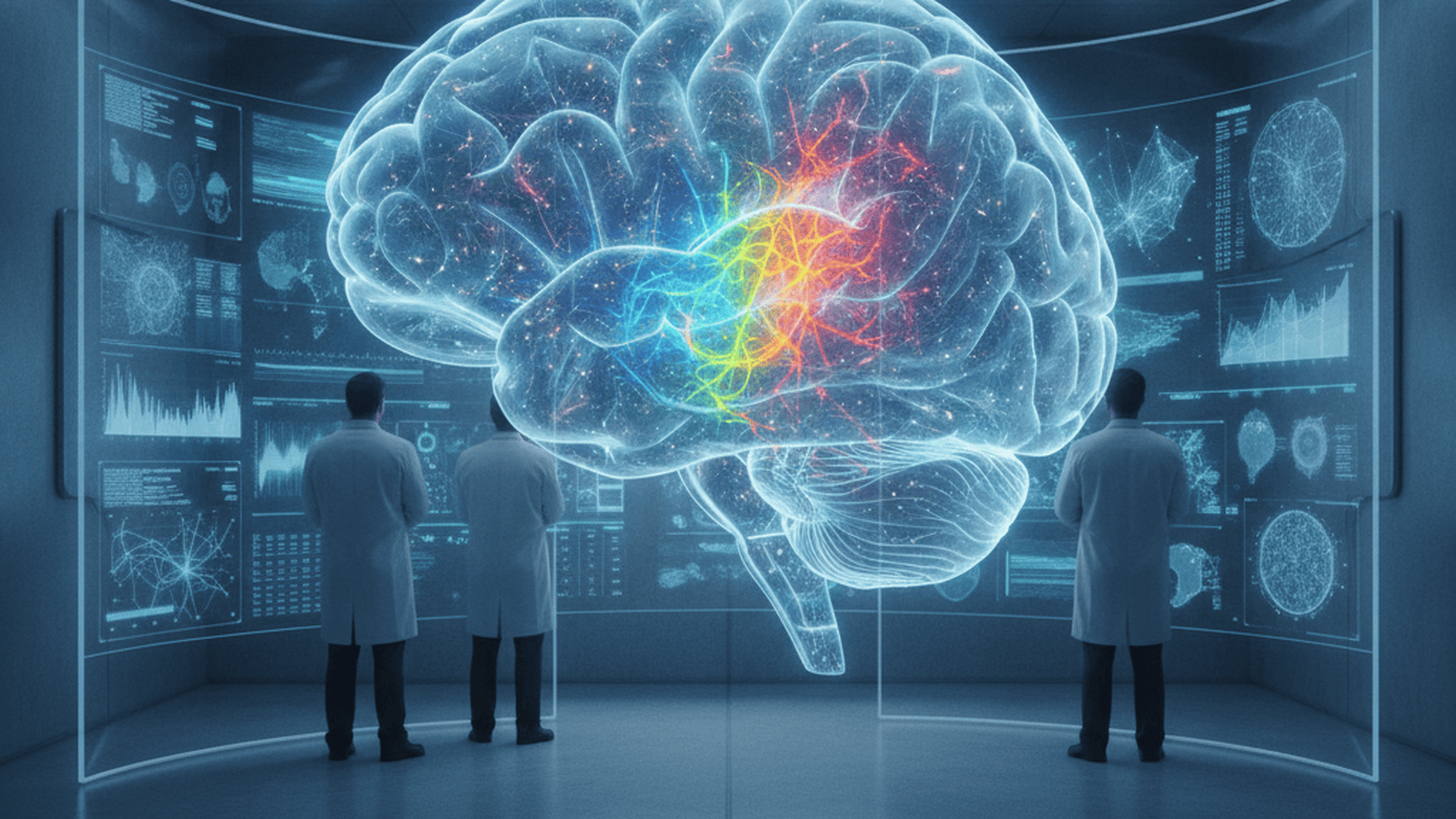
Scientists at Washington University have discovered the Somato-Cognitive Action Network (SCAN), a previously unknown system in the human motor cortex. This network integrates physical movement with executive function and autonomic control, challenging the long-held homunculus model of brain organization.
TLDR: Researchers have identified the Somato-Cognitive Action Network (SCAN), a brain system that links physical movement to mental planning and internal organ control. Interspersed within the traditional motor cortex, this network explains how the mind and body coordinate complex actions and physiological responses during physical activity.
For nearly a century, the scientific understanding of how the human brain controls movement was defined by the homunculus. This model, developed by neurosurgeon Wilder Penfield in the 1930s, depicted the motor cortex as a continuous strip where specific regions corresponded linearly to specific body parts, from the toes to the face. However, a groundbreaking study from the Washington University School of Medicine in St. Louis has revealed that this map is incomplete. Researchers have identified a previously unknown system called the Somato-Cognitive Action Network (SCAN) that is woven into the motor cortex, fundamentally changing the paradigm of human neuroanatomy.
The discovery began when researchers used precision functional magnetic resonance imaging (fMRI) to scan the brains of seven individuals for several hours each while they were at rest or performing various tasks. This high-resolution approach allowed the team to see details that are often blurred in larger, group-averaged studies. They noticed that the traditional body-map areas were separated by three distinct regions that did not seem to correspond to any specific body part. Instead, these inter-effector regions were thinner and more heavily connected to each other and to parts of the brain responsible for thinking, planning, and internal body functions like heart rate and pain.
To confirm these findings, the team expanded their analysis to include massive datasets from the Human Connectome Project and the UK Biobank, which contain brain scans from thousands of people. The pattern held true across all datasets. The motor cortex is actually composed of two alternating systems. The first is the traditional effector-specific system, which handles the fine-tuned, isolated movements of the fingers, toes, and tongue—the kind of movements required for typing or speaking. The second is the SCAN, which coordinates the body as a whole and links movement to the brain’s executive control centers.
The SCAN appears to be the neurological bridge between the mind and the body. While the effector-specific circuits focus on the mechanics of movement, the SCAN seems to focus on the goal and the physiological preparation required for action. For example, if a person decides to stand up, the SCAN coordinates the necessary changes in blood pressure and heart rate alongside the muscular movements required to change posture. This explains why the motor cortex is so closely linked to the autonomic nervous system, a connection that was previously observed but not well understood.
This discovery has significant implications for understanding various medical conditions. In disorders like Parkinson’s disease, the SCAN might be affected differently than the effector-specific regions, potentially explaining why some patients struggle with complex movements but can still perform isolated ones. It also provides a biological basis for the benefits of mind-body practices like yoga or tai chi, as it shows a direct physical pathway where mental focus and physical movement are integrated.
The researchers also looked at the SCAN from an evolutionary perspective. They found that while a similar network exists in monkeys, it is much less extensive and less integrated than in humans. This suggests that the development of a highly coordinated mind-body network may have been a key step in human evolution, allowing for more complex tool use and social coordination.
Future research will focus on how the SCAN develops throughout a person’s life. Scientists are interested in seeing if the network is present at birth or if it forms as a child learns to coordinate complex actions. Additionally, researchers hope to investigate whether targeted stimulation of the SCAN could help patients recovering from strokes or other brain injuries. By mapping this hidden network, neuroscience has moved closer to a unified theory of how the human brain manages the intricate dance between thought and action.

Mason Reed serves as a Staff Writer for Just Right News, where he spearheads the Future Frontiers & Special Projects desk. In an era defined by rapid technological shifts and evolving social landscapes, Mason provides a steady, principled voice, examining the innovations of tomorrow through the lens of traditional American values. His work is most prominently featured in his signature series, “The Next Horizon,” where he explores the intersection of emerging technology, national sovereignty, and the preservation of individual liberty.
A native of San Diego, California, Mason’s worldview was shaped by the unique culture of his hometown. Growing up in a region defined by its strong military presence and its history of maritime industry, he developed a deep-seated respect for the institutions that provide national stability and the entrepreneurial spirit that drives the American economy. This upbringing instilled in him a belief that true progress is not found in discarding the past, but in building upon a foundation of proven principles. His reporting often reflects this San Diego influence, emphasizing the importance of a robust national defense and the necessity of maintaining a competitive edge in the global marketplace.
Now based in San Francisco, Mason operates from the heart of the world’s technological engine. Living and working in the Bay Area provides him with a front-row seat to the advancements—and the ideological challenges—emanating from Silicon Valley. While many in the region embrace a “move fast and break things” mentality, Mason’s reporting serves as a vital counterweight. He offers Just Right News readers a “boots on the ground” perspective, documenting how radical local policies and the concentration of tech power impact the everyday lives of citizens. His proximity to the industry allows him to cut through the marketing jargon of big tech to uncover the real-world implications for privacy, free speech, and the nuclear family.
In his “Future Frontiers” beat, Mason tackles complex subjects ranging from the ethics of artificial intelligence to the burgeoning private space race. He approaches these topics with a healthy skepticism toward centralized bureaucracy, championing instead the decentralized innovations that empower individuals. Through “The Next Horizon,” he highlights the pioneers and thinkers who are working to ensure that the future remains a place where human dignity and constitutional rights are protected. He believes that the rapid pace of change requires more than just technical expertise; it requires a moral compass rooted in the Western tradition.
Throughout his tenure at Just Right News, Mason has remained committed to the idea that the future is something to be shaped, not merely accepted. His writing is characterized by a rigorous defense of American exceptionalism and a belief that the country’s best days lie ahead, provided it remains true to its founding ideals. Whether he is investigating the impact of automation on the American workforce or profiling the next generation of aerospace engineers, Mason Reed ensures that his readers are equipped with the insights they need to navigate a changing world with confidence and clarity.