

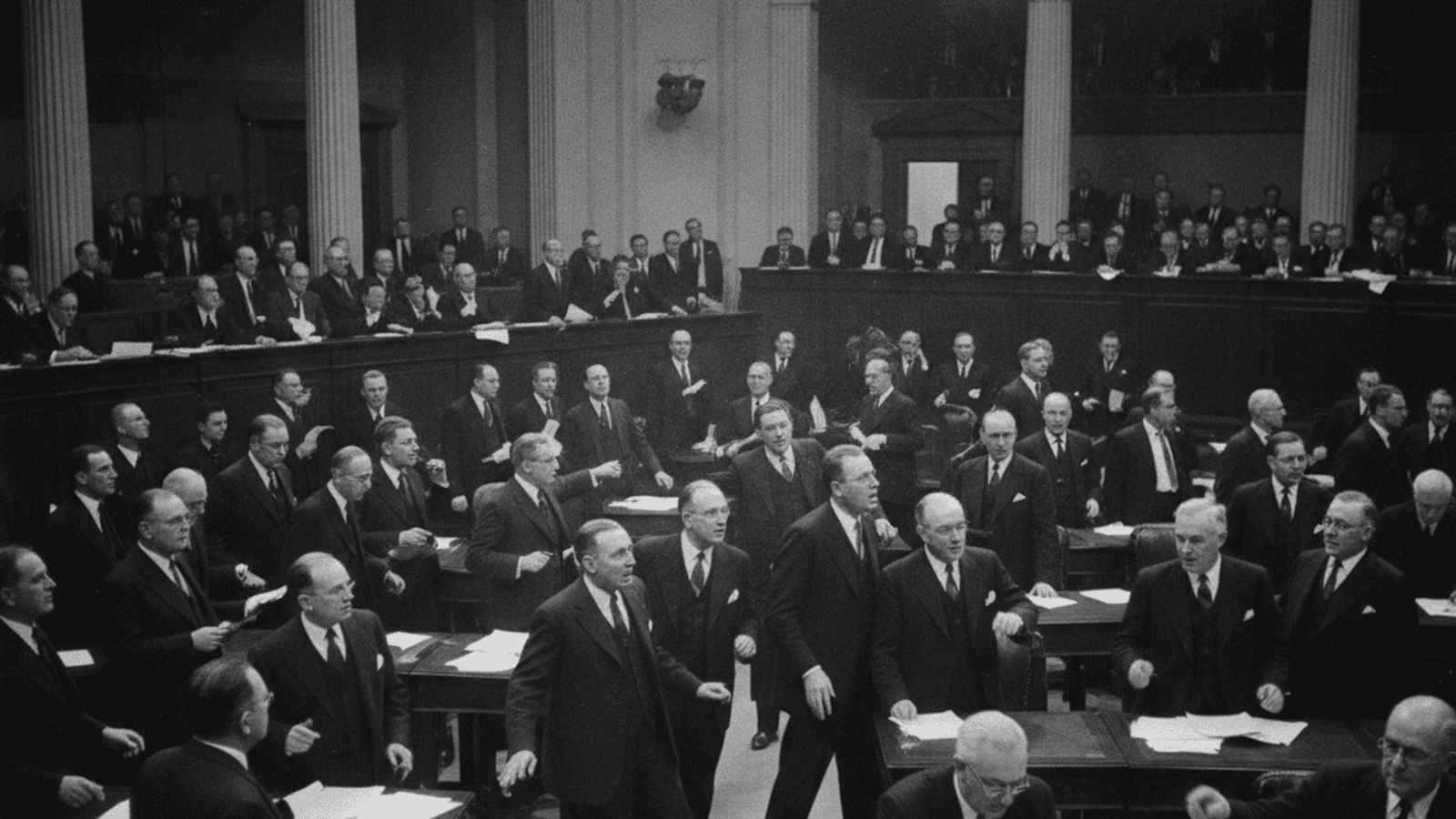
The Costigan-Wagner Bill was a landmark legislative attempt in the mid-1930s to make lynching a federal crime in the United States. Despite intense lobbying by the NAACP and support from Northern progressives, the bill was defeated by a sustained filibuster from Southern Democrats in the Senate.
TLDR: In 1934 and 1935, Senators Edward Costigan and Robert Wagner introduced federal anti-lynching legislation to combat racial violence. The bill faced a fierce filibuster from Southern Democrats, who argued it infringed on states’ rights. President Roosevelt’s refusal to intervene, fearing the loss of New Deal support, led to the bill’s legislative death.
During the height of the Great Depression, the United States faced a dual crisis of economic collapse and a persistent wave of racial violence. In 1934, Senators Edward Costigan of Colorado and Robert F. Wagner of New York introduced a federal anti-lynching bill designed to provide a federal remedy for a crime that state authorities frequently ignored or abetted. The legislation proposed that local officials who failed to protect individuals from mob violence could be prosecuted in federal court, and counties where lynchings occurred would be subject to significant fines. This move was the centerpiece of a sophisticated lobbying campaign by the National Association for the Advancement of Colored People (NAACP), led by Executive Secretary Walter White.
The bill arrived at a delicate moment for the New Deal administration. President Franklin D. Roosevelt was in the process of building a fragile coalition to support his massive economic recovery programs. This coalition included Northern progressives, urban laborers, and the “Solid South”—a bloc of Southern Democrats who held a stranglehold on the legislative process through seniority and committee chairmanships. While the President’s wife, Eleanor Roosevelt, was a vocal supporter of the anti-lynching cause, the President himself remained strategically silent. He privately told Walter White that he could not risk the Southerners blocking his must-pass economic bills, such as the Social Security Act, by forcing a confrontation over civil rights.
In early 1935, the Costigan-Wagner Bill finally moved toward a floor vote in the Senate. However, the Southern bloc was prepared to use every procedural tool at its disposal to prevent the bill from passing. Led by Senators such as Tom Connally of Texas and Richard Russell of Georgia, the opposition launched a grueling filibuster that lasted for nearly a week in April. The Southern senators argued that the bill was a direct assault on state sovereignty and a violation of the Tenth Amendment. They characterized the legislation as an attempt by the federal government to “subjugate” the South, using the same “states’ rights” arguments that had been employed since the Reconstruction era.
The filibuster effectively ground the business of the United States government to a halt. As the days passed, the Senate became a theater of high-stakes political maneuvering. Supporters of the bill tried to invoke cloture to end the debate, but they were unable to secure the necessary two-thirds majority. The NAACP attempted to increase public pressure by flying a black flag from its New York headquarters that read, “A Man Was Lynched Yesterday,” but the political reality in Washington remained unchanged. Faced with a legislative logjam that threatened his entire New Deal agenda, Senate Majority Leader Joseph Robinson eventually moved to displace the bill in favor of other business.
The defeat of the Costigan-Wagner Bill in 1935 was a watershed moment that revealed the limitations of the New Deal’s transformative power. It exposed the reality that for African Americans, the “forgotten man” of Roosevelt’s rhetoric often remained unprotected by the federal government. The failure to pass the bill ensured that lynching would continue to be a tool of domestic terror without federal intervention for several more decades. This legislative struggle laid the groundwork for the modern Civil Rights Movement, as activists realized that breaking the Southern veto in the Senate would require a much broader national mobilization. It took nearly ninety years for the spirit of the Costigan-Wagner Bill to be fully realized with the passage of the Emmett Till Antilynching Act in 2022.

James Foster serves as the Senior Correspondent for Inequality and the Social Safety Net at Just Right News, where he brings a principled and nuanced perspective to the most pressing economic challenges facing the nation. With a career dedicated to exploring the intersection of policy and personal responsibility, Foster has become a leading voice in documenting how government programs and economic shifts impact the American family. His reporting is characterized by a commitment to the “human element,” moving beyond cold statistics to highlight the stories of resilience, work, and community that define the modern American experience.
Foster’s perspective is deeply rooted in his upbringing in Birmingham, Alabama. Growing up in a city with a rich industrial heritage and a history of economic transformation, he witnessed firsthand the importance of the dignity of work and the strength of local institutions. In Birmingham, he saw how the most effective safety nets were often those woven by neighbors, faith-based organizations, and local civic groups. This background instilled in him a lifelong skepticism of “one-size-fits-all” solutions from distant bureaucracies, favoring instead the localized, community-driven support systems that he frequently champions in his writing.
Now based in Atlanta, Georgia, Foster operates from one of the most dynamic and rapidly evolving metropolitan hubs in the South. His location provides a front-row seat to the stark contrasts of the modern economy. From the gleaming towers of Atlanta’s financial districts to the struggling neighborhoods on the city’s periphery, Foster finds the stories that illustrate the complexities of upward mobility. His reporting from the Sun Belt serves as a microcosm for the national debate on poverty, highlighting how inflation, housing costs, and labor market shifts affect the working class in real-time.
As the lead for the acclaimed feature series “America’s Balancing Act,” Foster explores the delicate tension between providing a necessary hand up and fostering long-term independence. The series has become a cornerstone of Just Right News, offering a deep dive into the unintended consequences of social welfare policies. Foster’s work often focuses on the “cliff effect” and other systemic hurdles that can inadvertently discourage employment, arguing that true compassion is measured by how many people are empowered to leave the safety net, rather than how many are added to it.
Throughout his tenure, Foster has remained dedicated to the mission of Just Right News, providing a clear-eyed, conservative analysis of social issues. He believes that a free society thrives when individuals are empowered and the private sector is allowed to innovate. Whether he is interviewing small business owners about the challenges of a changing workforce or documenting the success of private charitable initiatives, Foster’s goal is to provide readers with the truth about the state of the American Dream. His work serves as a vital reminder that while the challenges of inequality are great, the solutions are often found in the strength of the American spirit and the preservation of traditional values.