

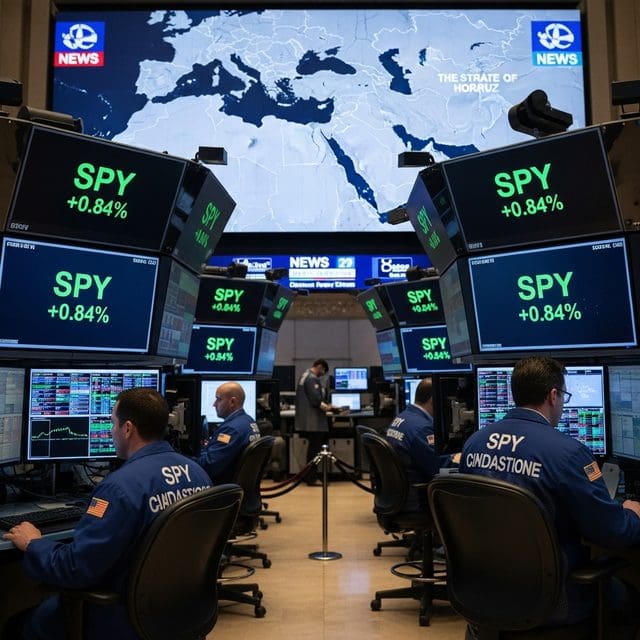
The SPY benchmark climbed 0.84% as global markets stabilized following U.S. strikes in the Middle East, with investors weighing semiconductor strength against persistent energy-driven inflation risks.
Global financial markets demonstrated a resilient, albeit cautious, recovery on Thursday, with the SPY benchmark trading up 0.84%. This move represents a significant rebound from the prior session’s volatility, as investors attempt to decouple robust corporate earnings and semiconductor growth from a deteriorating geopolitical situation in the Middle East. While the ‘Invisible Economy’ of central bank policy and energy costs remains a primary concern for the American taxpayer, the day’s trading suggests a market currently anchored by technological meritocracy rather than pure fear.
The primary driver of recent market turbulence has been the sharp escalation in the Strait of Hormuz. Following a series of attacks on commercial shipping, the U.S. military initiated fresh strikes on Iranian targets on July 8 and 9. This followed a declaration by President Trump that the existing ceasefire was over and that further negotiations with Tehran were a waste of time. Initially, West Texas Intermediate (WTI) crude futures jumped 6% post-settle on Wednesday, sparking fears that a four-month conflict was entering a new, more inflationary phase. However, as of Thursday, oil prices have steadied, allowing equity futures to recover as regional mediators from Qatar and Pakistan attempt to de-escalate the situation and revive nuclear negotiations.
For working households, the impact of these maneuvers is most visible in the Federal Reserve’s stance on interest rates. The June Fed minutes revealed a central bank deeply divided and reluctant to implement rate cuts until inflation clearly trends toward its target. The sudden spike in energy costs threatens to reignite broad-based inflation, potentially forcing the Fed to keep rates elevated for longer than Main Street had hoped. Despite this, some institutional analysts, such as those at Wells Fargo Investment Institute, remain bullish, suggesting that AI-driven earnings momentum could still push the S&P 500 toward a year-end target range of 7,800 to 8,000.
Corporate activity remains a vital sign of market health amidst the geopolitical noise. In a historic move, SK Hynix raised $26.5 billion in a U.S. equity offering on July 10, marking the second-largest equity offering ever recorded. This massive influx of capital into the semiconductor space underscores the market’s conviction in the AI revolution, even as traditional sectors face headwinds. Other institutional developments, such as the OCI N.V. Board recommending an unsolicited all-cash offer from NNS and Skanska’s divestment of a SEK 570 million multifamily project in Sweden, indicate that deal-making and capital rotation continue in the background of the headlines.
However, the collapse of the OPEC+ agreement to increase crude production—which was contingent on a U.S.-Iran peace deal—serves as a stark reminder of the fragility of the current stability. Without increased supply, the American consumer remains vulnerable to energy shocks that act as a hidden tax on every household. While the SPY’s 0.84% gain today provides a reprieve for retirement accounts, the long-term outlook remains tied to whether the U.S. can maintain its national sovereignty and energy security without triggering a sustained inflationary spiral.
As the week closes, the focus remains on whether the current rebound is a temporary bounce or a sustainable trend. The contrast between the Dow’s recent 576-point drop and the Nasdaq’s ability to find support in chip stocks like Nvidia illustrates a bifurcated market. For the principled investor, the lesson of the day is clear: while centralized geopolitical conflicts create the noise, the fundamental strength of the American private sector and its technological lead continue to be the primary engines of value in a volatile world.

Jordan Lee serves as the Senior Correspondent for Wall Street, Finance, and Monetary Systems at Just Right News. Based in the heart of the world’s financial capital, New York City, Lee brings a sharp, principled eye to the complex mechanisms that drive the global economy. His reporting is defined by a commitment to fiscal responsibility, the defense of the free market, and a deep-seated belief that a transparent monetary system is the bedrock of a free society.
Raised in Portland, Oregon, Lee’s perspective was forged in a city that has undergone significant cultural and economic shifts. His upbringing in the Pacific Northwest instilled in him a profound appreciation for the industriousness of small business owners and the importance of local economic stability. Watching the evolution of his hometown’s landscape sparked an early interest in how federal fiscal policy and large-scale financial trends eventually trickle down to the average citizen. This background provides him with a unique vantage point; he understands the growing disconnect between the policy-making elite and the reality of Main Street, a theme that frequently resonates throughout his work.
Now operating from his base in New York City, Lee bridges the gap between the high-stakes trading floors of Manhattan and the households of everyday Americans. He views the financial sector not merely as a collection of numbers and tickers, but as a vital engine of American prosperity that requires constant vigilance and accountability. His reporting often highlights the dangers of centralized financial control and the necessity of maintaining a system that rewards merit, risk-taking, and innovation.
As the creator and lead of the featured series, “The Invisible Economy,” Lee pulls back the curtain on the often-opaque world of monetary systems. He specializes in translating the dense jargon of central banking and international finance into actionable insights for the Just Right News audience. His work explores the “invisible” forces—such as inflationary pressures, regulatory creep, and the expansion of the administrative state—that erode the purchasing power of American families. By focusing on these systemic issues, Lee empowers readers to understand the hidden forces shaping their financial independence.
Lee’s journalistic philosophy is rooted in a steadfast commitment to traditional American values. As an Asian American professional who has navigated the competitive corridors of the financial world, he is a vocal advocate for meritocracy and the preservation of the American Dream. He believes that a stable currency and a predictable regulatory environment are essential for national sovereignty and individual liberty. His reporting frequently warns against the risks of government overreach in the private sector, arguing that the most effective solutions to economic challenges arise from competition and individual enterprise rather than bureaucratic mandates.
At Just Right News, Jordan Lee remains dedicated to providing a clear-eyed defense of the taxpayer. Whether he is analyzing market volatility or investigating the long-term implications of national debt, his mission is to provide the truth about where the money is going and what it means for the future of the country. Through his rigorous analysis and principled stance, Lee has become a trusted voice for those who value a strong, sovereign, and fiscally sound America.