

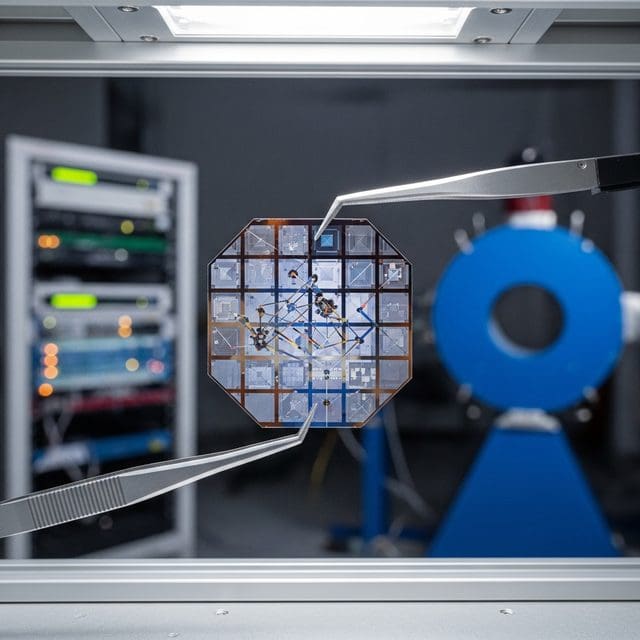
A theoretical breakthrough using semiconductor quantum wells could allow scientists to detect elusive axion particles, bridging the gap between condensed-matter physics and the search for the universe’s missing mass.
The pursuit of the invisible has long been the primary challenge of modern cosmology. While scientists have established that dark matter accounts for approximately 85 percent of the matter in the universe, the actual particles remains elusive. This week, a theoretical proposal from Rice University, published in Physical Review Letters, suggests that the answer may lie not in deeper space, but in the precise manipulation of semiconductor materials here on Earth.
Led by doctoral student Jaanita Mehrani and professors Shengxi Huang and Junichiro Kono, the research team has introduced a detector concept named SQWARE—the Semiconductor Quantum Well Axion Radiometer Experiment. The design leverages the unique properties of multiple quantum wells, which are stacks of ultrathin semiconductor layers that confine electrons into two-dimensional sheets. This architecture is a staple of condensed-matter physics, but Mehrani and her colleagues are applying it to a new frontier: the search for the axion.
Axions are hypothetical subatomic particles that are leading candidates for dark matter. The primary difficulty in detecting them involves a fundamental mismatch in momentum. In a vacuum, photons are massless, while axions are believed to possess a small but significant mass. This difference prevents axions from naturally converting into light, leaving them invisible to conventional sensors. The SQWARE design solves this by using the plasma formed by confined electrons within the quantum wells to give photons an “effective mass.” This synchronization allows for the resonant conversion of axions into photons, boosting the resulting electromagnetic signal by a factor of roughly 10,000.
Beyond the physics of particle conversion, the SQWARE proposal offers a significant engineering advantage over existing dark matter searches. Most current axion detectors, or haloscopes, rely on complex mechanical tuning mechanisms that physically move components to adjust the frequency of the search. These moving parts are prone to failure and introduce thermal noise that can drown out the incredibly faint signals of dark matter. The Rice University design, however, is tuned purely through electromagnetic means. By rotating the semiconductor cavity relative to a strong magnetic field, researchers can adjust the resonance frequency without any mechanical motion.
The target for this new technology is the milli-electron volt (meV) mass scale. This specific range has proven difficult for existing experiments to access, creating a “blind spot” in the global search for dark matter. By utilizing multiple quantum-well magnetoplasmonic cavities, SQWARE aims to close this gap. The research team is currently focused on characterizing candidate semiconductor structures and developing laboratory prototypes to move the project from a theoretical framework into a functional experimental reality.
This work represents a principled approach to innovation, utilizing established American semiconductor expertise to address fundamental questions of national and scientific importance. By bridging the gap between the study of materials and the study of the cosmos, the team at Rice is demonstrating how decentralized, university-led research can challenge the status quo of centralized bureaucracy in big-science projects. As the team moves toward physical testing, the scientific community watches closely to see if these engineered quantum environments will finally reveal the hidden architecture of our universe.
While other institutions, such as the Max Planck Institute, are exploring alternative materials like antiferromagnetic topological insulators for similar mass ranges, the Rice proposal stands out for its reliance on well-studied semiconductor heterostructures. This choice suggests a faster path to fabrication and deployment, potentially placing the next great discovery in particle physics within the reach of existing laboratory infrastructure. For now, the hunt for the axion continues, but the window into the dark universe has never looked clearer.

Mason Reed serves as a Staff Writer for Just Right News, where he spearheads the Future Frontiers & Special Projects desk. In an era defined by rapid technological shifts and evolving social landscapes, Mason provides a steady, principled voice, examining the innovations of tomorrow through the lens of traditional American values. His work is most prominently featured in his signature series, “The Next Horizon,” where he explores the intersection of emerging technology, national sovereignty, and the preservation of individual liberty.
A native of San Diego, California, Mason’s worldview was shaped by the unique culture of his hometown. Growing up in a region defined by its strong military presence and its history of maritime industry, he developed a deep-seated respect for the institutions that provide national stability and the entrepreneurial spirit that drives the American economy. This upbringing instilled in him a belief that true progress is not found in discarding the past, but in building upon a foundation of proven principles. His reporting often reflects this San Diego influence, emphasizing the importance of a robust national defense and the necessity of maintaining a competitive edge in the global marketplace.
Now based in San Francisco, Mason operates from the heart of the world’s technological engine. Living and working in the Bay Area provides him with a front-row seat to the advancements—and the ideological challenges—emanating from Silicon Valley. While many in the region embrace a “move fast and break things” mentality, Mason’s reporting serves as a vital counterweight. He offers Just Right News readers a “boots on the ground” perspective, documenting how radical local policies and the concentration of tech power impact the everyday lives of citizens. His proximity to the industry allows him to cut through the marketing jargon of big tech to uncover the real-world implications for privacy, free speech, and the nuclear family.
In his “Future Frontiers” beat, Mason tackles complex subjects ranging from the ethics of artificial intelligence to the burgeoning private space race. He approaches these topics with a healthy skepticism toward centralized bureaucracy, championing instead the decentralized innovations that empower individuals. Through “The Next Horizon,” he highlights the pioneers and thinkers who are working to ensure that the future remains a place where human dignity and constitutional rights are protected. He believes that the rapid pace of change requires more than just technical expertise; it requires a moral compass rooted in the Western tradition.
Throughout his tenure at Just Right News, Mason has remained committed to the idea that the future is something to be shaped, not merely accepted. His writing is characterized by a rigorous defense of American exceptionalism and a belief that the country’s best days lie ahead, provided it remains true to its founding ideals. Whether he is investigating the impact of automation on the American workforce or profiling the next generation of aerospace engineers, Mason Reed ensures that his readers are equipped with the insights they need to navigate a changing world with confidence and clarity.