

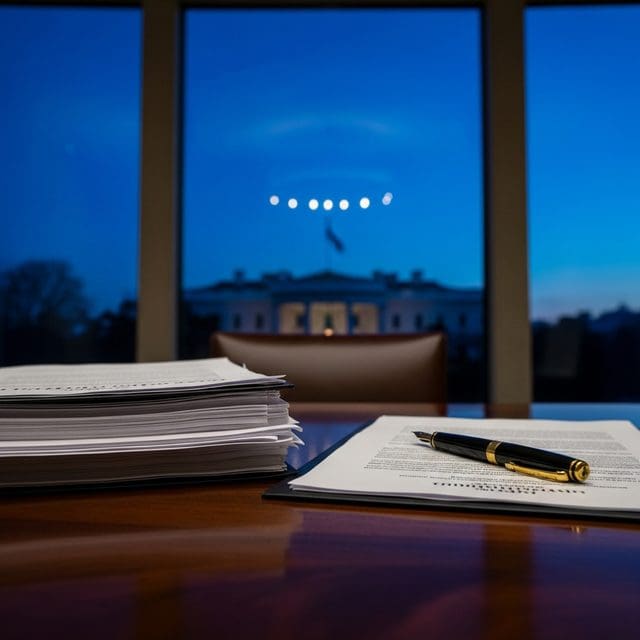
The Trump administration is fundamentally reshaping the federal workforce by stripping civil service protections from 8,000 senior roles to ensure bureaucratic alignment with executive policy.
The structural landscape of the American federal bureaucracy is undergoing its most significant transformation in decades as the White House moves to institutionalize a robust ‘unitary executive’ theory. At the heart of this shift is the June 3 executive order establishing ‘Schedule Policy/Career,’ a new employment classification that effectively strips civil service protections from approximately 8,000 career federal workers. By reclassifying these roles—specifically targeting GS-15 positions such as chiefs of staff, program managers, and senior public affairs officers—the administration has converted the backbone of the permanent government into at-will employees. This maneuver allows for the removal of officials who may dissent from the President’s policy agenda, replacing a merit-based system with one predicated on executive loyalty.
This consolidation of power comes as the administration aggressively fills top-tier vacancies with trusted allies. On June 3, the President nominated Todd Blanche for Attorney General, followed by the June 11 nomination of Jay Clayton for Director of National Intelligence. More recently, on June 27, the White House tapped Lance Schroyer, a former Oklahoma state trooper and U.S. Marine, to lead Immigration and Customs Enforcement (ICE). These appointments signal a clear intent to place the machinery of the executive branch under the firm hand of individuals vetted for their commitment to the President’s specific vision of governance. However, this path has not been entirely smooth; Senate Republicans have already signaled friction regarding Blanche’s nomination, specifically questioning his role in a proposed $1.8 billion compensation fund.
While the administration focuses on internal control, it is simultaneously navigating a volatile international landscape. The U.S. military was forced into action this week, conducting precision strikes against Iranian missile and drone storage sites on June 26 and June 27. These strikes were a direct response to Iranian aggression in the Strait of Hormuz, where four one-way attack drones struck a cargo ship on June 25, violating a standing ceasefire. These kinetic actions highlight the ongoing tension between the executive branch and a Congress that remains wary of war powers. Just days prior, on June 24, the Senate narrowly defeated a war-powers rebuke, illustrating the thin margin of support for unilateral executive military action.
On the humanitarian front, the administration has been forced to pivot resources to South America following powerful twin earthquakes in Venezuela on June 25. Defense Secretary Pete Hegseth has directed a military aid response to assist the more than 160 residents killed in the disaster. This effort is being bolstered by private sector and NGO support, including a $5 million disaster relief fund from Shell and the deployment of an emergency field hospital by Samaritan’s Purse via a 767 cargo plane. These events demonstrate the vast reach of the executive branch’s operational responsibilities even as it seeks to reform its internal personnel structures.
Domestically, the administration faces a burgeoning crisis in the healthcare sector. Data released June 27 by the Centers for Medicare and Medicaid Services (CMS) indicates that four million Americans dropped their Affordable Care Act (ACA) insurance coverage in 2026. This mass exit from the exchanges follows the expiration of enhanced subsidies, which led to soaring premium costs that many households could no longer sustain. This domestic instability provides a stark backdrop to the administration’s efforts to centralize power. From the ‘Schedule Policy/Career’ reclassifications to the ongoing fight over FISA Section 702 surveillance extensions, the White House is asserting a level of authority that challenges the traditional ‘Beltway bubble’ and seeks to redefine the relationship between the President and the administrative state.

Miles Harrington serves as the Senior Correspondent for Federal Systems & Executive Power at Just Right News, where he brings a disciplined, constitutionalist lens to the inner workings of the American government. With a focus on the mechanics of the federal bureaucracy and the limits of executive authority, Harrington has established himself as a vital voice for readers who value transparency, accountability, and the preservation of the separation of powers.
A native of Richmond, Virginia, Harrington’s perspective is deeply rooted in the traditions of the Old Dominion. Growing up in a city defined by its historical significance and its role as a center of American jurisprudence, he developed an early appreciation for the foundational principles of the Republic. His upbringing in Richmond—a place where the legacy of the Founding Fathers is woven into the landscape—instilled in him a belief that the federal government should remain within its constitutional bounds. This background informs his skepticism of centralized overreach and his commitment to reporting on the ways in which the administrative state impacts the lives of everyday citizens.
In his current role, Harrington specializes in the complexities of federal systems. He doesn’t just report on the headlines of the day; he digs into the structural shifts within the executive branch that often go unnoticed by the mainstream press. Whether he is analyzing the implications of a new federal regulation or investigating the expansion of agency jurisdiction, his work is characterized by a rigorous adherence to the facts and a dedication to the rule of law.
Harrington is perhaps best known for his signature feature series, “How Washington Works.” Through this ongoing project, he demystifies the often-opaque processes of the nation’s capital, pulling back the curtain on the “Deep State” and the unelected officials who wield significant influence over national policy. By breaking down complex legislative maneuvers and executive orders, he empowers Just Right News readers to understand the true levers of power in Washington. His reporting serves as a necessary check on the federal government, ensuring that the actions of those in power are held up to the light of public scrutiny.
Now based in Washington, D.C., Harrington operates at the epicenter of the political world, yet he remains intentionally distanced from the “Beltway bubble.” His proximity to the halls of power allows him to maintain a robust network of sources across the federal landscape, but his heart remains in the principled conservatism of his Virginia roots. He views his role not merely as a reporter, but as a steward of the public trust, dedicated to providing the clarity and context that conservative voters need to navigate an increasingly complex political environment.
Through his sharp analysis and unwavering commitment to the truth, Miles Harrington continues to be a cornerstone of the Just Right News team. His work ensures that the principles of limited government and executive restraint remain at the forefront of the national conversation, providing a crucial service to those who believe in a government that is truly of, by, and for the people.