

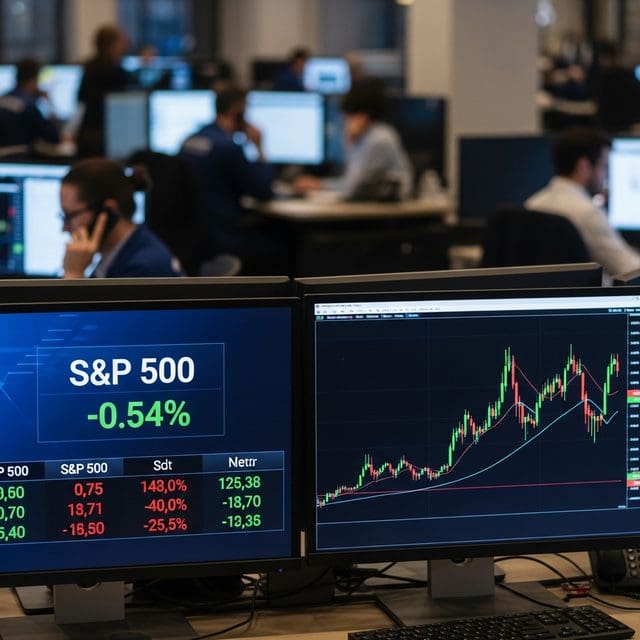
The S&P 500 declined 0.54% as investors rotated out of overextended technology sectors into defensive positions amid rising Middle East tensions and significant shifts in the global engineering landscape.
The American financial landscape faced a complex set of headwinds during the latest session as the S&P 500 (SPY) declined 0.54%. This movement serves as a benchmark for a broader market that is currently grappling with a significant sector rotation. While the Dow Jones Industrial Average recently touched all-time highs, the broader indices are being weighed down by an aggressive unwinding of the artificial intelligence and semiconductor trade. For the working household, this represents a transition away from the ‘growth at any cost’ mentality of the previous year toward more defensive, value-oriented positions.
Geopolitical instability has re-emerged as a primary driver for both commodities and Treasury yields. On June 27, 2026, the U.S. military conducted a second wave of retaliatory strikes against Iranian targets within a 24-hour window. These actions followed an attack on a commercial tanker, heightening the risk premium for global shipping and energy supplies. As oil prices react to these tensions, the ripple effects are felt across the domestic economy, influencing inflation expectations and the cost of living for families already burdened by a volatile monetary environment.
In the corporate sector, the appetite for high-stakes financing remains robust despite the equity market’s jitters. SpaceX is set to close one of the year’s largest AI-related debt deals on June 27, a strategic move designed to pay off existing debt and solidify its capital structure. This highlights a persistent theme in the ‘Invisible Economy’: while public equity markets may show signs of fatigue, massive liquidity continues to flow into private entities that command national strategic importance. Simultaneously, the digital engineering sector witnessed a massive consolidation play as Persistent announced an all-cash takeover offer for Nagarro at EUR 81 per share. This 140% premium to the undisturbed closing price suggests that institutional players are still willing to pay a high price for AI-led engineering capabilities, even as retail investors pull back from megacap tech.
Institutional shifts are also occurring in the labor and fintech markets. Adecco recently reported surpassing one million AI-powered candidate interactions, a move that has reportedly reduced delivery times by 50% across ten countries. This automation of the workforce is a double-edged sword for Main Street, promising efficiency for corporations while raising questions about long-term employment stability in a digital-first economy. Meanwhile, the expansion of Digital Wallet Group’s Smiles Mobile Remittance into the United States on June 17 signals increased competition in the fintech space, specifically targeting the North American remittance market.
Regulatory developments are also beginning to shape the fiscal outlook for the second half of the year. The Malta Financial Intelligence Analysis Unit recently published its 2025 Annual Report, noting enhanced international engagement and strengthened anti-money laundering preparedness. Closer to home, a significant shift in healthcare policy is approaching; starting July 1, 2026, Medicare beneficiaries will gain access to GLP-1 weight-loss drugs at a capped cost of $50 per month. While this provides immediate relief to seniors, the long-term impact on federal healthcare expenditures remains a point of concern for those advocating for fiscal responsibility.
As the session concludes, the divergence between the Nasdaq 100 and the equal-weighted S&P 500 remains the story of the tape. The former has been the weak link, suffering declines as high as 2% in recent wraps, while the latter has hit record highs. This indicates that the current market pressure is concentrated in the tech giants rather than being a broad-based economic washout. For the American taxpayer, the focus remains on whether these rotations and geopolitical shocks will lead to a stable monetary footing or further centralized financial control.

Jordan Lee serves as the Senior Correspondent for Wall Street, Finance, and Monetary Systems at Just Right News. Based in the heart of the world’s financial capital, New York City, Lee brings a sharp, principled eye to the complex mechanisms that drive the global economy. His reporting is defined by a commitment to fiscal responsibility, the defense of the free market, and a deep-seated belief that a transparent monetary system is the bedrock of a free society.
Raised in Portland, Oregon, Lee’s perspective was forged in a city that has undergone significant cultural and economic shifts. His upbringing in the Pacific Northwest instilled in him a profound appreciation for the industriousness of small business owners and the importance of local economic stability. Watching the evolution of his hometown’s landscape sparked an early interest in how federal fiscal policy and large-scale financial trends eventually trickle down to the average citizen. This background provides him with a unique vantage point; he understands the growing disconnect between the policy-making elite and the reality of Main Street, a theme that frequently resonates throughout his work.
Now operating from his base in New York City, Lee bridges the gap between the high-stakes trading floors of Manhattan and the households of everyday Americans. He views the financial sector not merely as a collection of numbers and tickers, but as a vital engine of American prosperity that requires constant vigilance and accountability. His reporting often highlights the dangers of centralized financial control and the necessity of maintaining a system that rewards merit, risk-taking, and innovation.
As the creator and lead of the featured series, “The Invisible Economy,” Lee pulls back the curtain on the often-opaque world of monetary systems. He specializes in translating the dense jargon of central banking and international finance into actionable insights for the Just Right News audience. His work explores the “invisible” forces—such as inflationary pressures, regulatory creep, and the expansion of the administrative state—that erode the purchasing power of American families. By focusing on these systemic issues, Lee empowers readers to understand the hidden forces shaping their financial independence.
Lee’s journalistic philosophy is rooted in a steadfast commitment to traditional American values. As an Asian American professional who has navigated the competitive corridors of the financial world, he is a vocal advocate for meritocracy and the preservation of the American Dream. He believes that a stable currency and a predictable regulatory environment are essential for national sovereignty and individual liberty. His reporting frequently warns against the risks of government overreach in the private sector, arguing that the most effective solutions to economic challenges arise from competition and individual enterprise rather than bureaucratic mandates.
At Just Right News, Jordan Lee remains dedicated to providing a clear-eyed defense of the taxpayer. Whether he is analyzing market volatility or investigating the long-term implications of national debt, his mission is to provide the truth about where the money is going and what it means for the future of the country. Through his rigorous analysis and principled stance, Lee has become a trusted voice for those who value a strong, sovereign, and fiscally sound America.