

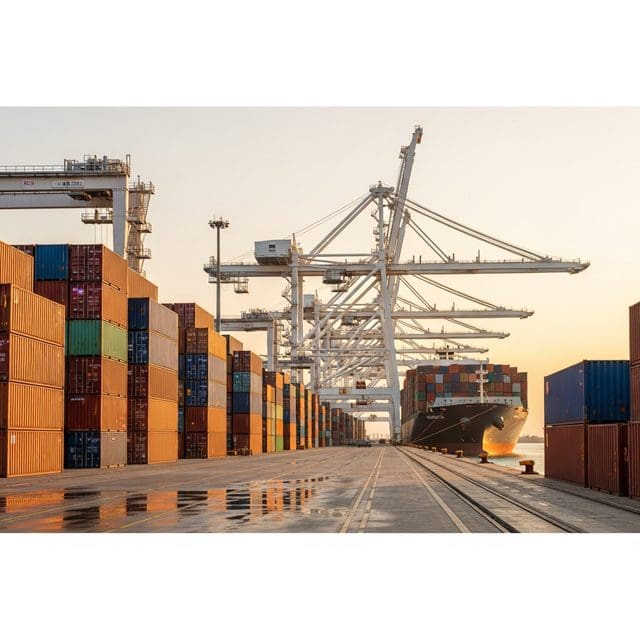
The interception of a massive illicit shipment in Lagos highlights growing security challenges within international shipping corridors and the necessity for robust maritime surveillance.
The integrity of the global supply chain is only as strong as its most vulnerable node. On June 28, 2026, the National Drug Law Enforcement Agency (NDLEA) in Nigeria provided a stark reminder of this reality by intercepting 4,959kg of ‘Canadian Loud’ cannabis at the Lagos port. With a street value of ₦12.3bn, the seizure represents a sophisticated effort by international syndicates to exploit the high-volume container traffic that defines modern commerce. For those who champion the dignity of the individual worker and the sanctity of domestic enterprise, such breaches are a call to action regarding port transparency.
This latest interdiction follows a consistent pattern of cargo interference at Nigerian maritime hubs. Just weeks prior, between May 12 and 13, authorities at the Tin Can Port intercepted 4,173.5kg of the same product, valued at over ₦10.4bn. These recurring incidents suggest that shipping routes connecting North American production to West African markets have become a preferred corridor for shadow economies. When illicit goods are commingled with legitimate manufacturing exports, the resulting security crackdowns and bureaucratic delays inevitably penalize the honest merchant and the blue-collar workforce relying on timely deliveries.
The geopolitics of maritime security are shifting as nations realize economic sovereignty depends on the safety of the seas. In the Indian Ocean, a critical theater for global trade, Indian Prime Minister Narendra Modi is currently engaged in a high-stakes diplomatic mission to Seychelles. From June 27 to June 29, 2026, the Prime Minister is advocating for a vision of the region as an ‘Ocean of Opportunity.’ The agenda focuses heavily on maritime domain awareness and surveillance, reflecting a growing skepticism toward globalist trade models that prioritize corporate efficiency over the security of national borders.
Closer to the American shore, the ripples of global instability are felt in the shifting landscape of labor. The Supreme Court’s 6-3 decision on June 25 to allow the termination of legal protections for 1.3 million migrants has created a ripple effect through the domestic labor market. While Ohio Governor Mike DeWine voiced concerns that such moves could act as ‘job killers’ for local industries, the broader perspective remains focused on the necessity of a stable, documented workforce that supports national manufacturing goals. The nomination of Lance Schroyer as ICE director further signals a pivot toward more stringent enforcement of the rules governing economic borders.
As we follow the journey of things from the factory floor to the consumer’s shelf, it is clear the current global trade architecture is under immense strain. Whether it is the seizure of billions in illicit cargo in Lagos or the struggle to secure naval facilities in the Seychelles, the message is the same: transparency is not a luxury. Corporate efficiency must no longer be allowed to trump the safety and prosperity of local communities. To protect the American worker, we must demand a trade system that values the security of the route as much as the value of the cargo.
Ultimately, the events of this week demonstrate that the ‘Journey of Things’ is often interrupted by those seeking to bypass the law. By strengthening our ports and supporting leaders who prioritize national security over unfettered globalism, we can ensure that the products on our shelves are the result of honest labor and secure trade. The fight for a principled trade policy continues on the docks of Lagos and in the diplomatic halls of the Seychelles, where the future of the global worker is being decided.

Sean Bradley serves as the Senior Correspondent for Trade, Supply Chains, and Global Labor at Just Right News, where he brings a principled, clear-eyed perspective to the complex systems that power the modern world. With a focus on the economic forces that impact the American household, Bradley has distinguished himself as a leading voice in explaining how global shifts in manufacturing and logistics translate to the kitchen table.
Growing up in Long Beach, California, Bradley’s interest in the movement of goods was forged against the backdrop of one of the nation’s most vital maritime gateways. Raised in a community where the towering cranes of the port were a constant fixture on the horizon, he developed an early appreciation for the blue-collar industries that form the backbone of the American economy. This upbringing instilled in him a profound respect for the dockworkers, truckers, and laborers who keep the country moving, a sentiment that remains a cornerstone of his reporting today. For Bradley, trade is not merely a series of abstract figures on a spreadsheet; it is a human endeavor that sustains families and defines the strength of a nation.
Now based in Seattle, Washington, Bradley occupies a strategic vantage point in another of the country’s most significant trade hubs. His location allows him to witness firsthand the intersection of traditional industry and the evolving technological landscape of global logistics. From the Pacific Northwest, he monitors the flow of goods across the ocean, providing Just Right News readers with timely insights into how international tensions, regulatory hurdles, and labor disputes affect the availability and cost of essential goods.
His signature feature series, “The Journey of Things,” has become a staple for readers seeking to understand the intricate path products take from raw materials to the retail shelf. Through this series, Bradley pulls back the curtain on the global marketplace, often highlighting the risks of over-reliance on foreign adversaries and the importance of domestic manufacturing resilience. His reporting consistently emphasizes the conservative values of national sovereignty, free-market competition, and the protection of the American worker from unfair global practices.
As a journalist of Irish heritage, Bradley maintains a deep-seated respect for the dignity of the individual worker and the importance of community stability. He approaches his beat with a commitment to transparency, often questioning the status quo of globalist policies that prioritize corporate efficiency over local prosperity. Whether he is reporting from a warehouse floor or analyzing a new international trade agreement, his goal remains the same: to provide the American public with the truth about where their products come from and what it costs to get them there.
Throughout his tenure at Just Right News, Bradley has remained a steadfast advocate for economic common sense. His work serves as a vital resource for those who believe that a strong nation is built on secure borders, robust trade, and a respected workforce. By combining his local roots in Long Beach with his professional experience in Seattle, Bradley continues to offer a unique and necessary perspective on the forces that shape the American way of life.