

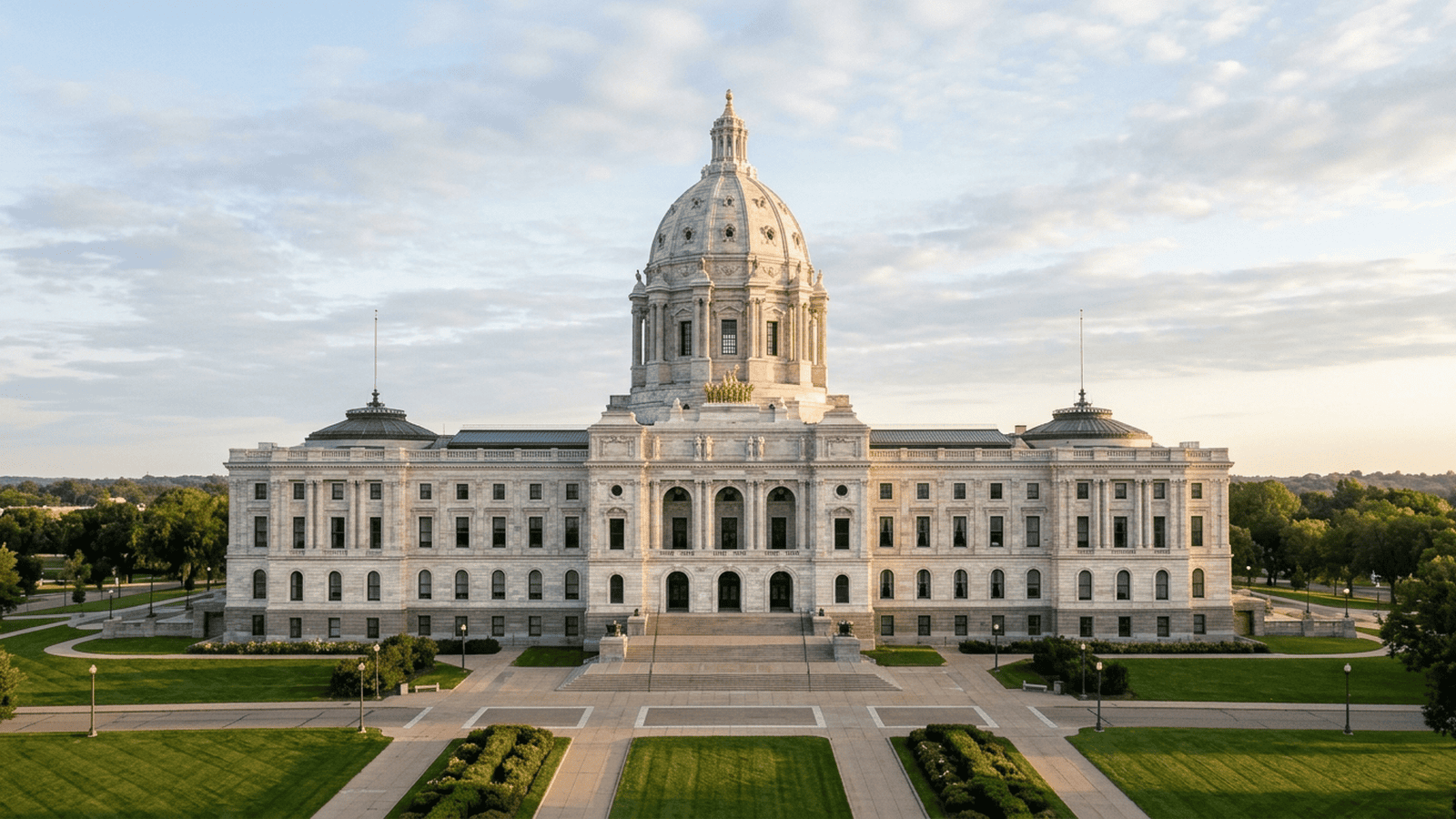
Minnesota Democrats have won the governor’s office and majorities in both chambers, restoring a DFL trifecta after divided government since 2024. Unofficial results showed at least 72 DFL seats in the 134-member House and at least 34 in the 67-member Senate, though races remained uncalled. The change ends a House power-sharing arrangement created after a 67-67 tie and removes one barrier associated with divided control. The election result does not enact labor measures, and the available account gives no specific proposals, fees, forms, compliance rules or deadlines. Final counts and legislative decisions are the next steps for determining what the new alignment will mean for workers and employers.
TLDR: The DFL now holds the governor’s office and majorities in the Minnesota House and Senate, although some races remained uncalled in unofficial results. No new labor rules or worker policies are enacted by the election itself, and specific proposals remain unstated.
Minnesota Democrats have won control of the governor’s office and both chambers of the Legislature, giving the DFL a state government trifecta. The result changes the balance of power after two years of divided government, when a tied House required a power-sharing agreement and several issues stalled. It does not, by itself, enact any new labor policy or worker protections.
The account of the election gives no official policy rationale for the change in control. It does establish a practical point: one party will hold the governor’s office, the House and the Senate. The same party will therefore lead all three parts of state government. That arrangement removes the divided governing structure that required negotiations between parties in the House. It does not establish what the DFL will do with that control.
U.S. Sen. Amy Klobuchar, the DFL nominee, won the governor’s race, defeating Republican House Speaker Lisa Demuth. Klobuchar entered the contest after Gov. Tim Walz said he would not seek a third term. She is expected to become Minnesota’s first woman governor. Her win gives the DFL the executive office alongside its legislative majorities, completing the party’s control of state government.
Unofficial results as of Wednesday morning showed the DFL with at least 72 of the House’s 134 seats. A majority requires 68. Republicans had won 50 seats, while 12 races remained outstanding. The reported DFL total was already above the threshold for control, but the final count was not complete in the account provided. The outstanding races could change the exact seat totals without changing the reported majority.
The Senate result also gave Democrats a majority. The DFL had won at least 34 of 67 seats, the number needed to control the chamber. Republicans had won 24 seats, with nine races still outstanding. The account described roughly a dozen Senate races as yet to be called, so those totals remained preliminary. The available information does not give a final count for either chamber.
The DFL entered Election Day with 67 House seats. A Republican resignation had broken a 67-67 tie, according to the report. In the Senate, Democrats began the election with a 34-33 majority. Those earlier margins made control of both chambers a central part of the election outcome. The account does not provide individual campaign promises on labor, wages or automation, so the result alone does not show which workplace issues lawmakers may prioritize.
The new alignment follows the 2024 election, when Republicans flipped three House seats and produced a 67-67 tie. That result ended the DFL’s previous two-year trifecta and began a period of divided government. The House had been tied only once before, in 1979, according to the account. The parties negotiated a power-sharing agreement that took effect in 2025. That agreement provided a way to manage the tie, but several issues still stalled under divided government.
The election now gives the DFL a clear majority in each chamber and the governor’s office. The results change the conditions under which legislation can be considered. They do not show which stalled issues will return, how lawmakers will address them or whether any specific proposal will pass. A majority can make it easier for one party to advance legislation, but the election account does not identify the next bills or describe the process lawmakers will use to resolve them.
For workers and employers, the immediate policy impact described in the available information is limited to the change in political control. No new fees, paperwork, compliance rules, enforcement actions or deadlines are identified. The account also does not specify which labor proposals the DFL intends to advance. Those details remain to be determined through future legislative action, rather than being established consequences of the election result.
That distinction matters for accountability. Campaign positions are not enacted measures, and a majority does not turn a proposal into law on its own. The reported results are unofficial, with House and Senate races still outstanding as of Wednesday morning. Completion of the counts will clarify the final seat totals. After that, lawmakers can decide what to introduce and debate during the next legislative period. Until specific measures are proposed and approved, workers and employers should not treat the change in control as a new rule, cost or deadline. The election changes who holds power; it does not establish the details of future policy.

Tom Blake serves as the Senior Correspondent for Labor, Wages, and Automation at Just Right News, where he brings a grounded, principled perspective to the most pressing economic issues facing the American heartland. As the lead voice behind the acclaimed feature series “The Price of Work,” Tom focuses his reporting on the intersection of traditional industry and the rapidly evolving technological landscape, always prioritizing the dignity of the individual worker and the health of the American family.
Tom’s deep understanding of the labor market is not merely academic; it is rooted in his upbringing in Detroit, Michigan. Growing up in the shadow of the automotive industry, he witnessed firsthand the triumphs and tribulations of the American blue-collar workforce. He saw how the stability of a manufacturing job could build a community and, conversely, how the erosion of those industries could tear the social fabric apart. This background instilled in him a lifelong respect for the trades and a healthy skepticism toward economic policies that prioritize globalist interests over the well-being of local communities.
Now based in Pittsburgh, Pennsylvania, Tom continues to report from the front lines of the shifting economy. Pittsburgh, a city that has reinvented itself while maintaining its gritty, industrious spirit, provides the perfect vantage point for his beat. From the steel mills that remain to the high-tech robotics labs reshaping the city’s future, Tom explores how automation is changing the nature of employment. His reporting often highlights the tension between innovation and tradition, arguing that while progress is inevitable, it must not come at the expense of the American worker’s ability to provide for their family through honest, meaningful labor.
In his role at Just Right News, Tom has become a vital voice for those who feel overlooked by mainstream economic coverage. He rejects the notion that the decline of American manufacturing is an unavoidable casualty of the modern era. Instead, his work often examines how regulatory overreach, rising energy costs, and the unchecked rise of automation impact the take-home pay of everyday citizens. Through “The Price of Work,” Tom delves into the true cost of economic shifts, looking beyond the raw data to tell the stories of the people behind the statistics.
Tom’s reporting is characterized by a commitment to the conservative values of self-reliance, fiscal responsibility, and the preservation of the American dream. He believes that a strong nation is built on a foundation of stable jobs and fair wages, and his work seeks to hold both government and corporate entities accountable to that standard. Whether he is interviewing a shop floor manager about the implementation of new AI technology or analyzing the impact of wage inflation on small businesses, Tom provides a clear-eyed analysis that resonates with readers who value hard work and common sense.
Through his dedicated coverage, Tom Blake remains a steadfast advocate for the American workforce, ensuring that the voices of those in the industrial heartland are heard loud and clear in the national conversation. His perspective is essential for anyone seeking to understand the complex realities of labor and automation in the twenty-first century.