

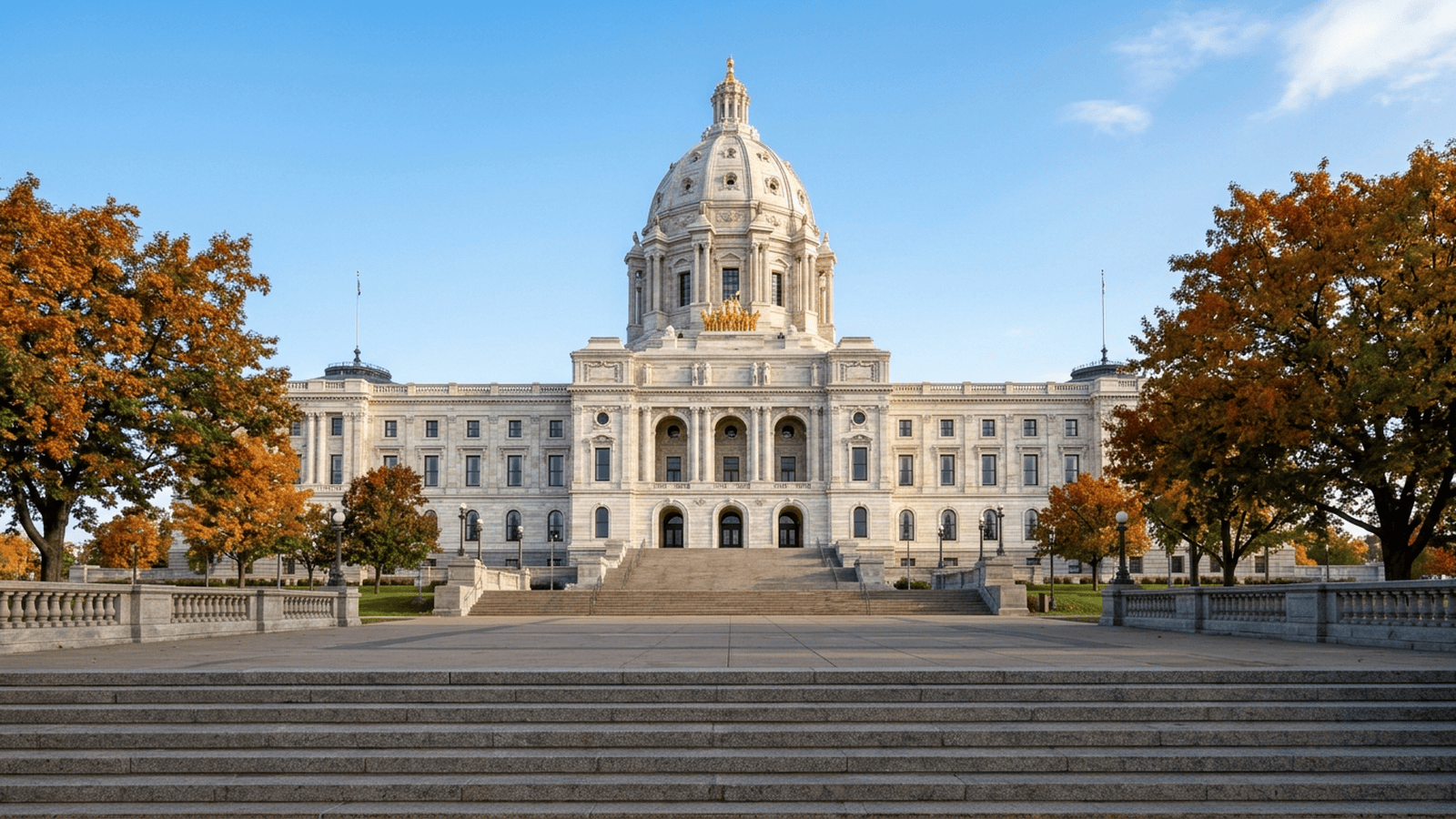
Minnesota Democrats have won the governor’s office and majorities in both legislative chambers, restoring a DFL trifecta after divided government since the 2024 election. Unofficial results showed at least 72 of 134 House seats and at least 34 of 67 Senate seats for the DFL, with races still uncalled. Amy Klobuchar defeated Republican Lisa Demuth in the governor’s race and is expected to become the state’s first woman governor. The excerpt says several issues stalled during divided government, but does not identify them or describe specific new policies. No technology rules, fees, forms, deadlines or enforcement plans are reported; outstanding counts and future legislative decisions remain to come.
TLDR: The DFL has won the Minnesota governor’s office and reported majorities in both legislative chambers, ending the divided-government arrangement that followed the 2024 election. Final race counts remain incomplete, and the available report names no specific new laws or technology policies.
Minnesota Democrats have won control of the governor’s office and both chambers of the Legislature, restoring a DFL trifecta after two years of divided government. Unofficial election results available Wednesday morning showed the party with at least 72 seats in the 134-member House and at least 34 of 67 Senate seats. Some races in both chambers were still outstanding, so the reported totals were not yet final.
The account points to stalled issues as a practical reason for the shift: several matters did not advance while state government was divided. That record offers a straightforward reason voters may see unified control as a way to move decisions forward. The excerpt does not identify those stalled issues or say which policies the incoming government plans to pursue. It does not provide a fuller official explanation for the result.
Amy Klobuchar, the DFL nominee, won the governor’s race Tuesday, defeating Republican House Speaker Lisa Demuth. Klobuchar entered the race after Gov. Tim Walz said he would not seek a third term. She is expected to become the first woman to serve as Minnesota’s governor, and her victory gives the DFL the executive office alongside its legislative majorities.
The House result gives Democrats a sizable lead over the majority threshold, even though the count remains unofficial. At least 72 DFL candidates had won, compared with 50 Republicans, and 12 races remained outstanding. A majority requires 68 seats. Democrats had entered Election Day with 67 seats after a Republican resignation broke a 67-67 tie that had followed the 2024 election.
The Senate picture is narrower. The DFL had won at least 34 seats, the number required for a majority, while Republicans had won 24. Nine races were still outstanding in the Senate, according to the excerpt, which also described roughly a dozen races as yet to be called. The DFL held a 34-33 majority before the election, so the reported result preserves its control while the final tally is completed.
A trifecta means one party controls the governor’s office, the House and the Senate. Minnesota last had divided government after the 2024 election, when Republicans flipped three House seats and the chamber ended in a tie. It was only the second tied House in state history, following 1979. The tie led the parties to negotiate a power-sharing agreement that took effect in 2025.
That agreement was a practical response to a chamber without a majority. It required the parties to share power rather than allowing either side to govern alone. The new election result changes that arrangement’s political context, because the DFL now has at least the reported number of seats needed for majorities in both chambers and has won the governor’s office as well. The final counts will determine the exact size of those legislative majorities.
The outcome does not, by itself, establish new laws or technology policies. No technology proposal, enacted measure, fee, compliance rule, deadline or enforcement plan appears in the excerpt. The election changes who will hold state power; any specific policy consequences remain unknown from the available information. That distinction matters for residents and businesses tracking proposals: a campaign result is not the same as an enacted law.
The practical impact at this stage is therefore institutional. The DFL is positioned to control the governor’s office, House and Senate, while final results in some legislative races remain outstanding. The excerpt lists no new forms, costs or compliance duties for residents, technology companies or other groups. It also provides no schedule for legislative action or details about how any stalled issues may be addressed. Without those details, the likely costs, paperwork, enforcement approach and timing of future proposals cannot be assessed.
The next steps are the completion of outstanding race counts and the transition to a government with DFL control across all three institutions. Those are necessary steps before the full legislative balance is settled. Any later technology policy should be judged by its actual text, costs and implementation details, none of which are provided here. The final seat totals and subsequent decisions will show what this new balance of power produces.

Ryan Mitchell serves as a Staff Writer for Just Right News, where he anchors the desk for Cyber, Technology Policy, and Digital Sovereignty. In an era where the digital landscape has become as much a battlefield as any physical territory, Ryan provides a critical conservative lens on the forces shaping the future of American innovation and national security. His work is defined by a commitment to the idea that American leadership in the digital age is not just a matter of economic success, but a necessity for the preservation of global liberty.
Born and raised in Austin, Texas, Ryan’s perspective is deeply rooted in the Lone Star State’s tradition of independence and skepticism of centralized authority. Growing up in a city that transformed from a quiet state capital into a global technology hub, he witnessed firsthand the disruptive power of the tech industry. This upbringing instilled in him a firm belief in free-market principles and the necessity of protecting individual liberties from both government overreach and corporate overstep. His Texan background serves as a foundational compass, guiding his reporting toward stories that emphasize national resilience and the preservation of constitutional values in an increasingly virtual world.
Now based in San Francisco, California, Ryan operates from the epicenter of the very industry he scrutinizes. Living and working in the heart of Silicon Valley allows him to provide “boots on the ground” reporting that few conservative journalists can match. He navigates the cultural and political complexities of the Bay Area to bring Just Right News readers an inside look at the boardrooms and coding labs where the next generation of digital policy is forged. For Ryan, being stationed in San Francisco is a strategic choice; it allows him to challenge the prevailing ideological monoculture of the tech elite from within their own backyard, ensuring that the concerns of middle America are represented in the conversation about our digital future.
His beat—Cyber, Technology Policy, and Digital Sovereignty—covers the high-stakes world of data privacy, artificial intelligence, and the infrastructure of the modern web. Ryan is particularly focused on the concept of digital sovereignty, arguing that for a nation to remain truly free, it must maintain control over its own technological destiny and critical infrastructure. He frequently explores how international regulations and domestic policies impact the ability of American firms to compete without sacrificing the privacy or security of their citizens.
Central to his current body of work is his featured series, “The New Cold War.” Through this project, Ryan examines the escalating technological rivalry between the United States and its global adversaries. He delves into the complexities of state-sponsored hacking, the global race for semiconductor dominance, and the ideological struggle to define the rules of the internet. Ryan views this competition not merely as a commercial race, but as a fundamental defense of Western values against authoritarian digital models. Through his rigorous reporting and principled analysis, Ryan Mitchell ensures that the readers of Just Right News stay informed about the invisible forces defining the 21st century, always advocating for a future where technology serves the cause of freedom.