

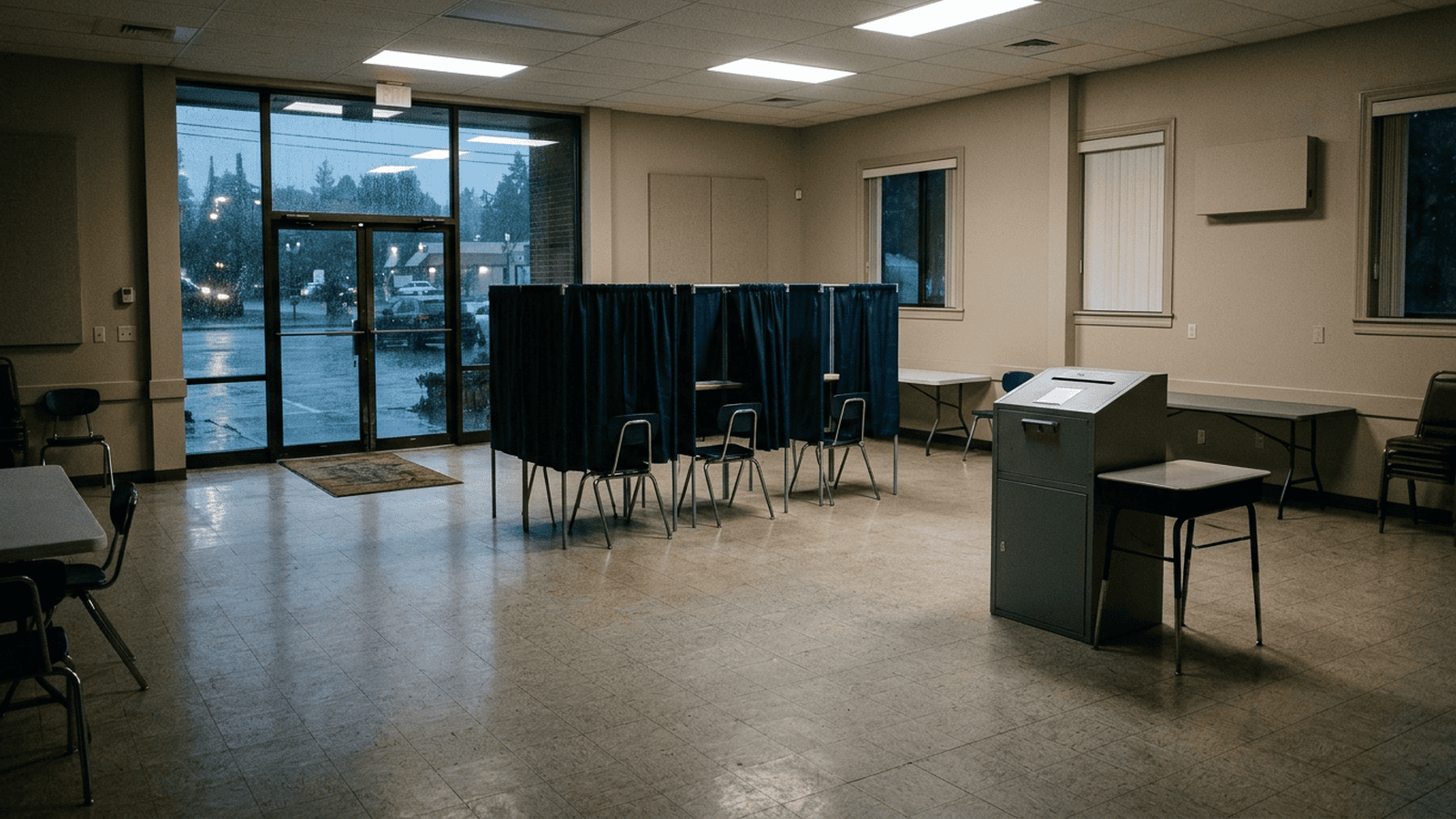
Reports from students across the United States describe a 2026 midterm night shaped by turnout, surprise results, and local concerns. An estimated 72 percent of voters ages 18 to 29 chose Democratic candidates for the U.S. House, compared with 25 percent who chose Republicans, while young voters also favored Democrats in several Senate races. In North Carolina, LaKesha Womack defeated incumbent Tim Moore in a district described as safe for Republicans. Student accounts also highlight concerns about rural living costs, land, and campus political speech. The reports document voter registration help, absentee-ballot forms, and waits at polling places, but do not describe a new election policy or a broader compliance plan.
TLDR: Young voters favored Democratic candidates in the reported 2026 midterm results, and students described local concerns from rural Alaska to college campuses. The accounts include voter-registration assistance and waits at polling places, but do not identify a new government policy.
The 2026 midterm election brought young voters to polling places and watch parties across the country. Reports from students in Alaska, Texas, Michigan, Indiana, Kansas, New York, Rhode Island, California, Connecticut, Massachusetts, and overseas describe a night of high hopes, uncertainty, and unexpected results. Their accounts offer individual snapshots, not a complete picture of every young voter.
The reporting’s stated purpose is to record what students experienced while watching the midterms. It also examines concerns raised by young voters about redistricting, local conditions, political representation, and the ability to speak openly on campus. The accounts do not describe a new government policy or present an official policy rationale.
One of the night’s largest political stories was the estimated youth vote for the U.S. House. The excerpt reports that 72 percent of voters ages 18 to 29 chose Democratic candidates, while 25 percent chose Republicans. Tufts University’s Center for Information & Research on Civic Learning and Engagement called the 47-point youth preference for Democrats the largest it had recorded in a national election. In Senate races, young voters also favored Democrats in Florida, Kansas, Maine, and Michigan, according to the reported figures.
North Carolina offered a sharp example of how the results challenged expectations. Democrat LaKesha Womack defeated Republican incumbent Tim Moore in the state’s 14th Congressional District, which the article describes as widely viewed as safe for Republicans. Moore had helped draw the district while serving in the General Assembly, and the district includes many students. The result came amid renewed attention to gerrymandering, or the drawing of electoral boundaries to influence likely outcomes.
In Nome, Alaska, the election unfolded against concerns about the cost of living and the place of local resources in the state’s future. Electrical lineman Perry Saito said promises made by the current president had not come true. Another resident, Amanda Van Vliet, described paying about $10,000 for diesel to heat her home the previous year and said costs were rising as her family cared for foster children. The excerpt also reports that unleaded fuel cost $7.39 a gallon in Nome.
For Guadalupe Callahan, a recent college graduate raised in Nome, land preservation was tied to fishing and hunting. Her comments reflected local concerns that she said were not well understood by people in the Lower 48. The reports do not establish that her views represent all young Alaskans. They show how rural costs, subsistence activities, and state identity appeared in one community’s election discussion.
On college campuses, election events offered a public setting for students to react to results. At Boston College, students described a campus where they often avoided political arguments. Junior Connor Moquin compared the atmosphere to holding back political discussion at a family dinner to avoid a fight. The account also notes the school’s low ranking in a free-speech ranking and reports student concerns about administrative limits on protests and self-censorship.
Other scenes were more openly celebratory. At Brown University in Providence, students gathered for games, food, analysis, and election updates. The Associated Press call in the Massachusetts Senate race prompted a shift in the watch party, while students followed results in other states. Reports from campus events show how political interest and social life mixed on election night, though the selected scenes cannot establish how students generally felt nationwide.
The practical details in the reports concern voting access rather than a new rule. At Cornell, a student group helped nearly 500 students register during the semester, compared with just over 300 during the 2024 presidential election, and distributed more than four times as many absentee-ballot forms. Members assisted voters at the campus polling place from 5 a.m. to 9 p.m. The excerpt gives no fee, new paperwork requirement, compliance deadline, or enforcement change. It also reports that some students waited nearly half an hour to vote in the rain, a real cost in time and comfort.
These accounts capture a consequential election through selected student experiences, while the reported vote estimates provide broader figures. The next steps described in the excerpt are limited to the election process: ballots placed in an emergency box were still to be counted after polls closed, according to a person quoted in the reporting. No further oversight schedule or election deadline is specified.

Deborah Cole serves as a Senior Correspondent for Just Right News, where she spearheads the network’s coverage of Housing, Infrastructure, and Mobility. With a career defined by a commitment to rigorous reporting and a focus on the fundamental pillars of American community life, Deborah brings a principled perspective to the complex issues that dictate how and where we live. Her work is grounded in the belief that sound policy, fiscal responsibility, and respect for private property are the essential foundations of a prosperous society.
Originally from Boston, Massachusetts, Deborah’s upbringing in one of the nation’s oldest and most historically significant cities deeply influenced her professional trajectory. Growing up amidst the architectural legacy and dense urban planning of New England, she developed an early appreciation for the importance of durable infrastructure and the role of local tradition in shaping neighborhoods. Her perspective is informed by the classic American values of her hometown—hard work, community cohesion, and a healthy skepticism of top-down bureaucratic mandates that often overlook the unique needs of individual citizens.
Today, Deborah operates from her base in Austin, Texas, a city that serves as a primary laboratory for her reporting. Austin’s rapid expansion and its status as a hub for innovation and migration provide her with a front-row seat to the most pressing challenges in modern infrastructure and housing. From the Lone Star State, she chronicles the tensions between rapid growth and the preservation of the American Dream, often highlighting how market-driven solutions and deregulation can address the housing shortages that plague many of the country’s metropolitan areas.
At Just Right News, Deborah is perhaps best known for her signature feature series, “Where We Live.” Through this platform, she explores the intersection of public policy and private life, moving beyond mere statistics to tell the stories of families, small business owners, and local developers. Her reporting frequently highlights the importance of mobility—not just in terms of transportation and transit, but as a vehicle for economic opportunity and social stability. She remains a staunch advocate for the taxpayer, consistently scrutinizing government spending on large-scale projects and advocating for transparency in how infrastructure dollars are allocated.
Deborah’s beat is more than just a collection of policy topics; it is an investigation into the physical and legal structures that allow families to flourish. Whether she is reporting on the impact of zoning laws on suburban development or the necessity of maintaining the nation’s highway systems, her work is characterized by a dedication to the facts and a respect for the constitutional principles that protect the rights of homeowners.
As a Senior Correspondent, Deborah Cole continues to be a vital voice for Just Right News, providing the audience with the clarity and context needed to navigate an ever-changing landscape. Her reporting ensures that the values of individual liberty and local sovereignty remain at the forefront of the national conversation regarding the future of our cities and towns. Through her tireless efforts, she remains committed to informing the public on the issues that hit closest to home.