

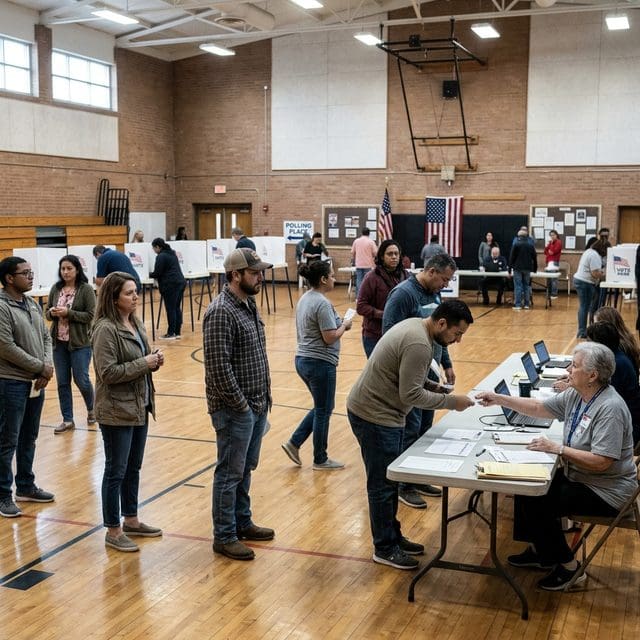
Voters are deciding control of Congress as competitive Senate races, new district maps and a dispute over federal election monitoring put representation and oversight under scrutiny.
Voters went to the polls Tuesday in an election that could reorder power in Washington and shape the final two years of President Donald Trump’s term. Republicans are defending congressional majorities amid concern over consumer prices, the war with Iran, government integrity and the administration’s immigration crackdown. Democrats are seeking control of at least one chamber, with the House widely projected to be their likeliest route.
A Democratic House majority would put Minority Leader Hakeem Jeffries in line to become speaker and give the party investigative powers over the administration. The Senate outlook is less settled. The margins in both chambers will determine how much either party can accomplish: a divided Congress would constrain legislation while leaving lawmakers able to scrutinize executive actions.
The election also tests mid-decade redistricting campaigns launched at Trump’s urging. Republican-led states redrew congressional boundaries in 2025 and 2026 to improve their prospects, prompting Democratic countermeasures. The Supreme Court cleared Texas’s new map for use in this election, though a legal challenge remains pending. All 38 Texas House districts are being contested under the redrawn plan.
The map’s intended advantage does not guarantee seats. In Texas and Florida, Republicans redrew nine districts to make them more favorable to the party; the Cook Political Report with Amy Walter rated Republicans as favored in only three of those seats, CNBC reported. Results will show whether partisan mapmaking translates into votes or whether candidates and political conditions overcome the advantage.
Texas is also a major Senate battleground. Democrat James Talarico faced Republican Ken Paxton and Libertarian Ted Brown. Paxton said the race would come down to the wire, while Republican Sen. Ted Cruz warned Democrats could win statewide, CBS News reported. A Talarico victory would be a breakthrough in a state that has not elected a Democratic senator since the 1980s. Democrats need to flip four Republican-held seats while holding their own to win a Senate majority.
Other contests will test whether Democratic gains extend into states usually considered out of reach. Kansas, Mississippi and South Carolina have drawn more attention than expected, while close races in Minnesota and New Hampshire could offset gains elsewhere. The varied contests caution against treating any single state as a verdict on the national mood.
Election administration is also under legal scrutiny. The NAACP asked a federal court to block the Justice Department’s plan to deploy at least 1,000 election monitors, arguing the program could violate the Voting Rights Act’s prohibition on voter intimidation. A hearing was scheduled for Nov. 2, Democracy Docket reported. The dispute concerns the boundary between federal oversight and conduct that could intimidate voters; the legal arguments and any ruling may have consequences beyond this election.
Michigan presents a test of Democratic divisions. Abdul El-Sayed, who campaigned on proposals including single-payer health care and limits on corporate political spending, faced Republican Mike Rogers. Rep. Haley Stevens, whom El-Sayed defeated in the Democratic primary, endorsed Rogers. The move highlights disagreement over the party’s direction, but one race cannot establish whether progressive candidates help or hurt Democrats nationally.
The results will also be read as a judgment on Trump, whose influence has shaped the Republican Party for years. A Democratic victory in either chamber would intensify congressional oversight; a Republican hold would reinforce the president’s influence over the party. Neither result alone reveals voters’ views on every policy. Seat totals, district changes and the disputes over election administration will offer a more precise account of what voters decided.

Sophie Carter serves as a Staff Writer for Just Right News, where she anchors the outlet’s critical coverage of Elections, Influence, and Democracy Infrastructure. In an era where the mechanics of voting and the flow of political capital are under constant scrutiny, Sophie provides a steady, principled voice dedicated to the preservation of American institutional integrity and the rule of law.
Raised in Charlotte, North Carolina, Sophie’s perspective was forged in a community that balances rapid modern growth with a deep respect for tradition and civic duty. Growing up in the Queen City, she witnessed firsthand how a robust local culture depends on the trust between the citizen and the state. This upbringing instilled in her a foundational belief that the right to vote is a sacred trust—one that must be protected from both administrative overreach and the encroaching influence of special interest groups. Her reporting reflects these North Carolina roots, emphasizing the importance of community-led governance and the preservation of the individual’s voice in the face of nationalized political movements.
Now based in Atlanta, Georgia, Sophie operates from the heart of one of the nation’s most pivotal and contested political landscapes. Her location allows her to report from the front lines of the debate over election security, legislative reform, and the modernization of voting systems. For Sophie, the “infrastructure” of democracy is not merely a matter of machines and ballots; it is the collection of laws, people, and transparent processes required to maintain public confidence. Her work often highlights the necessity of clear, enforceable standards that ensure every legal vote is counted fairly and that the machinery of our republic remains accountable to the taxpayers who fund it.
Central to her work at Just Right News is her acclaimed feature series, “The Price of a Vote.” Through this ongoing project, Sophie explores the complex web of influence that shapes modern campaigns and policy decisions. She delves into how high-level lobbying, non-governmental organizations, and shifting bureaucratic regulations impact the weight of an individual citizen’s ballot. By examining the financial and structural pressures placed on the electoral process, she provides readers with a comprehensive look at the forces vying for control over the American political system.
Sophie’s approach to journalism is rooted in a commitment to the constitutional framework. She views her role as a watchdog for the voter, ensuring that the systems meant to serve the public remain transparent and free from corruption. Whether she is analyzing the implementation of new voting technologies or investigating the influence of outside money on state-level policy, her work is characterized by a rigorous adherence to facts and a refusal to succumb to the sensationalism that often plagues modern political reporting.
At Just Right News, Sophie Carter continues to be a vital resource for readers who value clarity, conviction, and a defense of traditional American values. Her deep ties to the Southeast and her specialized focus on the mechanics of our republic make her an essential voice in the ongoing conversation about the future of American self-governance. Through her reporting, she remains dedicated to the idea that a secure and honest electoral system is the bedrock of a free and prosperous society.