

A Justice Department request to isolate disputed mail ballots tests how far federal authority can reach into a state’s election-counting procedures on the eve of voting.
A Justice Department emergency request to the Supreme Court has put California’s election procedures—and the boundary between federal and state power—under scrutiny one day before the state’s Nov. 3 midterm election.
Solicitor General D. John Sauer asked the justices for a “limited injunction” to prevent ballots identified by the federal government from being commingled with other ballots while citizenship is verified and the broader appeal proceeds. The request does not seek immediate cancellation of those ballots. As of the latest reports on Nov. 2, the Supreme Court had not publicly ruled.
The dispute centers on a federal list of people the Trump administration considers likely noncitizens. The Justice Department relies on federal law barring noncitizens from voting. California officials argue the list is unreliable and say isolating the ballots at this stage is infeasible. The Ninth Circuit concluded that the proposed process could disenfranchise eligible voters and jeopardize the Los Angeles County election.
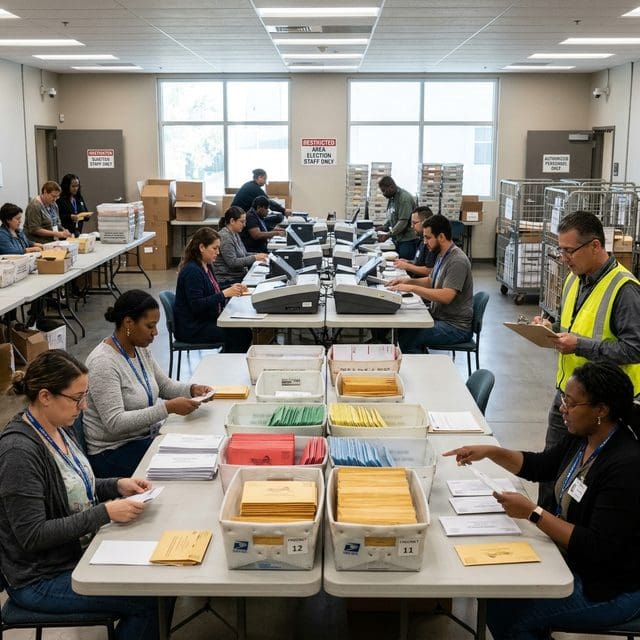
The timing sharpens the practical stakes. Ballot processing was already underway, with hundreds of thousands of ballots processed, according to an Associated Press report carried by the Boston Herald. California mails ballots to all of its roughly 23 million registered voters, making any last-minute change to handling procedures a significant operational challenge for local election officials.
A legal filing reported by The Hill said more than 40 percent of the names on the administration’s California list were not on the state’s voter rolls. That finding does not resolve the status of people whose names do appear on the list, but it underscores the risk of treating an unverified federal match as a definitive election record. California’s position is that existing safeguards and state-administered procedures should govern the ballots while the dispute is litigated.
The case is a test of federalism in a particularly compressed setting. States administer elections, and their counties carry out the work of processing and counting ballots. The federal government, meanwhile, may enforce federal voting restrictions. The question before the court is whether that federal interest permits an emergency intervention that changes how a state handles ballots before citizenship has been verified and before the underlying appeal is resolved.
The distinction between barring unlawful votes and prescribing a state’s counting process is central to the dispute. The Justice Department says its requested separation would preserve the ballots while verification and litigation continue. California argues the measure cannot practicably be carried out and could expose eligible voters to exclusion. The Ninth Circuit’s concern about disenfranchisement reflects the difficulty of translating a federal list into a workable county-level procedure on the eve of an election.
The case also illustrates how state and local authority can be affected without Congress passing a new election law or a state changing its own rules. A Supreme Court order could require California election officials to adopt a new handling procedure under intense time pressure; a denial would leave the state’s existing process in place while the larger legal fight continues. Either outcome could inform future disputes over federal enforcement and state election administration, though the immediate request concerns California and the ballots at issue there.
With the election a day away, the court’s decision may determine whether California’s local officials can continue processing ballots under existing procedures or must separate disputed ballots as the appeal proceeds. The broader question—how federal law operates alongside state control of election administration—will remain even after the immediate counting deadline passes.

Dylan Brooks serves as the Senior Correspondent for Statehouses and Local Governance at Just Right News, where he brings a principled, constitutionalist lens to the often-overlooked machinery of state-level politics. As the lead voice behind the acclaimed feature series “Fifty Laboratories of Power,” Dylan has dedicated his career to the idea that the most impactful governance happens closest to home. His reporting consistently champions the Tenth Amendment, exploring how individual states can serve as testing grounds for innovative, conservative policy solutions that prioritize personal liberty and fiscal responsibility.
A native of Des Moines, Iowa, Dylan’s journalistic philosophy was forged in the heart of the American Midwest. Growing up in a community where local school board meetings and town halls were the bedrock of civic life, he developed a deep appreciation for the “retail politics” of the heartland. This upbringing instilled in him a fundamental belief that the American experiment is best preserved when power is decentralized. He carries the values of his Iowa roots into every assignment, maintaining a healthy skepticism of federal overreach and a steadfast commitment to the concerns of everyday citizens over the interests of the administrative state.
Now based in Madison, Wisconsin, Dylan operates from one of the nation’s most pivotal political battlegrounds. His location in a state capital known for its rigorous policy debates allows him to provide Just Right News readers with a front-row seat to the legislative process. From Madison, he tracks the ripple effects of statehouse decisions on local municipalities, ensuring that the connection between high-level policy and community impact is never lost. His work often highlights the success of conservative governors and legislatures in fostering economic growth, protecting parental rights, and securing the integrity of local institutions.
As an African American man in the conservative media landscape, Dylan offers a vital perspective on how limited government and free-market principles empower individuals and families. He frequently reports on how deregulation and school choice initiatives provide new avenues for success in underserved communities, challenging the monolithic narratives often presented by legacy media outlets. Dylan’s work is characterized by a commitment to the facts and a refusal to shy away from the complex realities of modern governance.
Throughout his tenure at Just Right News, Dylan has become a trusted authority for readers who value a rigorous, principled approach to the news. Whether he is dissecting a complex state budget or profiling a local grassroots movement, his goal remains the same: to provide the American public with the information they need to hold their local leaders accountable. By focusing on the “Fifty Laboratories of Power,” Dylan Brooks ensures that the vital work being done in statehouses across the country receives the national attention it deserves, always through a lens that respects the traditions and sovereignty of the American people.