

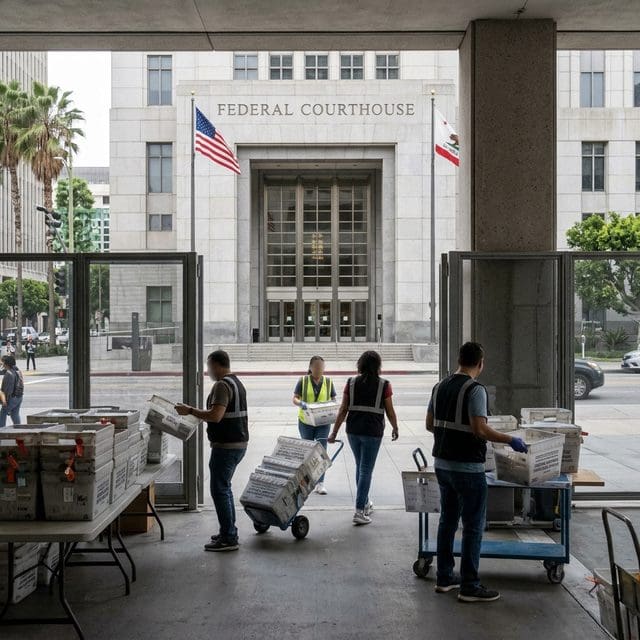
A federal judge rejected the Trump administration’s effort to stop California counting ballots flagged as potentially cast by noncitizens, citing unreliable evidence and risks to voters’ rights.
A federal judge has rejected the Trump administration’s attempt to stop California from counting ballots cast by more than 20,000 registered voters whom the Justice Department says may be noncitizens. The ruling leaves the state’s counting procedures in place while the department’s lawsuit proceeds.
U.S. District Judge David Carter denied the department’s request for a temporary restraining order. Filed October 15, the lawsuit sought to bar officials from counting ballots from the flagged voters. Carter said the request raised serious concerns about federal interference with state election procedures and the rights of eligible voters.
Carter’s 26-page order found the department’s list insufficiently reliable for the requested emergency relief. It also said the case likely implicated the National Voter Registration Act, Voting Rights Act and Civil Rights Act. The department had not adequately explained how counting ballots would hinder federal prosecutions of noncitizens who vote in federal elections, according to reporting on the ruling.
The data methodology remains central to the dispute. The department’s broader review initially identified about 190,000 possible noncitizens, then narrowed its case to 20,000 described as “high-confidence” matches. The Los Angeles Times and Daily Journal reported that the government did not adequately explain its matching method or provide error rates. A mistaken match could put an eligible voter’s ballot at risk, including those of naturalized citizens. The department has not said how many of the flagged people submitted mail ballots.
Carter warned that excluding ballots on the basis of unproven allegations could cause lasting harm to voters and public trust. California says its safeguards against noncitizen voting are robust and that complying with the federal demand could disenfranchise eligible voters. Gov. Gavin Newsom called the decision a victory for the rule of law and said the state would continue seeking dismissal of what he called a baseless lawsuit.
The Justice Department filed a notice of appeal after the ruling and said it would seek emergency relief from the Ninth Circuit Court of Appeals, according to NPR and CNN. Department lawyer Bill Essayli wrote on X that ballots were being processed each day and said he would seek an emergency order.
The Ninth Circuit had already rejected an earlier emergency request, filed before Carter ruled. On October 26, a three-judge panel dismissed that appeal as premature in a 2-1 decision. Judges Mark Bennett and Gabriel Sanchez formed the majority; Judge Patrick Bumatay dissented. The majority questioned the claimed urgency as at least partly “self-constructed” and indicated it might have denied relief even if the court had jurisdiction, according to The Hill and Democracy Docket.
The two appeals are distinct: the first was dismissed because Carter had not yet ruled; the latest challenges his order. Neither has blocked California from counting the ballots. The courts have not decided the merits of the lawsuit or established whether any flagged voter cast a ballot.
Carter plans further fact-finding, including another hearing within two weeks. Expert testimony and a court-appointed special master are expected to examine the list and the parties’ evidence, according to MyNewsLA. Officials have until December 3 to certify results, leaving a compressed schedule for review.
The administration has also pursued election-related actions involving Alaska and Washington, according to the source reporting. The California case turns on a narrower question: whether the federal government can obtain extraordinary pre-election relief based on a voter list whose reliability and methodology remain contested. For now, ballots remain subject to California’s procedures as the courts weigh the evidence and the limits of federal authority.

Sophie Carter serves as a Staff Writer for Just Right News, where she anchors the outlet’s critical coverage of Elections, Influence, and Democracy Infrastructure. In an era where the mechanics of voting and the flow of political capital are under constant scrutiny, Sophie provides a steady, principled voice dedicated to the preservation of American institutional integrity and the rule of law.
Raised in Charlotte, North Carolina, Sophie’s perspective was forged in a community that balances rapid modern growth with a deep respect for tradition and civic duty. Growing up in the Queen City, she witnessed firsthand how a robust local culture depends on the trust between the citizen and the state. This upbringing instilled in her a foundational belief that the right to vote is a sacred trust—one that must be protected from both administrative overreach and the encroaching influence of special interest groups. Her reporting reflects these North Carolina roots, emphasizing the importance of community-led governance and the preservation of the individual’s voice in the face of nationalized political movements.
Now based in Atlanta, Georgia, Sophie operates from the heart of one of the nation’s most pivotal and contested political landscapes. Her location allows her to report from the front lines of the debate over election security, legislative reform, and the modernization of voting systems. For Sophie, the “infrastructure” of democracy is not merely a matter of machines and ballots; it is the collection of laws, people, and transparent processes required to maintain public confidence. Her work often highlights the necessity of clear, enforceable standards that ensure every legal vote is counted fairly and that the machinery of our republic remains accountable to the taxpayers who fund it.
Central to her work at Just Right News is her acclaimed feature series, “The Price of a Vote.” Through this ongoing project, Sophie explores the complex web of influence that shapes modern campaigns and policy decisions. She delves into how high-level lobbying, non-governmental organizations, and shifting bureaucratic regulations impact the weight of an individual citizen’s ballot. By examining the financial and structural pressures placed on the electoral process, she provides readers with a comprehensive look at the forces vying for control over the American political system.
Sophie’s approach to journalism is rooted in a commitment to the constitutional framework. She views her role as a watchdog for the voter, ensuring that the systems meant to serve the public remain transparent and free from corruption. Whether she is analyzing the implementation of new voting technologies or investigating the influence of outside money on state-level policy, her work is characterized by a rigorous adherence to facts and a refusal to succumb to the sensationalism that often plagues modern political reporting.
At Just Right News, Sophie Carter continues to be a vital resource for readers who value clarity, conviction, and a defense of traditional American values. Her deep ties to the Southeast and her specialized focus on the mechanics of our republic make her an essential voice in the ongoing conversation about the future of American self-governance. Through her reporting, she remains dedicated to the idea that a secure and honest electoral system is the bedrock of a free and prosperous society.