

In 1889, Congress divided Dakota Territory and established a process for North Dakota and South Dakota to draft and ratify separate constitutions. The United States admitted both states on November 2, resolving a regional political dispute through federal conditions, local votes, and presidential proclamations.
TLDR: Congress authorized separate constitutional conventions for North and South Dakota in 1889. Voters approved both constitutions, and President Benjamin Harrison proclaimed both states admitted on November 2. The process transformed territorial political competition into two state governments and demonstrated Congress’s central role in setting conditions for admission.
In 1889, the United States faced an unusual statehood question on the northern Great Plains: whether the vast Dakota Territory should enter the Union as one state or be divided into two. The dispute was more than a boundary argument. It raised questions about who could authorize a new state, how territorial voters could frame its constitution, and whether Congress would admit communities with competing political interests as a single unit. The outcome was a carefully managed transition that created North Dakota and South Dakota together.
Dakota Territory had been organized in 1861, when its population and settlement patterns differed sharply from those of the late 1880s. Railroads, land promotion, and migration fueled rapid growth, especially in the south. Residents had long sought statehood, but disagreement over division complicated the campaign. Northern communities feared that a larger southern population would dominate a unified government; southern residents also had political reasons to favor a separate state. Congress ultimately chose division rather than asking territorial voters to settle the matter alone.
The Enabling Act, signed by President Grover Cleveland on February 22, 1889, authorized conventions to draft constitutions for North Dakota and South Dakota, as well as for Montana and Washington. It prescribed the process for admission and set conditions, including provisions concerning public lands and the establishment of state governments. The act did not simply declare the Dakotas states. Voters still had to approve constitutions, and Congress retained the authority to determine whether the requirements had been met.
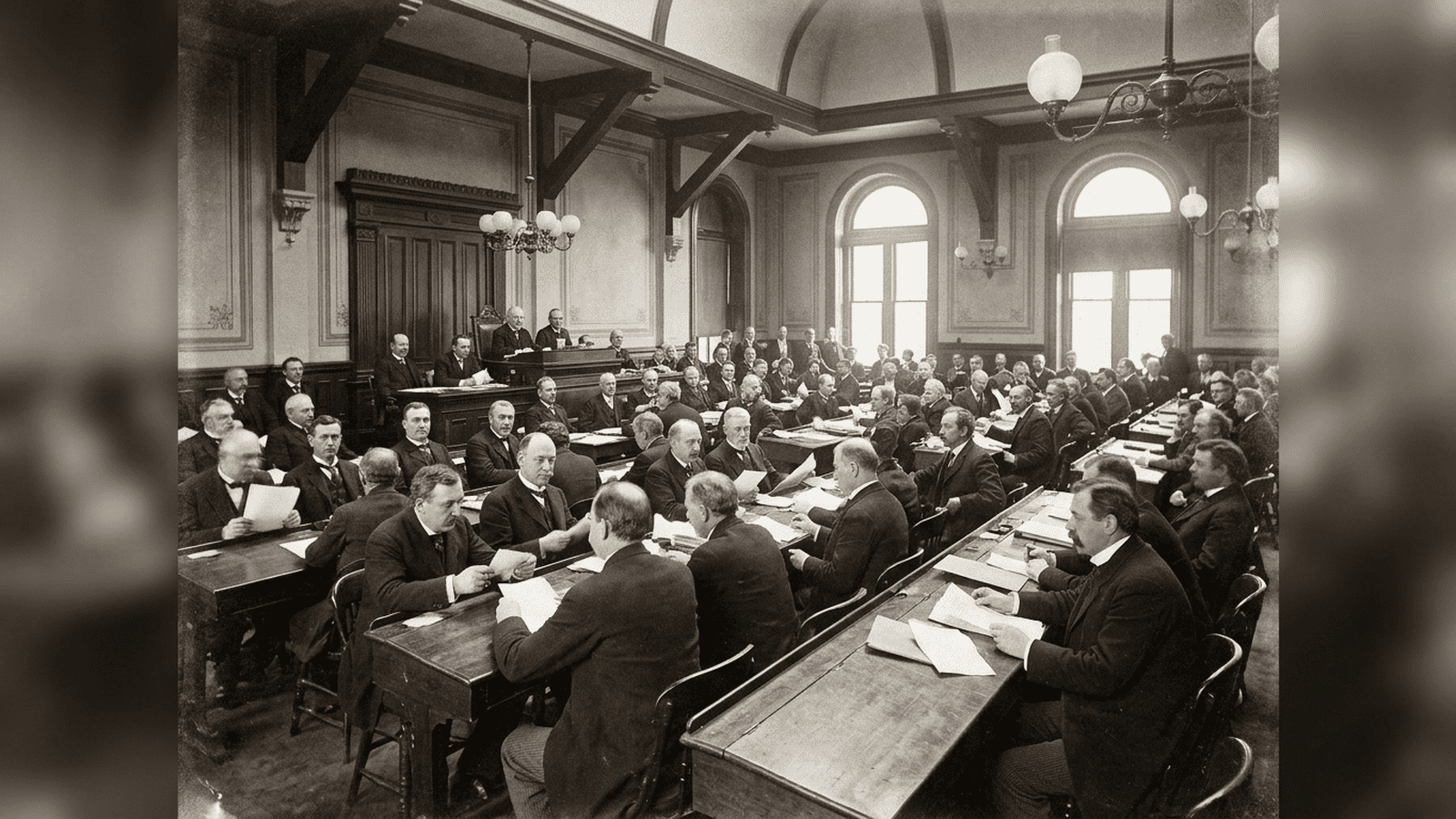
Constitutional conventions assembled in Bismarck and Sioux Falls during the summer. Delegates debated the structure and powers of their prospective governments, including the legislature, judiciary, and protections for civil rights. Both conventions produced constitutions, which voters approved in October. Elections also selected state officers and members of Congress. These proceedings gave each territory a separate constitutional framework, but formal admission remained a federal decision. Until Congress and the president completed that step, the new governments could not claim the full standing of states in the Union.
Congress passed the omnibus admission measure in February 1889, before the conventions had completed their work. Its conditions required the territories to organize governments consistent with the enabling law and submit the resulting constitutions to voters. The timetable made the change swift, but the sequence mattered: authorization came first, followed by convention, ratification, and federal recognition. The process illustrated the constitutional division of responsibilities. Local voters could endorse a proposed charter, while Congress controlled admission under its power to admit new states.
On November 2, President Benjamin Harrison signed proclamations admitting North Dakota and South Dakota. Accounts of the ceremony emphasize that Harrison shuffled the papers before signing, leaving uncertain which state formally entered first. The gesture avoided appearing to favor one Dakota over the other; legally, both were admitted on the same date. The new states began with separate constitutions and governments, replacing the territorial arrangement with equal representation in the Senate and a direct role in national elections.
The episode did not produce a lasting constitutional showdown, but it demonstrated how statehood could turn regional competition into questions of federal authority and self-government. The enabling act, constitutional conventions, voter approvals, and presidential proclamations created a defined path from territory to state, while leaving Congress with the decisive admission power. North Dakota and South Dakota’s simultaneous entry also expanded the political weight of the Great Plains. Their transition became a precedent in practice for managing multiple state admissions through federal conditions, local ratification, and final executive recognition.

Lila Hayes serves as a Staff Writer for Just Right News, where she anchors the “Courts, Law, and Constitutional Order” beat. Her work is defined by a steadfast commitment to the foundational principles of the American republic and a rigorous defense of the legal frameworks that ensure national stability. As a primary voice for the outlet, she provides readers with a clear-eyed analysis of the judiciary, focusing on the importance of originalism and the preservation of the separation of powers.
Lila’s perspective was forged in the American heartland. Raised in St. Louis, Missouri, she grew up in a Hispanic household where the values of hard work, faith, and respect for the law were paramount. Her upbringing instilled in her a deep appreciation for the American Dream and the legal protections that make it possible. This Missouri background remains a cornerstone of her reporting, providing a grounded, common-sense counter-narrative to the often-insular legal circles of the coastal elite. She understands that the decisions made in high-court chambers have real-world consequences for families and small business owners across the country.
At Just Right News, Lila has become widely recognized for her signature feature series, “The Rulebook of Power.” In this ongoing project, she delves into the mechanics of the federal government, examining how administrative overreach and judicial activism can threaten the delicate balance of the Constitution. She approaches her beat with the tenacity of a veteran journalist and the precision of a legal scholar, consistently advocating for a judiciary that interprets the law as written rather than legislating from the bench. For Lila, the Constitution is not a “living” document subject to the whims of modern social trends; it is a fixed standard that ensures the government remains the servant of the people, not their master.
Now based in Philadelphia, Pennsylvania, Lila finds herself at the very epicenter of American constitutional history. Living and working in the city where the Founders drafted the documents she defends daily provides a constant source of inspiration. The historic halls and landmarks of Philadelphia serve as a daily reminder of the high stakes involved in her reporting. Her presence in the city allows her to bridge the gap between the historical intent of the law and its contemporary application, ensuring that the legacy of the Founding Fathers remains central to the national conversation.
Throughout her career, Lila has remained dedicated to the idea that a free society requires an informed citizenry and a transparent legal system. Her reporting is more than just a collection of headlines; it is a defense of the constitutional order that has sustained the nation for over two centuries. By focusing on the “Rulebook of Power,” she ensures that her readers understand not just what is happening in the courtrooms, but why those decisions matter for the future of American liberty. Lila Hayes continues to be a vital voice for those who believe that the law should be a shield for the citizen and a constraint on the state.