

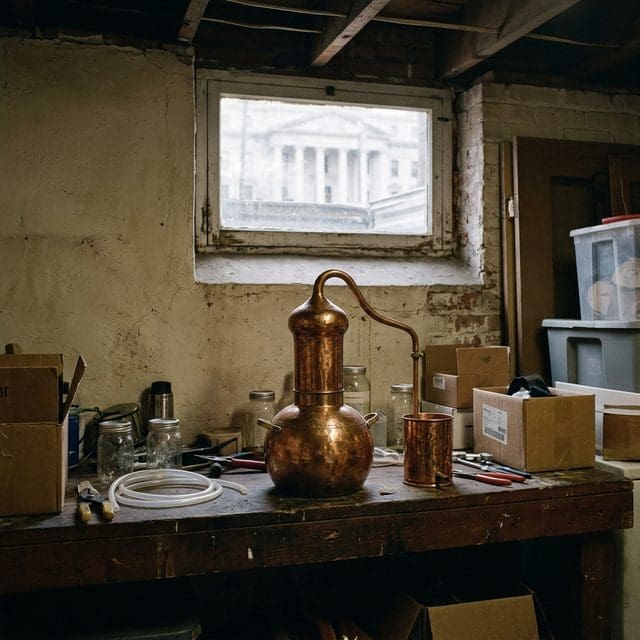
The justices will resolve a split over whether Congress may use its taxing power to prohibit the production of distilled spirits in private homes.
The Supreme Court has agreed to decide whether Congress may prohibit Americans from distilling spirits in their homes as a way to enforce federal liquor taxes, taking up a dispute that has divided two federal appeals courts.
The justices granted review October 19 in Department of Justice v. McNutt, accepting the Justice Department’s appeal from the Fifth U.S. Circuit Court of Appeals. The case concerns a federal law barring the production of distilled spirits in “any dwelling house” or a connected “shed, yard, or inclosure.” Violations can bring up to five years in prison and a $10,000 fine.
The constitutional question is narrower than whether Congress can tax alcohol. It is whether the taxing power also permits Congress to forbid distilling in a particular place, including a private home, as a means of protecting the tax system. The Fifth Circuit concluded that the home-production prohibition exceeded that power. The Sixth Circuit reached the opposite result in a separate challenge brought by John Ream, creating a circuit split the Supreme Court can now resolve.
The administration says the restriction helps prevent concealed production, unreliable measurements of alcohol strength and evasion of federal excise taxes. Solicitor General D. John Sauer has argued that taxes on distilled spirits produce billions of dollars in annual revenue, and that the location rule assists their collection.
The challengers counter that the law works against revenue by preventing people from producing spirits that could otherwise be taxed. They also warn that accepting the government’s reasoning could give Congress authority to prohibit other activities in private homes under the label of tax enforcement.
That disagreement goes to the boundary between raising revenue and regulating conduct. Congress’s power to tax necessarily involves measures for administering and enforcing taxes. But the challengers argue that a flat ban on home production is not merely a tool for collecting a tax: it prevents the underlying activity altogether. The Court’s task will be to assess the challenged restriction, not to decide that every measure connected to a federal tax is valid—or that Congress has no authority to take practical steps against tax evasion.
The administration has also urged the justices not to reach a separate question about Congress’s power to regulate interstate commerce raised in Ream’s litigation. The Solicitor General says that issue was not part of the government’s arguments in McNutt or the Fifth Circuit case. That request could keep the eventual decision focused on the taxing power rather than producing a broader ruling on federal authority over home distilling.
The dispute has historical resonance. Federal efforts to tax distilled spirits were an early test of national authority, most famously in the Whiskey Rebellion of the 1790s. The present case, however, turns on the scope of a specific modern restriction and the government’s stated justification for it—not on whether the federal government may impose an excise tax on liquor.
A decision against the federal restriction would not, by itself, make home distilling lawful everywhere. Cleveland.com reported that Ohio separately requires state authorization to make spirituous liquor, including for personal use. State rules would remain a distinct issue even if the justices concluded that Congress had exceeded its taxing power in this federal law.
The Court’s grant of review settles no part of the constitutional dispute. It puts the competing rulings before the justices and leaves the practical reach of the federal ban unresolved until they decide whether tax enforcement justifies barring production in the home.

Lila Hayes serves as a Staff Writer for Just Right News, where she anchors the “Courts, Law, and Constitutional Order” beat. Her work is defined by a steadfast commitment to the foundational principles of the American republic and a rigorous defense of the legal frameworks that ensure national stability. As a primary voice for the outlet, she provides readers with a clear-eyed analysis of the judiciary, focusing on the importance of originalism and the preservation of the separation of powers.
Lila’s perspective was forged in the American heartland. Raised in St. Louis, Missouri, she grew up in a Hispanic household where the values of hard work, faith, and respect for the law were paramount. Her upbringing instilled in her a deep appreciation for the American Dream and the legal protections that make it possible. This Missouri background remains a cornerstone of her reporting, providing a grounded, common-sense counter-narrative to the often-insular legal circles of the coastal elite. She understands that the decisions made in high-court chambers have real-world consequences for families and small business owners across the country.
At Just Right News, Lila has become widely recognized for her signature feature series, “The Rulebook of Power.” In this ongoing project, she delves into the mechanics of the federal government, examining how administrative overreach and judicial activism can threaten the delicate balance of the Constitution. She approaches her beat with the tenacity of a veteran journalist and the precision of a legal scholar, consistently advocating for a judiciary that interprets the law as written rather than legislating from the bench. For Lila, the Constitution is not a “living” document subject to the whims of modern social trends; it is a fixed standard that ensures the government remains the servant of the people, not their master.
Now based in Philadelphia, Pennsylvania, Lila finds herself at the very epicenter of American constitutional history. Living and working in the city where the Founders drafted the documents she defends daily provides a constant source of inspiration. The historic halls and landmarks of Philadelphia serve as a daily reminder of the high stakes involved in her reporting. Her presence in the city allows her to bridge the gap between the historical intent of the law and its contemporary application, ensuring that the legacy of the Founding Fathers remains central to the national conversation.
Throughout her career, Lila has remained dedicated to the idea that a free society requires an informed citizenry and a transparent legal system. Her reporting is more than just a collection of headlines; it is a defense of the constitutional order that has sustained the nation for over two centuries. By focusing on the “Rulebook of Power,” she ensures that her readers understand not just what is happening in the courtrooms, but why those decisions matter for the future of American liberty. Lila Hayes continues to be a vital voice for those who believe that the law should be a shield for the citizen and a constraint on the state.