

Candidates in New York and Florida are emphasizing public safety and voter turnout, while Minnesota’s Senate contest could determine control of the chamber.
Recent campaign activity in New York, Florida and Minnesota highlights competing priorities for state and local government. Candidates are talking about public safety, voter coalitions and control of institutions that shape daily life. The developments reported this week, however, are campaign arguments rather than new policy experiments. They show where candidates want government to act, not whether proposals will become law or how they would interact with federal authority.
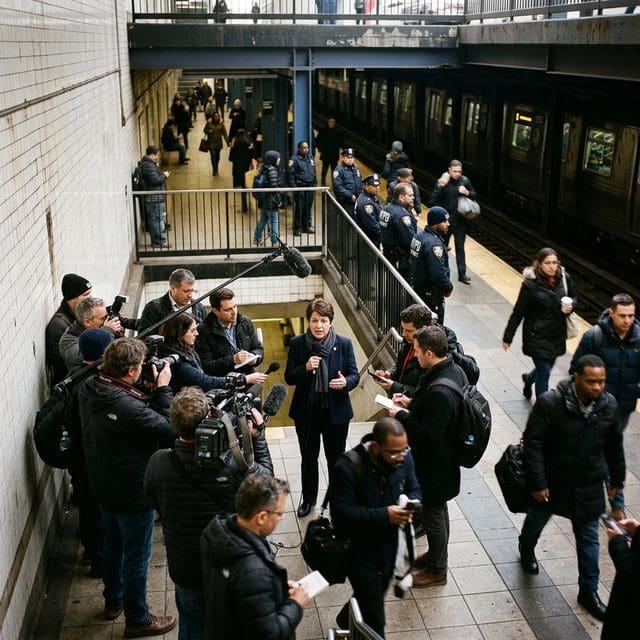
In New York, Republican gubernatorial candidate Bruce Blakeman rode the subway on October 19 and called for more police, better lighting, additional conductors and mental-health services. His campaign stop followed a fatal shooting at 53rd Street and Seventh Avenue over the weekend. A 26-year-old man was killed, and the suspect remained at large as of October 19. NY1 reported seven subway deaths this year, compared with four last year.
Blakeman’s demands put transit safety at the center of the governor’s race, but the reports do not provide a detailed plan. Democratic Gov. Kathy Hochul’s campaign pointed to state funding for NYPD overtime and overnight transit patrols. The exchange reflects the divided responsibilities of local governance: New York City operates the transit system and its police department, while the state can provide funding and set broader priorities. The campaign accounts do not specify costs, implementation details or measures of success.
New York City mayoral candidate Zohran Mamdani accused Blakeman of exploiting the shooting politically. A local emergency has become an issue in the state campaign, even though the immediate response involves city agencies. The available reporting does not show either candidate copying a policy adopted elsewhere or facing a federal rule that limits state or city action.
In Florida, early voting is underway ahead of the November 3 election. Democrat David Jolly campaigned in Eatonville on October 19, focusing on Black voters. He said the race could turn on 10% of undecided Black voters. Former President Bill Clinton campaigned with Jolly in Hollywood on October 20.
Polling snapshots show a competitive race, though the results differ. A Mason-Dixon poll released October 20 gave Republican Byron Donalds a seven-point lead over Jolly, with 10% undecided. An N+ Univision poll cited by Florida Politics put Donalds ahead 50% to 42%, with 7% undecided. Florida Politics also reported that Fox News shifted its rating from “likely Republican” to “lean Republican.” Politico’s Florida Playbook reported that 1.1 million Floridians had voted early or by mail as of October 20.
These figures describe a campaign, not a settled mandate for particular policies. The reports do not identify a major gubernatorial proposal being adopted or copied across state lines. The Florida race does show how turnout and voter coalitions can shape the agenda a governor brings to office.
Minnesota offers a different measure of state-level political stakes. More than $1.2 million in outside spending is going into the state Senate rematch between Democratic incumbent Grant Hauschild and Republican Andrea Zupancich, MPR News reported October 20. Control of the 67-seat chamber is expected to hinge on a small number of districts.
The outcome could affect legislation and oversight, but the reports do not identify specific bills at stake. Across these states, the gap between campaign claims and governing action remains substantial. Federalism gives states and local institutions room to make their own choices, but assessing a policy experiment requires details about implementation and results. This week’s reporting documents the arguments and political stakes, not yet the outcomes.
Dylan Brooks serves as the Senior Correspondent for Statehouses and Local Governance at Just Right News, where he brings a principled, constitutionalist lens to the often-overlooked machinery of state-level politics. As the lead voice behind the acclaimed feature series “Fifty Laboratories of Power,” Dylan has dedicated his career to the idea that the most impactful governance happens closest to home. His reporting consistently champions the Tenth Amendment, exploring how individual states can serve as testing grounds for innovative, conservative policy solutions that prioritize personal liberty and fiscal responsibility.
A native of Des Moines, Iowa, Dylan’s journalistic philosophy was forged in the heart of the American Midwest. Growing up in a community where local school board meetings and town halls were the bedrock of civic life, he developed a deep appreciation for the “retail politics” of the heartland. This upbringing instilled in him a fundamental belief that the American experiment is best preserved when power is decentralized. He carries the values of his Iowa roots into every assignment, maintaining a healthy skepticism of federal overreach and a steadfast commitment to the concerns of everyday citizens over the interests of the administrative state.
Now based in Madison, Wisconsin, Dylan operates from one of the nation’s most pivotal political battlegrounds. His location in a state capital known for its rigorous policy debates allows him to provide Just Right News readers with a front-row seat to the legislative process. From Madison, he tracks the ripple effects of statehouse decisions on local municipalities, ensuring that the connection between high-level policy and community impact is never lost. His work often highlights the success of conservative governors and legislatures in fostering economic growth, protecting parental rights, and securing the integrity of local institutions.
As an African American man in the conservative media landscape, Dylan offers a vital perspective on how limited government and free-market principles empower individuals and families. He frequently reports on how deregulation and school choice initiatives provide new avenues for success in underserved communities, challenging the monolithic narratives often presented by legacy media outlets. Dylan’s work is characterized by a commitment to the facts and a refusal to shy away from the complex realities of modern governance.
Throughout his tenure at Just Right News, Dylan has become a trusted authority for readers who value a rigorous, principled approach to the news. Whether he is dissecting a complex state budget or profiling a local grassroots movement, his goal remains the same: to provide the American public with the information they need to hold their local leaders accountable. By focusing on the “Fifty Laboratories of Power,” Dylan Brooks ensures that the vital work being done in statehouses across the country receives the national attention it deserves, always through a lens that respects the traditions and sovereignty of the American people.