

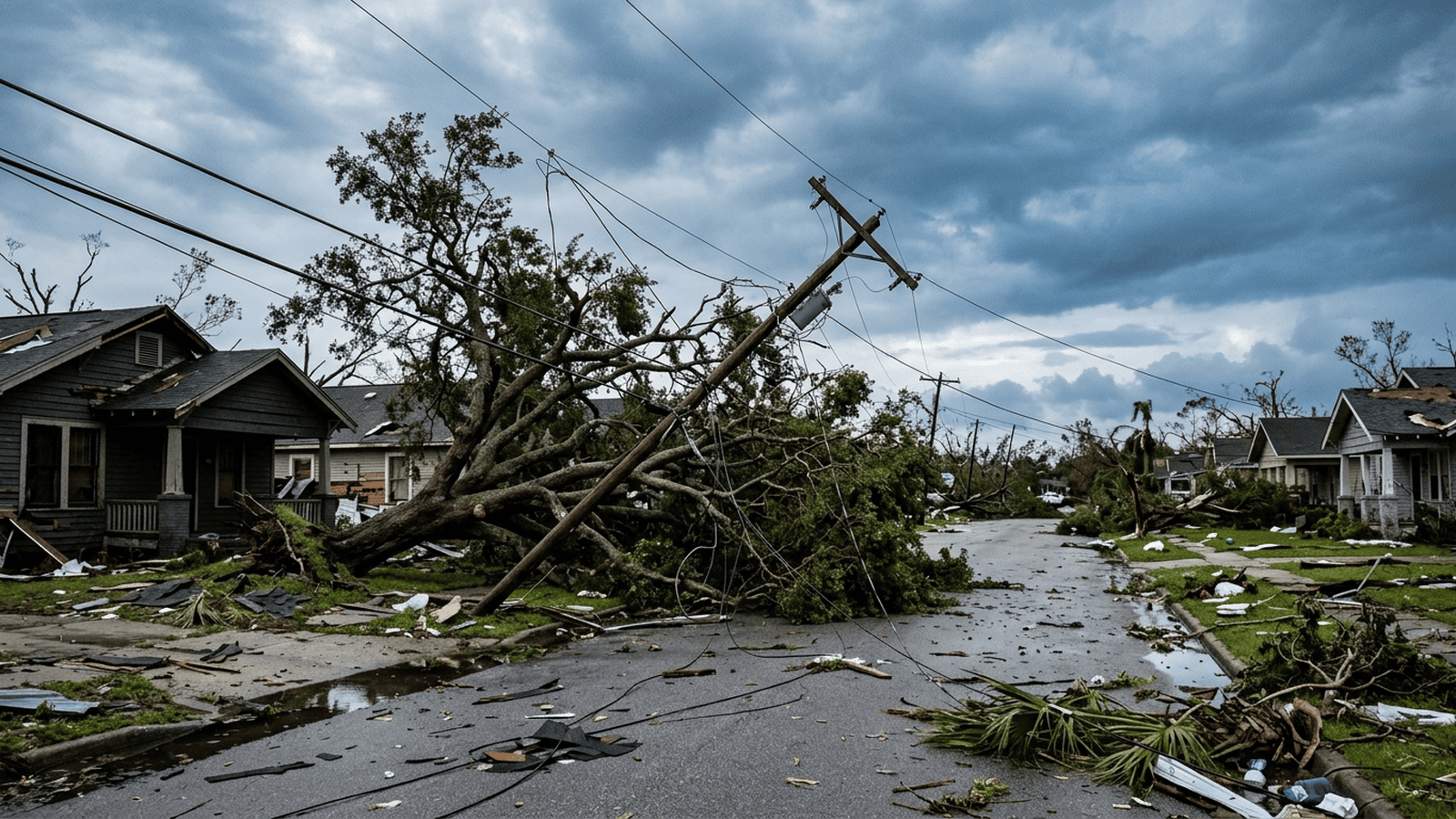
Nearly 396,000 customers in Florida’s Panhandle and southern Alabama remained without power early Sunday as Isaias moved north. Forecasters warned of heavy rain, flash flooding, strong winds, dangerous coastal surf and possible further outages across the Southeast, Appalachians and mid-Atlantic. At least four deaths were linked to the storm, while fallen trees and damaged buildings were reported in Florida and Alabama. Emergency declarations for Florida, Alabama and Georgia allow federal aid, and the Energy Department authorized crude oil exchanges to address supply disruptions. No restoration timetable, customer forms, fees or compliance deadlines appear in the report, and officials warned that storm hazards were continuing.
TLDR: Isaias left nearly 396,000 customers without power in Florida and Alabama, with flooding, wind and coastal hazards still forecast farther north. Federal emergency declarations allow aid in three states, while officials report no restoration schedule or customer deadlines.
Nearly 396,000 customers across Florida’s Panhandle and southern Alabama remained without power early Sunday as the remnants of Hurricane Isaias moved north. Widespread moderate to heavy rain was expected across the central Appalachians and mid-Atlantic, extending the storm’s reach beyond the Gulf Coast. The National Weather Service warned of possible flash flooding, strong wind gusts, scattered outages and downed trees and power lines.
There is no new policy change in the reported story, so no official policy rationale applies. The immediate response described is practical: the president approved emergency declarations for Florida, Alabama and Georgia to allow federal aid, while the Energy Department authorized emergency exchanges of crude oil from the strategic petroleum reserve to address storm-related supply disruptions. Those steps reflect the stated purposes in the report, not a broader policy plan.
The storm came ashore Friday near Destin, Florida, as a Category 2 hurricane. It brought hurricane-force winds to the Florida Panhandle, where a Pensacola hotel lost its roof and the city’s mayor said the airport “took some damage.” In Destin, a boathouse was flattened, and part of a high-rise facade in Panama City Beach was torn away.
By daybreak Saturday, several major coastal routes were open and clear of the downed trees and power lines often seen after major hurricanes. That offered a limited sign of access returning, but it did not mean the damage was over. In a condominium parking lot, a worker swept piles of insulation while others put beach chairs back after they had been tossed about by the storm.
At least four deaths were linked to Isaias. In Florida’s Escambia County, Sheriff Chip Simmons said a woman died when a tree fell on her home. A man died from carbon monoxide fumes from a generator running in his garage, and four family members, ages four to 72, were treated and expected to survive, the sheriff said.
Alabama also reported two storm-related deaths. One person died when a tree fell on a house in Birmingham, Fire Chief Cory Moon said. A second death, in Barbour County, followed a vehicle crash involving a downed tree, according to Josh Johnson of the state emergency management agency. Authorities in Mobile reported numerous fallen trees and power lines along Alabama’s Gulf Coast.
The hazards were still moving north. The National Weather Service said heavy rain could bring isolated flash flooding and strong wind gusts across the southeastern United States, especially near the southern Appalachians. Forecasters warned that flooding could extend into the Appalachians, while parts of Georgia and the Carolinas could also receive heavy rain capable of causing flash floods.
Coastal dangers remained in place as well. Life-threatening surf and rip currents were expected to continue along the Gulf and southeastern Atlantic coasts. The forecast included possible additional outages and downed trees and power lines, making travel and power service uncertain in areas affected by the rain and wind.
The practical impact is already substantial: nearly 396,000 electricity customers in the Florida Panhandle and southern Alabama were without power early Sunday, and officials reported damaged buildings, fallen trees and downed power lines. The figure covers electricity customers, not necessarily individual people, and the report does not say how many homes or businesses are included. It also does not identify which utility areas had the largest losses or when service might return. Federal emergency declarations allow aid in Florida, Alabama and Georgia, and the Energy Department’s authorized oil exchanges are intended to address supply disruptions. The report gives no restoration timetable, application forms, fees, compliance rules or deadline for affected customers. Those missing details are part of the plan only in the sense that the report does not specify them; no schedule or process can be stated from the available information. The storm has also disrupted everyday independence, access to power and the use of coastal roads, even as several routes were open by Saturday morning.
The next necessary steps are continued weather monitoring and response to outages, flooding and storm damage. No timetable for those efforts is provided, and no specific oversight process is described beyond the named weather and emergency agencies. Forecasts still warn of rain, flooding, wind and dangerous coastal water, so the conditions remain unsettled. Officials and forecasters are tracking the threats, but the report offers no basis for claiming that every risk has been handled.

Greg Sanders serves as the Senior Correspondent for Corporate Power and Antitrust at Just Right News, where he brings a principled, conservative perspective to the complex intersection of big business, government regulation, and the American consumer. With a career dedicated to investigative depth and economic clarity, Greg has become a leading voice in examining how the consolidation of industry power impacts the foundational values of the free market and individual liberty.
Raised in Denver, Colorado, Greg’s reporting is deeply informed by the Western spirit of independence and a healthy skepticism of centralized authority. Growing up in the shadows of the Rockies, he witnessed firsthand the importance of local entrepreneurship and the vital role that small-medium enterprises play in sustaining vibrant communities. This upbringing instilled in him a belief that the American Dream is best preserved when the playing field remains level and when competition—rather than backroom deals between corporate lobbyists and federal regulators—dictates success. For Greg, the rugged individualism of his home state serves as a constant reminder that the economy should serve the people, not the other way around.
Now based in Chicago, Illinois, Greg operates from the heart of the nation’s industrial and financial crossroads. His location in the Midwest provides him with a unique vantage point to observe the real-world consequences of corporate overreach. From the boardrooms of the Loop to the manufacturing hubs that define the region, he tracks the movement of capital and the shifting tides of market influence. Chicago’s history as a center of trade and labor offers a rich backdrop for his work, allowing him to bridge the gap between high-level economic theory and the lived experiences of hardworking Americans who feel the squeeze of monopolistic practices.
At Just Right News, Greg’s beat focuses on the “new monopolies” and the rise of “woke” corporate culture. He argues that when corporations become too large, they often abandon their fiduciary duties to shareholders in favor of social engineering and political posturing. His reporting seeks to hold these “Titans” accountable, ensuring that the power of the purse is not used to silence dissent or bypass the democratic process. He is a firm advocate for the idea that true conservatism requires a vigilant defense of competition, preventing any single entity—public or private—from exerting undue control over the lives of citizens.
This mission is most clearly seen in his acclaimed feature series, “The Titans and the Toll.” In this ongoing project, Greg explores the human cost of market consolidation, from the erosion of consumer choice to the decline of local economies. Through rigorous analysis and boots-on-the-ground reporting, he documents how the concentration of power in sectors like tech, agriculture, and finance creates a “toll” paid by the average family.
Greg Sanders remains committed to the idea that a transparent, competitive market is the greatest engine for prosperity ever devised. Through his work at Just Right News, he continues to provide the essential oversight necessary to protect that engine from the encroaching influence of corporate giants and the bureaucratic structures that enable them.