

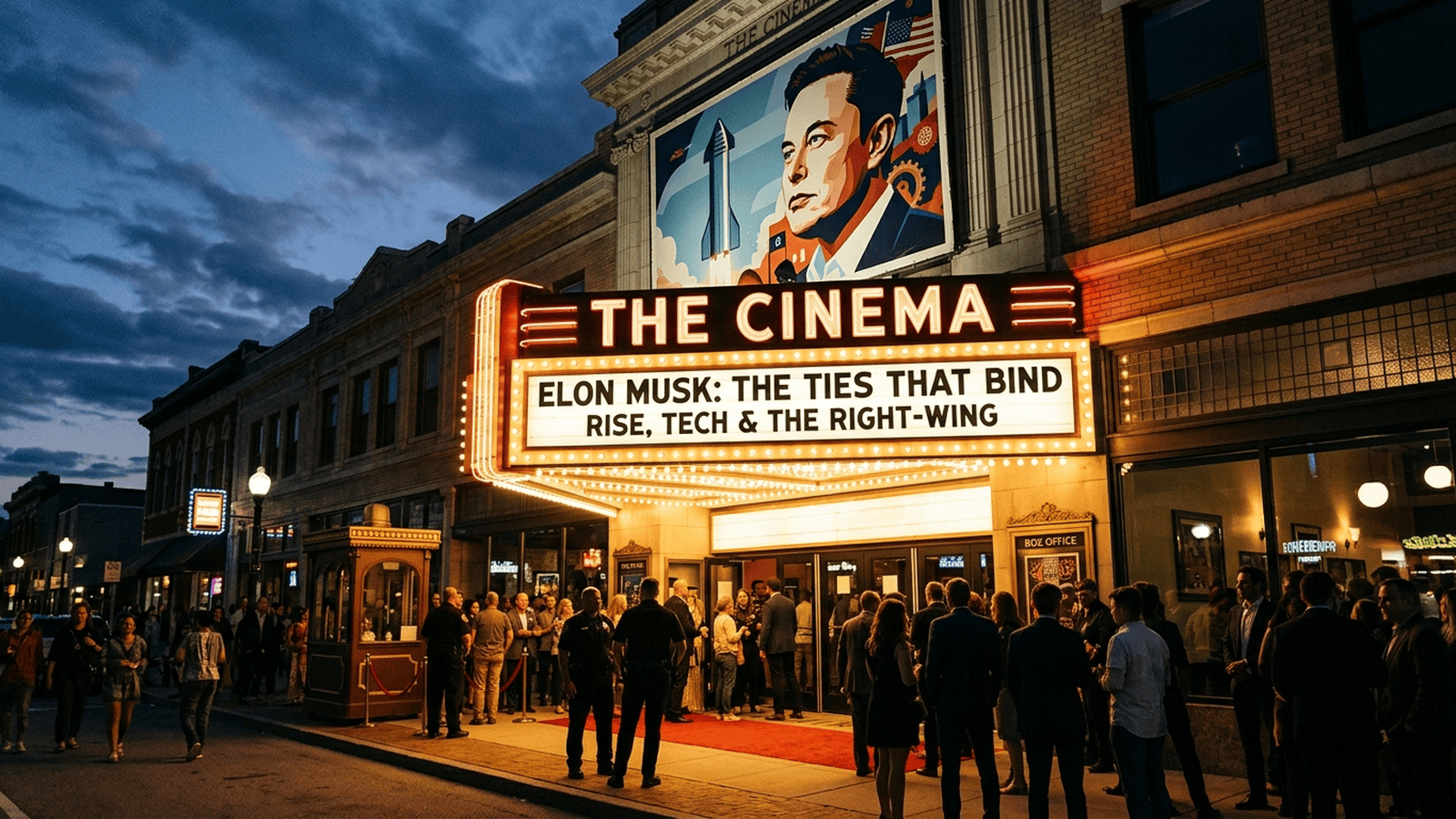
Alex Gibney’s documentary “Musk” examines Elon Musk’s rise across Tesla, SpaceX, Starlink and X, along with his increasing political influence. The film asks how Musk gained power and how society enabled that rise, while discussing his large contribution to President Donald Trump’s reelection campaign and his brief leadership of DOGE. Gibney says federal subsidies and government contracts helped Tesla and SpaceX grow, though the interview provides no exact total. The documentary opens in New York and Los Angeles this weekend, then is scheduled for nationwide release next week. The excerpt gives no ticket costs, forms, compliance requirements or oversight deadlines.
TLDR: Alex Gibney’s film examines Elon Musk’s business reach, political activity and the filmmaker’s account of federal support for his companies. It begins in New York and Los Angeles this weekend, then is set for theaters nationwide next week.
A new documentary about Elon Musk follows his rise across business, technology and politics, and considers how that reach grew. The film, titled “Musk,” is directed by Alex Gibney. It opens in New York and Los Angeles this weekend and is scheduled to reach theaters nationwide next week.
The film’s stated purpose is to examine how Musk amassed power and how society enabled that rise. That is the rationale Gibney gave for the project, rather than an official government rationale for a policy change. The documentary traces Musk’s innovations alongside his embrace of right-wing politics.
Musk’s companies include Tesla, SpaceX and Starlink, while he also owns the social media platform X. The report describes Tesla as a major international car company, SpaceX as a rocket company and Starlink as a satellite internet service. Together, those businesses give Musk influence across transportation, space launches, communications and online media.
The documentary also places his political activity in that wider picture. Musk gave nearly $300 million to President Donald Trump’s reelection campaign, making him the largest donor by far, according to the report. He played a central role in the early days of the second Trump administration and briefly led the Department of Governmental Efficiency, known as DOGE.
During that period, Musk oversaw major cuts to parts of the federal government, including the dismantling of USAID. The account identifies those actions but does not provide a full inventory of programs or a detailed measure of their effects. President Trump denied that he had ceded too much power to Musk because of Musk’s political contributions.
Gibney’s interview gives attention to both Musk’s business record and his access to public support. The director said Tesla’s success depended on federal subsidies, mostly carbon credits. He also characterized SpaceX as reliant on government money for launches. The excerpt does not state an exact total for the contracts or subsidies involved, and Gibney said he could not recall the figure during the interview.
That account complicates a simple story of private enterprise operating apart from government. The companies are privately run, while the filmmaker describes federal support as important to their growth. Musk’s influence therefore sits at the intersection of private business, public funds and political access. The documentary asks viewers to consider how those elements combined, without supplying a precise financial accounting in the excerpt.
The film also considers Musk’s political shift. Brangham notes that some people knew him first as an innovator leading an electric-car company who appeared concerned about climate change. Gibney attributed the turn toward Trump to pragmatism. He said Musk opposed constraints on his power and believed he faced pressure from civil and criminal investigations by federal agencies.
Those explanations are Gibney’s assessment, not a statement from Musk. The report says the News Hour requested an interview with Musk, but the excerpt does not include a response from him. Ashley St. Clair, described as a former girlfriend, said that views of Musk as either a free-speech champion or a source of hateful posts fail to capture the scale of his power and influence.
The documentary’s practical impact is limited to its release schedule in the available account. It opens in New York and Los Angeles this weekend, followed by a nationwide release next week. The excerpt lists no ticket price, forms, compliance rules, enforcement measures or government deadlines. Those details are not part of the film’s described release plan.
For energy and resource economics, the account’s clearest point is the reported role of federal subsidies and contracts in the growth of Tesla and SpaceX. It gives no exact contract totals, subsidy amounts or schedule for further disclosure. The film’s next step is its wider release next week; no formal government oversight process is identified in the excerpt. The reported facts and the filmmaker’s interpretation remain distinct, and the available information provides no basis to claim that experts have settled the larger questions.
That distinction matters when weighing the film’s claims. The report includes statements about Musk’s business and political roles, alongside Gibney’s views on why those roles matter. It does not provide a full set of financial records or a detailed account of the federal programs involved. Viewers therefore have a clear outline of the documentary’s argument, but not a complete accounting of public support or its effects. The available account also gives no further schedule for policy action or review.
Mark Davis serves as the Senior Correspondent for Energy, Climate, and Resource Economics at Just Right News. In an era where the conversation around the environment is often dominated by alarmism and top-down mandates, Mark provides a vital, market-oriented perspective on the complex forces shaping our world. As the lead voice behind the acclaimed feature series “Power and the Planet,” he explores the intersection of environmental policy, global energy markets, and the fundamental economic principles that sustain modern civilization.
Mark’s pragmatic approach to resource management was forged in the high desert of his hometown, Albuquerque, New Mexico. Growing up in a region defined by both its breathtaking natural beauty and its rugged, resource-dependent landscape, he developed an early appreciation for the delicate balance between conservation and utilization. New Mexico’s unique position as a hub for both traditional energy production and cutting-edge scientific research provided Mark with a front-row seat to the evolution of the American energy sector. This upbringing instilled in him a deep-seated belief that true environmental stewardship is inseparable from economic prosperity and technological innovation.
Now based in Boulder, Colorado, Mark operates from the heart of the nation’s climate research community. While Boulder is often seen as a bastion of environmental idealism, Mark utilizes his post to provide a necessary counterweight, grounded in the realities of resource economics. He understands that energy policy does not exist in a vacuum; it has tangible consequences for the American taxpayer, the stability of the national power grid, and the strength of the domestic manufacturing sector. By reporting from the front lines of the climate debate, he is able to challenge prevailing narratives with hard data and a commitment to the principles of the free market.
Throughout his tenure at Just Right News, Mark has distinguished himself by focusing on the “Resource Economics” aspect of his beat. He frequently highlights the hidden costs of rapid energy transitions and advocates for an “all-of-the-above” energy strategy that prioritizes American energy independence. His work often shines a light on the geopolitical implications of resource scarcity, arguing that a secure nation must first be an energy-secure nation. Whether he is analyzing the impact of federal land-use regulations or investigating the supply chains required for new technologies, Mark remains focused on how policy decisions affect the lives and livelihoods of everyday citizens.
In “Power and the Planet,” Mark continues to bridge the gap between complex scientific concepts and the economic realities facing the country. He rejects the false choice between a healthy environment and a thriving economy, instead seeking out solutions that leverage American ingenuity and private-sector competition. For Mark, reporting on the climate is not about following the latest trends, but about ensuring that the conversation remains tethered to the foundational values of liberty, property rights, and fiscal responsibility. His contributions ensure that Just Right News readers receive a comprehensive, clear-eyed view of the challenges and opportunities defining the future of our planet.