

Trump’s pledge to avoid Iran strikes before the midterms, an immigration action against Microsoft and a judge’s scrutiny of press access put executive authority under separate tests.
President Donald Trump has put an election date on one of the administration’s most consequential national-security decisions: the United States will not resume attacks on Iran before the November 3 midterm elections. The pledge came as reports described military planning for possible renewed operations, leaving a gap between the president’s public timetable and options officials have reportedly considered.
“We will not be attacking Iran at any time prior to the Midterm Elections,” Trump said. He also described discussions with Iran as “productive,” while leaving open the possibility of military action after the election. Vice President JD Vance and senior national-security officials had discussed options at Camp David, according to Associated Press reporting.
The statement offers a date, not a full account of the policy. It does not clarify what conditions could change the pledge, what preparations remain active or how Congress is being consulted. For lawmakers and U.S. allies, a public pause is not necessarily a durable strategy.
A separate test of executive authority is the administration’s action against Microsoft. On October 8, Vance announced the company was suspended from a program through which employers can seek green cards for workers who entered the country on H-1B visas. He accused Microsoft of replacing laid-off American workers with foreign employees. The supplied reporting does not establish that accusation as an adjudicated finding or detail the evidence behind the suspension.
The announcement came as Trump presented Microsoft chief executive Satya Nadella with the National Medal of Technology and Innovation, calling him a “key figure” in the company’s transformation. The Associated Press reported Trump did not mention the visa allegations at the ceremony. The juxtaposition underscores a policy tension: the administration is honoring a technology leader while taking an immigration-enforcement step against his company.
The action could affect workers seeking permanent residence and employers considering the H-1B system. But the available reporting does not specify the suspension’s duration, Microsoft’s avenue of appeal or the evidence supporting the government’s case. Those details will help show whether this is a targeted enforcement measure or a broader warning to employers.
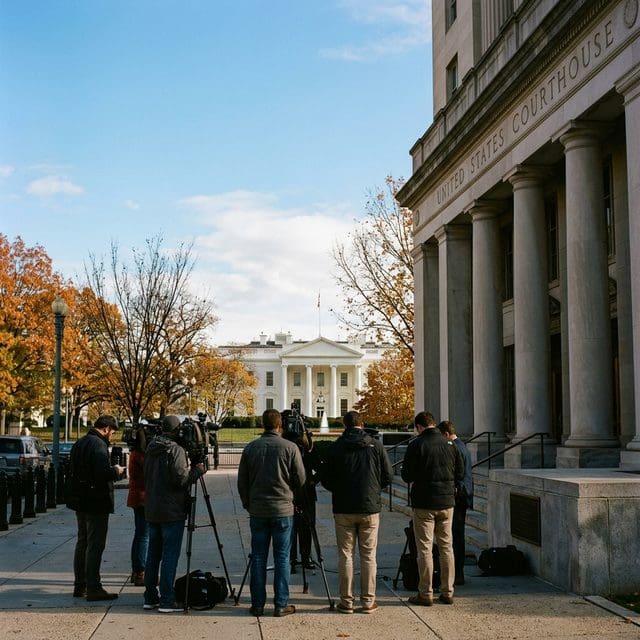
In court, U.S. District Judge Timothy Kelly has questioned the government’s defense of a White House ban on reporters from CNN, MS NOW and Politico. The outlets say they were excluded after Trump criticized their coverage. The government has cited professional standards and national security; Kelly questioned why that rationale differed from Trump’s public explanation that he was responding to negative coverage.
Kelly called the government’s position an “uphill climb” and said due process was likely its “biggest hurdle,” CBS News reported October 9. A temporary restraining order protecting the outlets’ access was extended, with a decision on a preliminary injunction expected by October 13. The case tests whether the executive branch can selectively control access to presidential information and what safeguards apply when its stated rationale shifts.
FEMA also said it was rescinding election-related conditions on the $1 billion Homeland Security Grant Program after a district-court ruling found them unlawful. The conditions included citizenship checks for voters and election workers, plans to move to hand-marked ballots and post-election audits. FEMA had threatened to withhold 20 percent of grants, but said the requirements could return if the court order is vacated.
That dispute illustrates how federal funding can become a lever over state policy—and how judicial review can limit that leverage. Across these cases, the key questions are practical: what authority supports an action, what evidence backs it and what process is available to challenge it. Those details matter more than a press release, whether the subject is military restraint, immigration enforcement, press access or election funding.

Miles Harrington serves as the Senior Correspondent for Federal Systems & Executive Power at Just Right News, where he brings a disciplined, constitutionalist lens to the inner workings of the American government. With a focus on the mechanics of the federal bureaucracy and the limits of executive authority, Harrington has established himself as a vital voice for readers who value transparency, accountability, and the preservation of the separation of powers.
A native of Richmond, Virginia, Harrington’s perspective is deeply rooted in the traditions of the Old Dominion. Growing up in a city defined by its historical significance and its role as a center of American jurisprudence, he developed an early appreciation for the foundational principles of the Republic. His upbringing in Richmond—a place where the legacy of the Founding Fathers is woven into the landscape—instilled in him a belief that the federal government should remain within its constitutional bounds. This background informs his skepticism of centralized overreach and his commitment to reporting on the ways in which the administrative state impacts the lives of everyday citizens.
In his current role, Harrington specializes in the complexities of federal systems. He doesn’t just report on the headlines of the day; he digs into the structural shifts within the executive branch that often go unnoticed by the mainstream press. Whether he is analyzing the implications of a new federal regulation or investigating the expansion of agency jurisdiction, his work is characterized by a rigorous adherence to the facts and a dedication to the rule of law.
Harrington is perhaps best known for his signature feature series, “How Washington Works.” Through this ongoing project, he demystifies the often-opaque processes of the nation’s capital, pulling back the curtain on the “Deep State” and the unelected officials who wield significant influence over national policy. By breaking down complex legislative maneuvers and executive orders, he empowers Just Right News readers to understand the true levers of power in Washington. His reporting serves as a necessary check on the federal government, ensuring that the actions of those in power are held up to the light of public scrutiny.
Now based in Washington, D.C., Harrington operates at the epicenter of the political world, yet he remains intentionally distanced from the “Beltway bubble.” His proximity to the halls of power allows him to maintain a robust network of sources across the federal landscape, but his heart remains in the principled conservatism of his Virginia roots. He views his role not merely as a reporter, but as a steward of the public trust, dedicated to providing the clarity and context that conservative voters need to navigate an increasingly complex political environment.
Through his sharp analysis and unwavering commitment to the truth, Miles Harrington continues to be a cornerstone of the Just Right News team. His work ensures that the principles of limited government and executive restraint remain at the forefront of the national conversation, providing a crucial service to those who believe in a government that is truly of, by, and for the people.