

Storm outages in Florida and Alabama put electric reliability in focus, while limited data on climate-aligned ETF NZAC offers little basis for judging investor sentiment.
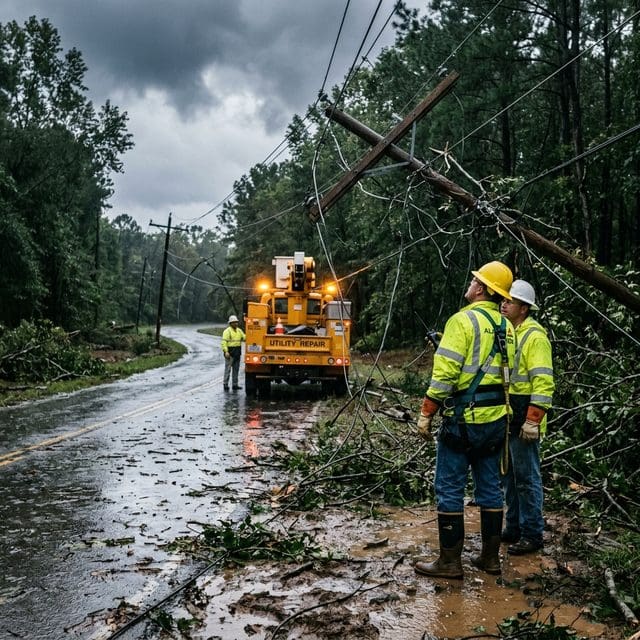
Isaias weakened to a post-tropical cyclone over Alabama, but its passage left a practical test for the region’s electric system: restoring service amid downed trees and power lines, blocked roads and localized flooding. More than 726,000 customers in Florida and Alabama were without power early Saturday, according to PowerOutage.com, as heavy rain of 4 to 8 inches or more was forecast across parts of the region through the weekend, ABC 33/40 reported, citing The Associated Press.
The National Hurricane Center issued its final advisory at 4 a.m. Saturday. The storm’s classification changed; the consequences for customers and utility crews did not end with it. Restoration can be slowed where roads are blocked or crews cannot safely reach damaged equipment. Before the storm, Alabama Power and Georgia Power had prepared crews and resources, according to company announcements. The available reporting does not provide verified customer totals for Alabama Power or detailed restoration timelines by area.
The outage figure is a snapshot, not a measure of how long customers remained without service or the economic cost of the interruption. It combines two states and does not specify where outages were concentrated. Still, it underscores a basic energy-policy tradeoff: electricity must be affordable, but it must also be available when weather damages the system. Evaluating resilience requires information on restoration times, damage and the costs of preventive investment—details not supplied in the reports.
The forecast rain added uncertainty. It could keep roads hazardous and complicate repair work even after damaging winds eased. Reports confirmed downed trees, power lines, blocked roads and localized flooding, but did not identify specific equipment failures or quantify additional damage from the weekend rain. The outage count alone cannot show which parts of the grid were most vulnerable or whether particular resilience measures worked.
A separate headline published Saturday said short interest in the SPDR MSCI ACWI Climate Paris Aligned ETF, which trades on Nasdaq as NZAC, had increased. The supplied material does not verify a current figure or explain why traders took those positions. Short interest alone cannot show whether investors are wagering on climate policy, energy companies, the broader market or another factor.
Nor does the fund’s name establish how its holdings would perform during a regional outage. The available information does not provide verified fund assets, expenses, holdings or trading data. There is no basis to treat NZAC as a proxy for grid reliability or to connect the Isaias outages to its trading.
For policymakers, the storm’s immediate lesson is operational: a grid must withstand disruption and recover, while the cost and effectiveness of resilience investments should be measured. Generation, transmission and local distribution all affect reliability, but the reports do not identify which equipment failed or what resources were available. They cannot establish that a particular technology or policy would have prevented the outages.
Climate-aligned funds may let investors express views about emissions, companies or regulation, but their labels do not tell customers what infrastructure can deliver in a storm. The clearest facts are narrower: outages were widespread across Florida and Alabama, hazards remained, and heavy rain was forecast. Better outage and restoration data, alongside transparent fund disclosures, would help distinguish evidence about system performance from speculation about market sentiment.

Mark Davis serves as the Senior Correspondent for Energy, Climate, and Resource Economics at Just Right News. In an era where the conversation around the environment is often dominated by alarmism and top-down mandates, Mark provides a vital, market-oriented perspective on the complex forces shaping our world. As the lead voice behind the acclaimed feature series “Power and the Planet,” he explores the intersection of environmental policy, global energy markets, and the fundamental economic principles that sustain modern civilization.
Mark’s pragmatic approach to resource management was forged in the high desert of his hometown, Albuquerque, New Mexico. Growing up in a region defined by both its breathtaking natural beauty and its rugged, resource-dependent landscape, he developed an early appreciation for the delicate balance between conservation and utilization. New Mexico’s unique position as a hub for both traditional energy production and cutting-edge scientific research provided Mark with a front-row seat to the evolution of the American energy sector. This upbringing instilled in him a deep-seated belief that true environmental stewardship is inseparable from economic prosperity and technological innovation.
Now based in Boulder, Colorado, Mark operates from the heart of the nation’s climate research community. While Boulder is often seen as a bastion of environmental idealism, Mark utilizes his post to provide a necessary counterweight, grounded in the realities of resource economics. He understands that energy policy does not exist in a vacuum; it has tangible consequences for the American taxpayer, the stability of the national power grid, and the strength of the domestic manufacturing sector. By reporting from the front lines of the climate debate, he is able to challenge prevailing narratives with hard data and a commitment to the principles of the free market.
Throughout his tenure at Just Right News, Mark has distinguished himself by focusing on the “Resource Economics” aspect of his beat. He frequently highlights the hidden costs of rapid energy transitions and advocates for an “all-of-the-above” energy strategy that prioritizes American energy independence. His work often shines a light on the geopolitical implications of resource scarcity, arguing that a secure nation must first be an energy-secure nation. Whether he is analyzing the impact of federal land-use regulations or investigating the supply chains required for new technologies, Mark remains focused on how policy decisions affect the lives and livelihoods of everyday citizens.
In “Power and the Planet,” Mark continues to bridge the gap between complex scientific concepts and the economic realities facing the country. He rejects the false choice between a healthy environment and a thriving economy, instead seeking out solutions that leverage American ingenuity and private-sector competition. For Mark, reporting on the climate is not about following the latest trends, but about ensuring that the conversation remains tethered to the foundational values of liberty, property rights, and fiscal responsibility. His contributions ensure that Just Right News readers receive a comprehensive, clear-eyed view of the challenges and opportunities defining the future of our planet.