

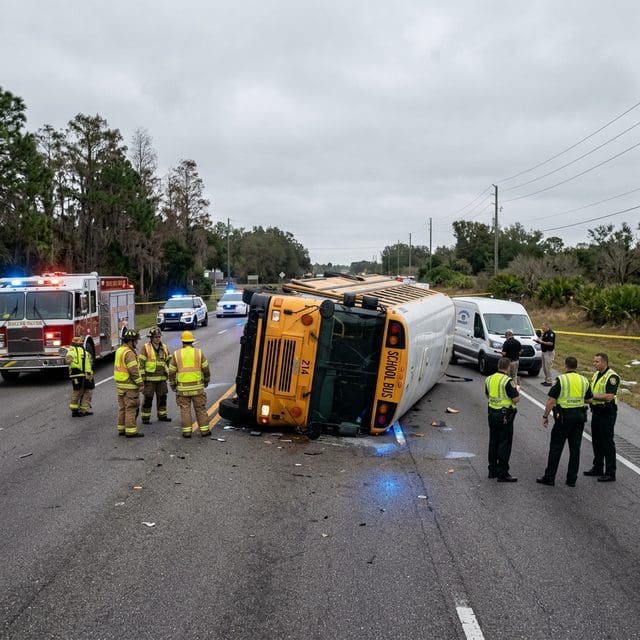
Two people died after a car crossed the center line and struck a school bus in Winter Haven, but investigators have not completed their work and no policy response is reported.
A deadly crash involving a school bus in Winter Haven has put student transportation safety in public view, but the available facts do not yet establish why the collision occurred or whether existing rules played any part. Authorities have described the investigation as preliminary, and no state or local policy response is reported.
The bus was carrying 39 people — 37 students, the driver and the driver’s daughter — when it overturned Monday after an oncoming Chevrolet Malibu crossed the center line, according to reports by The Associated Press via 6abc and WJLA. A 10th-grade student and the driver of the car died. Reports put the number of hospitalized people at five to seven, including one person in critical condition.
Those details provide an account of the crash’s immediate circumstances, not a determination of fault beyond the reported vehicle movements, nor a full explanation of how the impact unfolded. The authorities’ description of the inquiry as preliminary is consequential: the available accounts do not say whether investigators have finished examining the vehicles, established a complete sequence of events or reached conclusions about contributing factors.
They also do not report whether the bus’s route, condition, safety equipment or operating procedures contributed to the crash. There is no account of a finding that any safety requirement was violated, or that the bus operator or school system had received prior warnings. Without such evidence, the crash cannot responsibly be presented as proof of a broader failure in Florida’s school transportation system.
That distinction matters in state and local governance. School transportation is a public responsibility carried out in communities, while state rules can establish requirements for how services operate. A serious incident can prompt scrutiny of both local practices and statewide standards. But the reporting available so far does not identify which particular Florida standards might be relevant, whether any were breached, or whether state officials are reviewing them.
The source material likewise does not document a response from the governor, lawmakers, school officials or local authorities beyond the investigation itself. It identifies no proposed bill, executive action, school-system change or new safety measure. Nor does it offer a comparison with another state or show that another jurisdiction is considering a similar response. There is no reported dispute involving federal preemption or a federal rule that limits Florida’s options.
Those absences set the limits of what can be said about the case as a policy story. A state-by-state comparison could be useful if verified findings later raise questions about different rules or practices. At present, however, the supplied reporting offers no evidence about how another state handles comparable situations or what policy, if any, officials might consider copying. Naming a particular regulatory fix now would amount to speculation, not a conclusion grounded in the investigation.
Further information from authorities could clarify the vehicles’ movements and the sequence that led to the bus overturning. Any inquiry into school-bus operations or safety requirements would be a separate step, and the available reports do not say that such a review has been ordered. The distinction between reconstructing a collision and evaluating policy should remain clear as more details emerge.
The crash is a grave event for the people involved and the Winter Haven community. But its policy significance has not yet been established. For now, the firm account is limited: a car crossed the center line, a bus overturned, two people died and others were hospitalized. A careful public discussion of state or local responsibility must await evidence that investigators have not yet supplied.

Dylan Brooks serves as the Senior Correspondent for Statehouses and Local Governance at Just Right News, where he brings a principled, constitutionalist lens to the often-overlooked machinery of state-level politics. As the lead voice behind the acclaimed feature series “Fifty Laboratories of Power,” Dylan has dedicated his career to the idea that the most impactful governance happens closest to home. His reporting consistently champions the Tenth Amendment, exploring how individual states can serve as testing grounds for innovative, conservative policy solutions that prioritize personal liberty and fiscal responsibility.
A native of Des Moines, Iowa, Dylan’s journalistic philosophy was forged in the heart of the American Midwest. Growing up in a community where local school board meetings and town halls were the bedrock of civic life, he developed a deep appreciation for the “retail politics” of the heartland. This upbringing instilled in him a fundamental belief that the American experiment is best preserved when power is decentralized. He carries the values of his Iowa roots into every assignment, maintaining a healthy skepticism of federal overreach and a steadfast commitment to the concerns of everyday citizens over the interests of the administrative state.
Now based in Madison, Wisconsin, Dylan operates from one of the nation’s most pivotal political battlegrounds. His location in a state capital known for its rigorous policy debates allows him to provide Just Right News readers with a front-row seat to the legislative process. From Madison, he tracks the ripple effects of statehouse decisions on local municipalities, ensuring that the connection between high-level policy and community impact is never lost. His work often highlights the success of conservative governors and legislatures in fostering economic growth, protecting parental rights, and securing the integrity of local institutions.
As an African American man in the conservative media landscape, Dylan offers a vital perspective on how limited government and free-market principles empower individuals and families. He frequently reports on how deregulation and school choice initiatives provide new avenues for success in underserved communities, challenging the monolithic narratives often presented by legacy media outlets. Dylan’s work is characterized by a commitment to the facts and a refusal to shy away from the complex realities of modern governance.
Throughout his tenure at Just Right News, Dylan has become a trusted authority for readers who value a rigorous, principled approach to the news. Whether he is dissecting a complex state budget or profiling a local grassroots movement, his goal remains the same: to provide the American public with the information they need to hold their local leaders accountable. By focusing on the “Fifty Laboratories of Power,” Dylan Brooks ensures that the vital work being done in statehouses across the country receives the national attention it deserves, always through a lens that respects the traditions and sovereignty of the American people.