

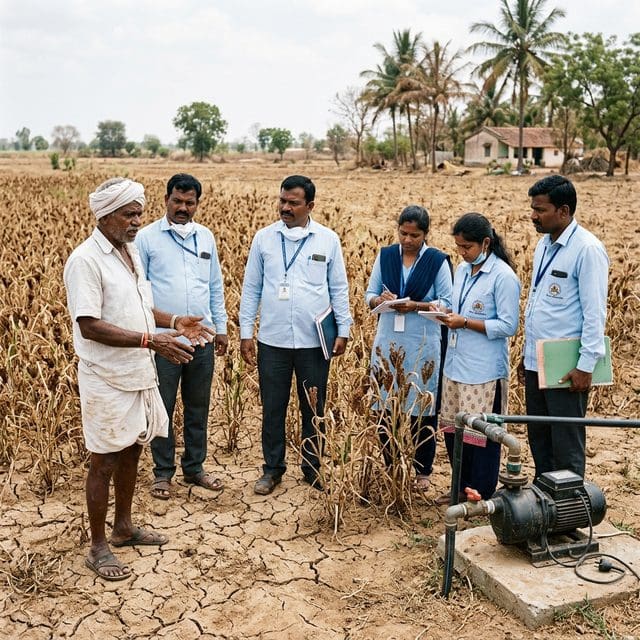
A central team is checking Karnataka’s drought damage as crop losses, depleted reservoirs and heavier groundwater pumping expose the strain of a weak monsoon across southern India.
A central assessment team’s visit to Saligrama taluk on October 4 is part of a broader check of Karnataka’s drought claims: whether rainfall shortfalls have caused crop and water losses severe enough to warrant federal relief.
Karnataka is seeking ₹7,142.64 crore under National Disaster Response Fund norms. The state has declared 177 of its 240 taluks drought-affected and estimates losses at ₹46,324.50 crore. A three-day Inter-Ministerial Central Team assessment is verifying the figures, according to The New Indian Express and The News Minute.
In Saligrama, the team is assessing crop impacts, water availability and local conditions. The Hindu reported the visit; separate Karnataka government reporting said rain over the preceding two or three days offered little benefit to crops already damaged. Late rain may ease immediate conditions without undoing losses from a critical growing period.
Damage in 76 newly added taluks covers 27.57 lakh hectares, The News Minute reported: 26.08 lakh hectares of field crops and 1.49 lakh hectares of horticulture. Red gram accounts for 6.49 lakh hectares, maize 5.31 lakh, cotton 4.13 lakh and sugarcane 2.80 lakh among the crops reported affected. These state-reported figures are being verified, not presented as a final independent determination.
From June 1 to September 16, the 76 taluks received 495 millimeters of rain against a normal 766 millimeters, a 35% deficit. Shortfalls ranged from 47% in south interior Karnataka and 42% in north interior Karnataka to 37% in Malnad and 27% on the coast. The regional differences show why statewide averages can obscure the conditions in particular farming areas.
Officials said 23 additional taluks are undergoing ground verification and could be declared drought-affected if they meet the criteria. Karnataka has also reported measures targeting about 1.27 lakh person-days of employment in affected areas. The available reports do not say how many workers have received jobs or when the work will be provided.
Across the state border, Telangana ended the southwest monsoon with rainfall 17% below normal. Eighteen of its 33 districts recorded deficient rain, and the state Cabinet declared 235 mandals drought-hit, Telangana Today reported. The available coverage does not provide district-level crop-loss totals, so rainfall and drought declarations alone do not show the full effect on individual farms.
Water storage was also lower. Krishna and Godavari reservoir storage stood at 503.43 TMCft on September 30, down from 834.92 TMCft a year earlier. Krishna-basin storage was 323.37 TMCft, compared with 583.35 TMCft; Godavari storage was 180.06 TMCft, versus 251.57 TMCft.
Greater reliance on borewells amid weak rains contributed to Telangana’s record peak electricity demand of 19,543 megawatts in September, with agricultural use cited as a factor. Pumping can help sustain crops during a dry spell, but it adds pressure to groundwater and power supplies. The reports do not quantify groundwater levels or agriculture’s share of electricity consumption.
The reporting documents drought and agricultural stress, not contamination of food or drinking water. Nor does it establish how much groundwater remains available locally or whether Karnataka’s relief request will be approved. The central assessment will help test the state’s loss estimates against field conditions. Its findings matter for directing relief and local employment, while the figures from both states show how weak monsoon rainfall can affect farms, reservoirs and electricity demand.

Eric Nolan serves as the Senior Correspondent for Food, Water, and Environmental Health at Just Right News, where he brings a principled, common-sense perspective to the most fundamental issues facing the American public. With a career dedicated to uncovering the truth behind the policies that govern our natural resources, Eric has become a trusted voice for readers who value traditional stewardship over bureaucratic overreach. His reporting is defined by a commitment to the idea that true environmentalism is rooted in the protection of the American family and the preservation of the nation’s agricultural heritage.
Raised in Fresno, California, Eric’s worldview was shaped in the heart of the San Joaquin Valley. Growing up in one of the world’s most productive agricultural hubs, he witnessed firsthand the vital connection between the land, the water, and the dinner table. In Fresno, he saw the resilience of farmers and the devastating impact that distant, top-down regulations can have on local communities. This upbringing instilled in him a deep respect for the producers who feed the country and a lifelong skepticism toward the alarmist narratives often pushed by mainstream media. For Eric, environmental health is not an abstract political talking point; it is a matter of ensuring that the people who work the land have the freedom and the resources to do so effectively.
Now based in Eugene, Oregon, Eric operates from a unique vantage point in the Pacific Northwest. Living in a region often defined by intense environmental debate, he provides a necessary counter-narrative to the prevailing trends of the area. From his base in Eugene, he monitors the shifting tides of federal and state policies, ensuring that the voices of rural citizens and property owners are not drowned out by urban activism. His reporting often bridges the gap between the rugged realities of the outdoors and the legislative halls where decisions are made, offering a grounded perspective that prioritizes local sovereignty and practical solutions.
As the lead for the acclaimed feature series “Earth on the Table,” Eric explores the intricate journey of the American food supply. He tackles critical issues such as water rights, soil health, and food security through a lens of national stability and individual liberty. He believes that a healthy environment and a thriving economy are not mutually exclusive, but rather two sides of the same coin of national prosperity. His work consistently highlights how innovation and private-sector ingenuity are the most effective tools for ensuring clean water and a safe food supply, rather than the expansion of the administrative state.
At Just Right News, Eric’s reporting serves as a vital resource for those who seek accountability and transparency. Whether he is investigating the impact of federal land management on local economies or examining the safety of the national food infrastructure, his work remains anchored in the values of heritage and hard work. Eric Nolan continues to be a leading voice in environmental journalism, championing the belief that the best way to protect our natural resources is to empower the people who live and work closest to them.