

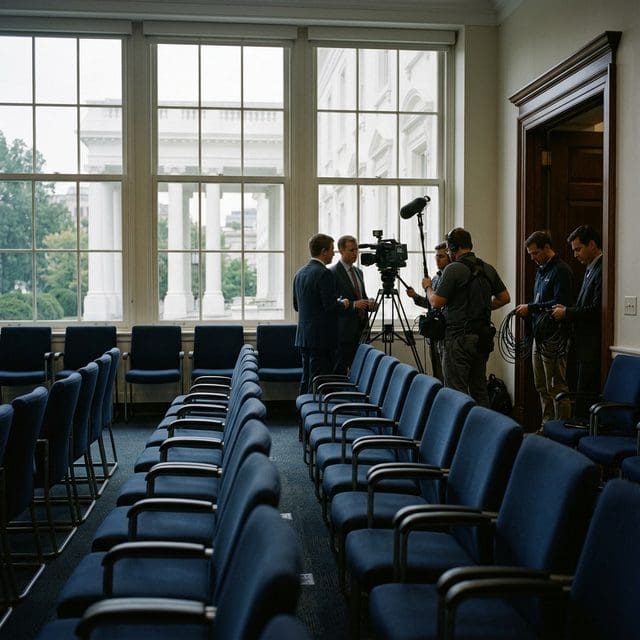
CNN, MS NOW and Politico are seeking court protection from renewed White House restrictions, putting due process, presidential access authority and press retaliation before a federal judge.
CNN, MS NOW and Politico are asking a federal judge to preserve their White House access while their lawsuit against the Trump administration proceeds. Their request puts a practical question of presidential control before the court: when can the White House restrict journalists’ access, and what rules must govern that decision?
The outlets seek a preliminary injunction from U.S. District Judge Timothy Kelly. Their request came as a temporary order protecting access was set to expire Thursday, Oct. 8. On Sept. 24, Kelly blocked the administration’s ban after finding the outlets were likely to prevail on a claim that they had been denied fair treatment under the Fifth Amendment.
That order did not decide the outlets’ separate First Amendment claim. The distinction is important: the dispute is not simply whether journalists have an unconditional right to enter every presidential space. It is also whether the administration followed constitutionally adequate procedures and applied its access rules fairly.
The outlets say the White House continued to retaliate after Kelly’s order. CNN and Politico were barred from the Oval Office and Air Force One, even though those spaces had been opened to the rotating press pool. The White House cited coverage of its ballroom, the Iran war and Republican convention turnout as violations of national-security or professionalism standards.
The outlets argue that those standards are too vague to give journalists adequate notice of what could cost them access. They also say most articles cited by the White House were written by reporters without White House credentials. One Politico article, they say, relied on a press call organized by the White House.
The Justice Department argues that the outlets endangered national security by publishing classified information about the ballroom and attendance at a Republican midterm convention. At a Sept. 23 hearing, Kelly expressed skepticism about the government’s arguments. The department also says each outlet declined to respond to White House letters by the Sept. 25 deadline.
The administration’s argument rests on a real feature of presidential power: access to the president and secure government spaces is not the same as access to a public forum. A 2025 appeals-court ruling held that Trump probably could restrict access to spaces including Air Force One and the Oval Office. But the power to manage access does not by itself resolve whether a particular restriction is lawful. The court must weigh security and operational interests against constitutional limits on arbitrary or retaliatory treatment.
Kelly’s September order was preliminary, not a final judgment. The new request would keep protections in place during litigation; it would not settle the outlets’ claims or establish a permanent standard for press access. The government’s security rationale and the plaintiffs’ challenge to the clarity of the rules will remain central.
The timing gives the dispute added weight. With the Nov. 3 midterms approaching, access to presidential events can shape how the administration is covered. But any legal remedy must account for both the press’s ability to report and the government’s legitimate security needs. Treating access to every restricted space as an absolute press entitlement would overstate the case; allowing penalties under unclear rules could leave constitutional protections dependent on executive discretion.
The court is therefore being asked to examine not only who may enter a room or travel aboard Air Force One, but also whether access decisions were made under clear, fairly applied rules. Its ruling on the injunction will set the terms for the next stage of the case, though it may not resolve every claim.
Other White House announcements have more immediate effects on household budgets. Trump has announced plans to send $90 checks to more than 20 million Medicare beneficiaries to offset Part B premiums. The press-access litigation raises a different question of public power: whether control of government facilities can be used to penalize coverage. The answer will turn on the evidence, the governing rules and the constitutional claims before the court—not on the administration’s characterization of the reporting or the outlets’ description of the ban.

Lila Hayes serves as a Staff Writer for Just Right News, where she anchors the “Courts, Law, and Constitutional Order” beat. Her work is defined by a steadfast commitment to the foundational principles of the American republic and a rigorous defense of the legal frameworks that ensure national stability. As a primary voice for the outlet, she provides readers with a clear-eyed analysis of the judiciary, focusing on the importance of originalism and the preservation of the separation of powers.
Lila’s perspective was forged in the American heartland. Raised in St. Louis, Missouri, she grew up in a Hispanic household where the values of hard work, faith, and respect for the law were paramount. Her upbringing instilled in her a deep appreciation for the American Dream and the legal protections that make it possible. This Missouri background remains a cornerstone of her reporting, providing a grounded, common-sense counter-narrative to the often-insular legal circles of the coastal elite. She understands that the decisions made in high-court chambers have real-world consequences for families and small business owners across the country.
At Just Right News, Lila has become widely recognized for her signature feature series, “The Rulebook of Power.” In this ongoing project, she delves into the mechanics of the federal government, examining how administrative overreach and judicial activism can threaten the delicate balance of the Constitution. She approaches her beat with the tenacity of a veteran journalist and the precision of a legal scholar, consistently advocating for a judiciary that interprets the law as written rather than legislating from the bench. For Lila, the Constitution is not a “living” document subject to the whims of modern social trends; it is a fixed standard that ensures the government remains the servant of the people, not their master.
Now based in Philadelphia, Pennsylvania, Lila finds herself at the very epicenter of American constitutional history. Living and working in the city where the Founders drafted the documents she defends daily provides a constant source of inspiration. The historic halls and landmarks of Philadelphia serve as a daily reminder of the high stakes involved in her reporting. Her presence in the city allows her to bridge the gap between the historical intent of the law and its contemporary application, ensuring that the legacy of the Founding Fathers remains central to the national conversation.
Throughout her career, Lila has remained dedicated to the idea that a free society requires an informed citizenry and a transparent legal system. Her reporting is more than just a collection of headlines; it is a defense of the constitutional order that has sustained the nation for over two centuries. By focusing on the “Rulebook of Power,” she ensures that her readers understand not just what is happening in the courtrooms, but why those decisions matter for the future of American liberty. Lila Hayes continues to be a vital voice for those who believe that the law should be a shield for the citizen and a constraint on the state.