

Recent court developments range from Senate preparations for a possible Supreme Court vacancy to a Colorado defamation appeal and an Indonesian ruling that left the vice president in office.
Three recent court developments illustrate why a headline about a case or a possible vacancy is not the same as a ruling’s legal effect. A report of a lawsuit proceeding does not establish that its allegations are true; preparations for a Supreme Court vacancy do not mean one is imminent; and a court’s refusal to disqualify an official may rest on limits to its authority rather than a finding that every eligibility question has been settled.
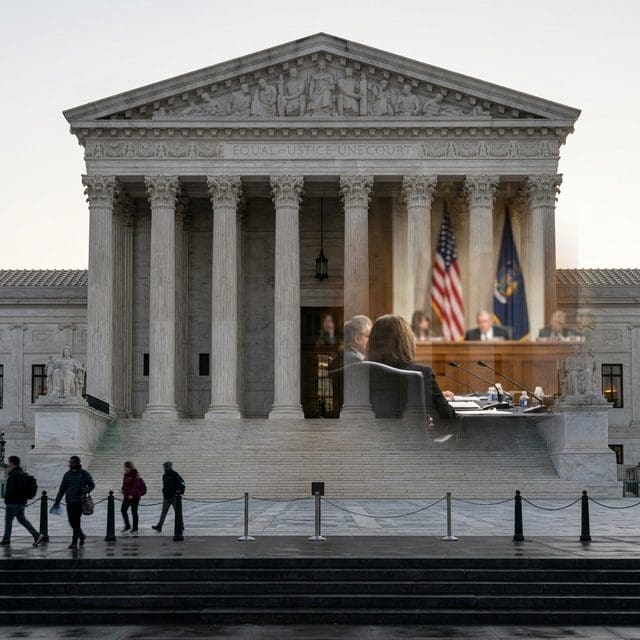
In Washington, Senate Republicans are preparing to move quickly if a Supreme Court vacancy arises after the November 3 midterms. Politico reported October 7 that Majority Leader John Thune and Judiciary Committee Chair Chuck Grassley support rapid action. The calendar presents a practical constraint: only five scheduled Senate session weeks fall between the election and the start of the next Congress.
But the contingency remains just that. Justice Samuel Alito has said he would remain at least through the current term, which ends in early summer 2027. The reporting describes preparations for a possible vacancy, not an announced retirement or a pending nomination. Any confirmation would still require a nomination by the president and Senate consideration under the Constitution’s appointments process.
In Colorado, the state’s second-highest court has allowed a former Dominion Voting Systems executive’s defamation lawsuit against President Donald Trump’s campaign and election-fraud claimants, including Sidney Powell and Rudy Giuliani, to proceed, according to The Gazette’s October 8 report. That is a procedural development, not a final judgment on whether the defendants are liable or whether the challenged statements were defamatory.
The available report does not provide the court’s reasoning or a case number, limiting what can responsibly be said about the decision’s doctrinal significance. In particular, it does not establish whether the court resolved any questions about the statements’ meaning, the evidence, or the legal standards applicable to public-figure defamation claims. The case’s advancement means the claims may continue; it does not itself prove them.
The broader Dominion litigation has also generated conflicting accounts of which cases remain active. A CNN headline describes pending lawsuits against election deniers, while a litigation tracker cited in the source material says Giuliani’s case was dismissed with prejudice after a confidential settlement and reports a separate Powell settlement. Those accounts concern different proceedings and cannot be reconciled from the information available here. The Colorado report concerns a former Dominion executive’s suit against the campaign and prominent claimants; it should not be treated as confirmation that every Dominion-related case remains pending.
A clearer statement of jurisdictional limits came from Indonesia’s Constitutional Court. Reuters reported October 7 that all nine judges rejected a challenge to Vice President Gibran Rakabuming Raka. The court found no convincing evidence that he had a foreign diploma equivalent to Indonesian senior-high-school completion, but said it could not disqualify him after his October 20, 2024, inauguration. It said eligibility questions belonged to other institutions.
That distinction leaves Gibran in office while preserving questions about whether other state bodies could examine his eligibility or pursue impeachment-related action, The Jakarta Post reported the next day. The court’s decision therefore did not amount to a broad ruling that no eligibility issue could ever be considered. It rejected the petition before it and identified a limit on what the court could do after inauguration.
Across these developments, the practical lesson is one of institutional boundaries. A reported appellate permission to proceed is not a verdict, Senate planning is not a vacancy, and a court’s jurisdictional limit is not necessarily a resolution of every underlying dispute.

Lila Hayes serves as a Staff Writer for Just Right News, where she anchors the “Courts, Law, and Constitutional Order” beat. Her work is defined by a steadfast commitment to the foundational principles of the American republic and a rigorous defense of the legal frameworks that ensure national stability. As a primary voice for the outlet, she provides readers with a clear-eyed analysis of the judiciary, focusing on the importance of originalism and the preservation of the separation of powers.
Lila’s perspective was forged in the American heartland. Raised in St. Louis, Missouri, she grew up in a Hispanic household where the values of hard work, faith, and respect for the law were paramount. Her upbringing instilled in her a deep appreciation for the American Dream and the legal protections that make it possible. This Missouri background remains a cornerstone of her reporting, providing a grounded, common-sense counter-narrative to the often-insular legal circles of the coastal elite. She understands that the decisions made in high-court chambers have real-world consequences for families and small business owners across the country.
At Just Right News, Lila has become widely recognized for her signature feature series, “The Rulebook of Power.” In this ongoing project, she delves into the mechanics of the federal government, examining how administrative overreach and judicial activism can threaten the delicate balance of the Constitution. She approaches her beat with the tenacity of a veteran journalist and the precision of a legal scholar, consistently advocating for a judiciary that interprets the law as written rather than legislating from the bench. For Lila, the Constitution is not a “living” document subject to the whims of modern social trends; it is a fixed standard that ensures the government remains the servant of the people, not their master.
Now based in Philadelphia, Pennsylvania, Lila finds herself at the very epicenter of American constitutional history. Living and working in the city where the Founders drafted the documents she defends daily provides a constant source of inspiration. The historic halls and landmarks of Philadelphia serve as a daily reminder of the high stakes involved in her reporting. Her presence in the city allows her to bridge the gap between the historical intent of the law and its contemporary application, ensuring that the legacy of the Founding Fathers remains central to the national conversation.
Throughout her career, Lila has remained dedicated to the idea that a free society requires an informed citizenry and a transparent legal system. Her reporting is more than just a collection of headlines; it is a defense of the constitutional order that has sustained the nation for over two centuries. By focusing on the “Rulebook of Power,” she ensures that her readers understand not just what is happening in the courtrooms, but why those decisions matter for the future of American liberty. Lila Hayes continues to be a vital voice for those who believe that the law should be a shield for the citizen and a constraint on the state.